
Ahimsa in the Age of Algorithms
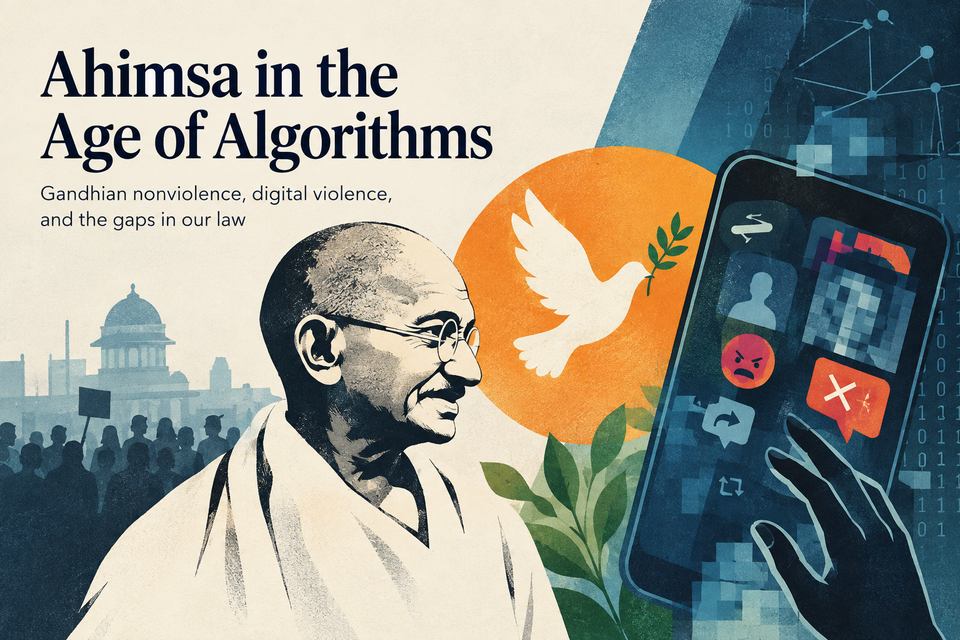
Gandhian nonviolence, digital violence, and the gaps in our law
2 Oct 2026 · Author : @Sanjana Rathi, CEO - The Cyberdiplomat
From the street to the screen
Every 2 October, the world marks the International Day of Non-Violence on Gandhi's birthday. The United Nations chose the date in 2007 to honour a man who showed that injustice could be resisted without a single blow struck in anger.
Nineteen years on, the meaning of violence itself has shifted. It no longer needs a fist, a lathi or a gun. It can be a morphed photograph shared in a WhatsApp group, a coordinated pile-on against a journalist, a deepfake video released the night before polling, or a loan app that phones every contact in a borrower's address book to shame them.
This violence is cheap to commit, anonymous by default, global in reach and amplified by algorithms built to reward outrage. Our laws, written for a world of physical acts and local jurisdictions, have not kept pace. Where law falls short, injustice fills the gap. Gandhi's ideas of Ahimsa and Satyagraha offer a surprisingly practical way to think about closing it.
How violence changed shape
India recorded over 1.01 lakh cybercrime cases in 2024, up 17.9% in a year when overall registered crime fell (NCRB 2024, via Drishti IAS). Only two years earlier the figure was 86,420, and over 4,000 of those cases targeted women and children (BOOM). These are only the cases that reached a police station.
Three features make digital violence different from the physical kind:
- Anonymity. The attacker can hide behind a fake profile, a burner SIM or a VPN. The victim is fully visible; the aggressor is not.
- Global reach. A scam call centre in one country can empty a pensioner's account in Pune. Evidence sits on servers in a third country, governed by a fourth country's law.
- Algorithmic amplification. Platforms reward engagement, and anger engages. A single hateful post can be multiplied into a mob within hours, without any one person deciding to start a riot.
The result is a spectrum of harm that our older vocabulary struggles to name: cyberstalking and trolling, doxxing, non-consensual intimate images, deepfake pornography, "digital arrest" extortion, predatory loan-app harassment, coordinated hate campaigns, and disinformation that spills over into physical lynching. The wound may be invisible, but the fear, shame, financial ruin and, in the worst cases, suicide are not.
Gandhi's principles, translated for the cyber domain
For Gandhi, Ahimsa was never just the absence of a blow. It meant refusing hatred itself, resisting injustice without seeking to harm the opponent, and insisting that ethical ends can only be reached through ethical means. Satyagraha, the "force of truth", turned that ethic into a method of struggle.
Each of these ideas has a direct digital counterpart.
Gandhian principle | Original meaning | What it asks of us online |
|---|---|---|
Ahimsa (nonviolence) | Do no harm in thought, word or deed; refuse hatred | Words, images and data can wound. Trolling, doxxing and deepfakes are violence, not "just speech" |
Satya (truth) | Seek truth relentlessly | Resist disinformation; label synthetic media; do not share what you have not verified |
Satyagraha | Resist injustice openly, without hatred | Counter-speech, fact-checking, public-interest litigation and lawful campaigns, not counter-trolling or vigilante hacking |
Means and ends | A good goal pursued by bad methods is corrupted | Fighting cybercrime must not justify mass surveillance, broken encryption or arbitrary takedowns |
Self-discipline | Master one's own anger and appetites | Digital restraint: pausing before posting, refusing the outrage economy, protecting one's own data hygiene |
Responsibility | Own the consequences of one's acts | Platforms own the harms their algorithms amplify; users own what they forward |
Sarvodaya (welfare of all) | Organise society around the dignity of the last person | Design law and technology for the most vulnerable user: the first-time smartphone owner, the woman, the child, the elderly |
The "means and ends" principle cuts both ways. It condemns the troll who silences a journalist. It equally condemns a state that answers online harm with blanket internet shutdowns or opaque blocking orders. Nonviolence in cyberspace is not only about restraining individuals; it is about restraining power.
Where the law falls short
India's core cyber statute, the Information Technology Act, was written in 2000, before smartphones, social media or generative AI. Its promised replacement, the Digital India Act, was unveiled as a concept in March 2023 but no draft Bill has been published since (Mondaq; Chambers 2026). In the meantime, the country governs a 2026 internet largely through amendments to subordinate rules.
There has been real movement. The IT Amendment Rules, in force since 20 February 2026, define "synthetically generated information" for the first time, require AI-made media to be labelled, and order platforms to remove non-consensual intimate imagery within two hours and other unlawful synthetic content within three (Freshfields; Sansa Legal). On 25 September 2026, India signed the UN Convention against Cybercrime (IAS Point). But large gaps remain.
Harm | What the law does today | The gap |
|---|---|---|
Online harassment and trolling | Scattered provisions on stalking, obscenity, intimidation and defamation; the broad Section 66A was struck down in Shreya Singhal (2015) | No clear, rights-respecting offence for coordinated pile-ons, doxxing or targeted hate campaigns |
Deepfakes | Labelling and 2–3 hour takedowns under the 2026 Rules; AI-generated text excluded | Duties fall on platforms through rules, not statute; little for the victim by way of compensation or a fast court remedy |
Algorithmic amplification | Platforms are liable mainly for content they fail to remove after notice | No duty to assess or reduce the systemic risks their recommender systems create |
Data misuse and leaks | DPDP Rules notified November 2025, but most duties bind companies only from May 2027 (PIB) | Penalties flow to the state; the individual whose data was abused has no direct route to compensation; wide government exemptions |
Cross-border fraud and "digital arrest" scams | Requests for evidence travel through slow mutual legal assistance treaties | UN Convention has 91 signatories and only 3 parties; it is not yet in force, and India has yet to ratify |
Enforcement | Cyber cells, the 1930 helpline and the national reporting portal | Cybercrime conviction rate below 18% (NCRB 2022), owing to weak digital-evidence handling and jurisdictional hurdles |
The law also risks failing in the opposite direction. The Draft IT (Second Amendment) Rules released on 31 March 2026 drew criticism from Human Rights Watch, which argued that they would erode safe-harbour protections and extend obligations to ordinary users (Anantam IAS). Gandhi would recognise the danger: a law that answers violence with overreach replaces one injustice with another.
How the gap becomes injustice
A gap in law is never neutral. Someone always pays for it, and it is rarely the powerful.
- The burden shifts to the victim. A woman whose morphed images circulate must find the uploader, prove the harm, chase the platform and convince a police station that it is a crime at all. The attacker spends seconds; she spends months.
- Harm outpaces remedy. Content goes viral in hours, while an FIR, a blocking order or a court injunction takes days or weeks. By the time justice arrives, the damage is permanent.
- The vulnerable are hit hardest. Elderly citizens fall to "digital arrest" scams, first-time internet users to loan apps, women and minorities to coordinated hate. Those with the least digital literacy have the least access to legal help.
- Impunity breeds repetition. With conviction rates below one in five, offenders learn that the expected cost of cyber violence is close to zero.
- Silence becomes the price of safety. Journalists, activists and ordinary women withdraw from public conversation. That is a quiet but real injury to democracy.
Gandhi described the nonviolent struggle as a refusal to cooperate with injustice. Today, a legal system that cannot see digital harm becomes an unwilling collaborator in it.
A Gandhian agenda for cyber law
Closing the gap needs action from the state, from platforms and from each of us. Gandhi's principles suggest what that action should look like.
For lawmakers (truth and responsibility)
- Bring the Digital India Act to Parliament as a published draft with open public consultation, so that core duties and offences rest in statute, debated by elected representatives, not in executive rules.
- Define a narrow, precise offence of targeted online abuse covering doxxing and coordinated harassment, drafted within Article 19(2) so it cannot become a new Section 66A.
- Give victims a direct right to compensation and a fast-track remedy, through dedicated cyber benches or online dispute resolution, so that justice moves at the speed of harm.
- Ratify the UN Convention against Cybercrime with strong human-rights safeguards, and use it to speed up cross-border evidence sharing.
For platforms (Ahimsa by design)
- Assess and publicly report the systemic risks of recommender systems, as Europe's Digital Services Act already requires.
- Build friction against virality: pause prompts before forwarding, limits on mass forwarding, and default protections for new and young users.
- Publish transparency data on takedowns, appeals and response times, in Indian languages.
For the state (means and ends)
- Invest in police capacity: trained cyber investigators, forensic labs and secure chains of digital evidence in every district.
- Prefer targeted, reviewable orders over blanket internet shutdowns or opaque blocking; protect encryption.
For citizens (self-discipline and Satyagraha)
- Practise digital restraint: verify before sharing, refuse to join pile-ons, and protect your own data.
- Answer hate with counter-speech, not counter-hate. Report abuse, support its targets publicly, and use lawful collective action to demand better laws.
- Teach digital literacy at home and in schools, so the most vulnerable are not left to fend for themselves.
Conclusion: the keyboard as a charkha
Gandhi turned the spinning wheel into a symbol of self-reliance and quiet resistance. Today, the keyboard and the smartphone could play the same role, or they could become weapons. Which they become depends on the choices of lawmakers, engineers and every person who holds a phone.
The lesson of Ahimsa for the digital age is simple. Violence that leaves no bruise is still violence. A law that cannot see it leaves injustice unanswered, and a law that overreaches creates new injustice. Between those two failures lies Gandhi's path: seek the truth, resist harm without hatred, discipline ourselves, take responsibility for what we amplify, and build a digital society around the dignity of the most vulnerable user.
On this International Day of Non-Violence, that is the Satyagraha our times demand.
Sources
- Drishti IAS: Rising digital frauds and the challenge of ensuring cyber justice (NCRB 2024 data)
- BOOM: NCRB data on cyber crimes
- Freshfields: Key changes under MeitY's 2026 amendments to the IT Rules
- Sansa Legal: IT Amendment Rules 2026 takedown regime
- IAS Point: The UN Cybercrime Treaty and India
- UNODC: United Nations Convention against Cybercrime
- PIB: Government notifies DPDP Rules
- Mondaq: Digital India Act
- Chambers: Artificial Intelligence 2026, India
- Anantam IAS: Draft IT (Second Amendment) Rules 2026
Member discussion