
Behind the Loan Recovery Front: Chennai Police Dismantle SIM Box Network Linked to 301 Cyber Fraud Complaints
- Filed
- Desk
- Chennai
- Read
- 3 min read
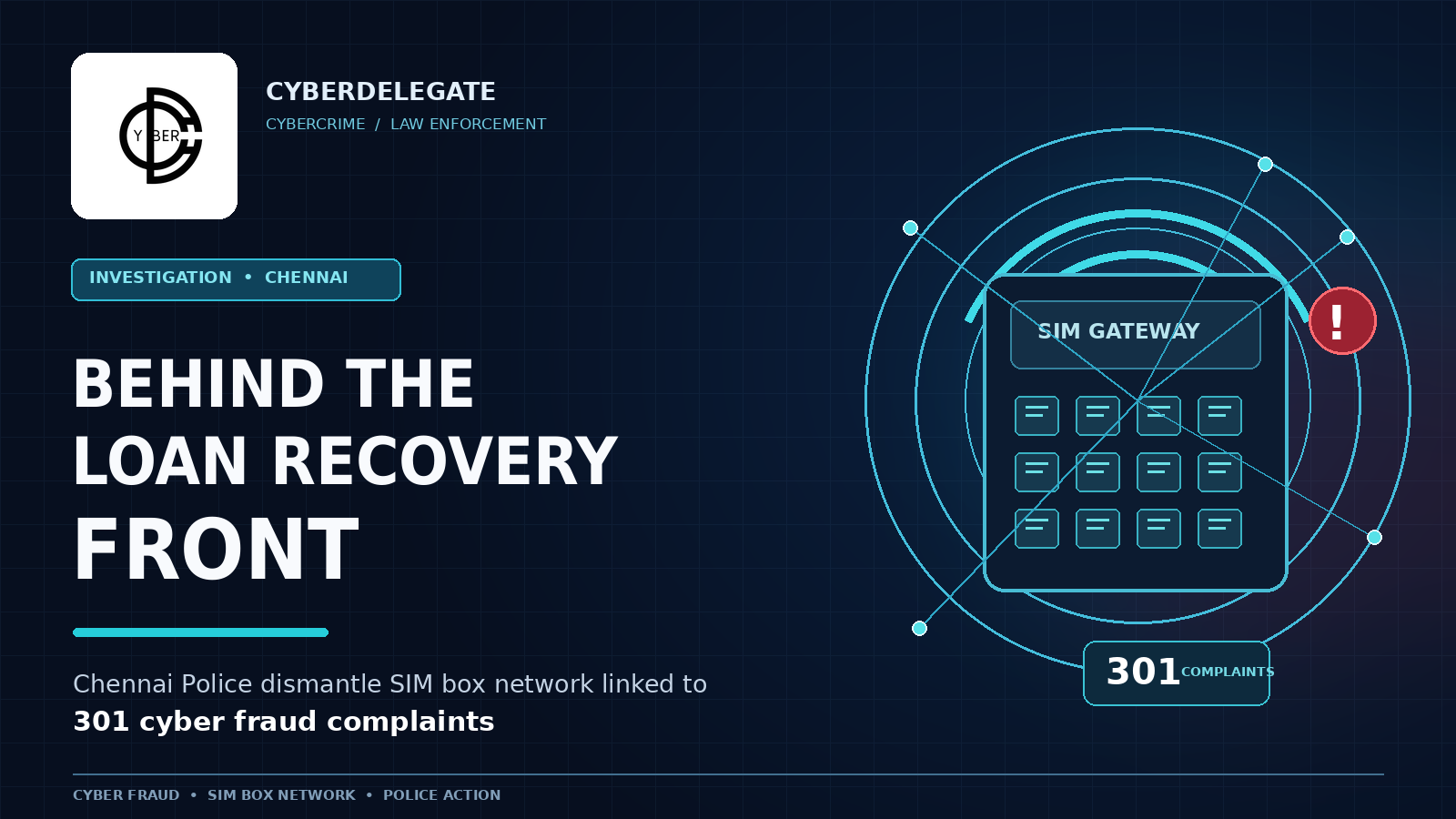
A Saidapet firm posing as a bank and NBFC collection agent was allegedly running illegal telecom gear that disguised scam calls as local Indian numbers.
The Tamil Nadu Cyber Crime Wing has broken up an illegal SIM box operation in Chennai's Saidapet that police say was hiding behind a legitimate-looking loan recovery business. Two employees have been arrested, and the equipment seized has been tied to 301 cybercrime complaints filed across India.
The raid, carried out on joint intelligence from the Indian Cyber Crime Coordination Centre (I4C) and the Department of Telecommunications (DoT), targeted premises linked to Forte Management Services and Polly Towers.
A legal business up front, cybercrime behind it
According to Superintendent of Police (Cyber Crime Wing) S. Selvanagarathinam, Forte Management Services presented itself as a recovery and collection agent for loans issued by banks and NBFCs. That front gave the operation an ordinary commercial cover while, police allege, its back end was being used to carry out a range of cyber crimes.
The choice of cover is telling. A collection agency naturally makes large volumes of outbound calls to borrowers, so heavy telecom traffic from its premises would draw little suspicion.
What police seized
Item | Quantity |
|---|---|
SIM boxes | 11 (three 64-slot, seven 32-slot, one damaged) |
SIM cards | 182 |
Servers | 2 |
CPUs | 2 |
Police arrested the company's manager, Srinivasan, and an IT technician, Sanjay. The owner has not yet been arrested. Officers said questioning of other employees and forensic analysis of the seized equipment are under way.
How SIM box fraud works
A SIM box is a piece of hardware loaded with dozens, sometimes hundreds, of SIM cards. It takes internet-based (VoIP) calls — often originating abroad — and pushes them onto the mobile network through those local SIMs. The effect is to bypass legitimate international telecom gateways and mask where a call actually comes from.
For the person receiving the call, it simply looks like a regular +91 mobile number. That disguise is what makes SIM boxes so valuable to fraud networks: overseas scam centres can reach Indian victims while appearing local, slipping past call-origin checks and making the call harder to trace. The setups also cost the exchequer and telecom operators revenue by evading international call charges.
301 complaints across the country
Investigators have linked the Saidapet setup to 301 complaints on the National Cyber Crime Reporting Portal (NCRP), 52 of them from Tamil Nadu. The national spread of victims underlines how a single unauthorised telecom node can feed fraud far beyond the city where it sits.
Selvanagarathinam stressed that this is not an isolated case. Several SIM box operations have already been uncovered across Tamil Nadu, he said, describing the Saidapet raid as a coordinated effort between DoT, the Cyber Crime Wing and other agencies, and signalling that enforcement will continue.
Why it matters for lenders and fintechs
The case adds a new dimension to the risks facing India's lending ecosystem. Banks and NBFCs routinely outsource collections to third-party agencies, and this bust shows that such a vendor can double as infrastructure for fraud. For financial institutions, it is a reminder that third-party risk management needs to cover not just data handling and conduct, but also what a vendor's telecom and IT setup is actually being used for. Unusual call volumes, large SIM inventories or unexplained server equipment at a collection partner should be red flags.
It also comes as national agencies sharpen their focus on the telecom layer of cyber fraud, with DoT and I4C intelligence-sharing increasingly driving on-the-ground action by state police.
Police advisory for the public
The Cyber Crime Wing urged citizens to practise basic digital hygiene:
- Protect your accounts and devices with two-factor authentication, strong passwords and biometric locks.
- Don't click on unsolicited links or emails.
- Ignore lures — calls pitching cryptocurrency, share-trading or other investment schemes.
- Ignore threats — including so-called "digital arrest" calls and extortion involving non-consensual intimate images.
- Remember: no genuine police or government agency will ever demand money over a phone or video call to settle a case or prevent an arrest.
How to report
Anyone who receives suspicious calls or messages, or falls victim to an online financial scam, should call the national cyber fraud helpline 1930 or file a complaint at cybercrime.gov.in as soon as possible. Quick reporting gives investigators the best chance of tracing the criminals and stopping the money.
Source: Rediff News / PTI report on the Tamil Nadu Cyber Crime Wing's Saidapet operation (provided by user).
Sources
Keep reading
Operation TorNado dismantles global dark‑web drug networks
US DOJ and Europol’s Operation TorNado nets 354 arrests, seizes $234 million and 5.7 tons of drugs across 14 countries.

Machine-Speed Fraud: TGCSB Warns NBFCs and Fintechs of AI-Assisted Attacks on Payment Systems
Telangana's cyber agency says lenders must stop fraud at the source, not just report it after the money is gone

Hackers Use Fake Job Interview to Steal $6.34 Billion from Binance
A fake recruitment scam let state‑backed hackers install malware on a Binance engineer’s Mac, leading to a multi‑billion dollar crypto theft and prompting a massive asset‑freeze effort.