
Between Two Giants: The Maldives, India, and China — A Past, Present, and Future Analysis
Why a Tiny Archipelago Keeps Becoming a Big-Power Story
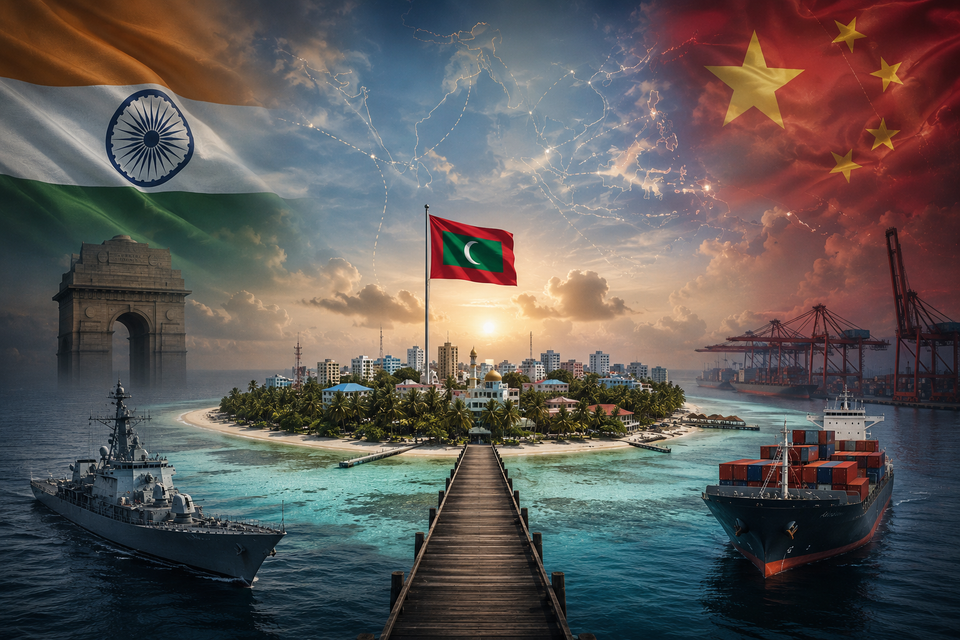
With a population of roughly half a million spread across 1,200 coral islands, the Maldives is, by almost any measure, a small country. Yet it has repeatedly punched far above its demographic weight in South Asian geopolitics, because its geography places it directly astride some of the busiest and most strategically vital shipping lanes in the Indian Ocean — corridors through which a significant share of global trade, and a striking proportion of China's own oil imports from the Persian Gulf, must pass. That single fact of geography is the thread connecting every turn in India-Maldives-China relations over the past two decades, and it is the reason the relationship deserves sustained, clear-eyed attention from policymakers rather than reactive crisis management.
Past: A Relationship Shaped by Pendulum Swings
India has been the Maldives' primary partner since the islands gained independence from the United Kingdom in 1965, built on geographic proximity, cultural ties, and a consistent record of crisis response — India was the first responder during the 2004 tsunami, the 2014 Malé water crisis, and the COVID-19 pandemic. But the relationship has never been static. It has moved through identifiable cycles tied closely to changes in Maldivian domestic politics.
The first major inflection point came under President Abdulla Yameen (2013-2018), who pursued closer ties with Beijing, joined China's Belt and Road Initiative in 2014, and signed Maldives' first bilateral free trade agreement with China in 2017. The Maldives' Chinese-funded debt grew substantially during this period, eventually reaching roughly 20 percent of the country's public debt. The pendulum swung back under President Ibrahim Mohamed Solih (2018-2023), who adopted an explicit "India First" policy, restored closer cooperation with New Delhi, and shelved several Chinese-aligned strategic initiatives.
The second, sharper swing came with the September 2023 election of Mohamed Muizzu, who campaigned on an "India Out" platform tapping into domestic resentment over what he characterized as excessive Indian influence. Muizzu made China the destination of his first state visit as president in January 2024 — breaking a longstanding tradition of newly elected Maldivian leaders visiting India first — and signed roughly twenty new agreements with Beijing covering financial and military assistance, including a defense cooperation pact. This period also saw a significant public flashpoint: derogatory remarks about Indian Prime Minister Narendra Modi by Maldivian officials, following Modi's visit to India's Lakshadweep islands, triggered a sharp social media backlash and a measurable drop in Indian tourist bookings to the Maldives, a serious blow given that tourism represents close to 30 percent of Maldivian GDP and Indian visitors were among the largest single nationality group of tourists.
The key lesson from this history is that Maldivian foreign policy swings have tracked electoral cycles and individual leaders' strategic calculations far more than any deep structural realignment away from India. Each "tilt" toward China has eventually run into the same constraint: China's economic relationship with the Maldives is built primarily around debt-financed infrastructure, while India's is built around budgetary support, healthcare, food security, and crisis response — and when fiscal pressure mounts, it is India's form of assistance that becomes politically indispensable.
Present: A Documented Reset, Built on Economic Necessity
The period since mid-2024 represents a genuine and well-documented course correction, though one driven less by sentiment than by hard fiscal arithmetic. The Maldives' debt position deteriorated sharply during this period: credit rating agencies Moody's and Fitch both downgraded the country, foreign exchange reserves fell to levels covering only a matter of weeks of essential imports, and the World Bank projected the country's annual debt servicing costs would exceed $1 billion by 2026. China, as the largest single bilateral creditor, offered only a modest debt write-off and explicitly resisted broader restructuring, with its ambassador stating restructuring would jeopardize future aid — a signal that Beijing's economic relationship, while substantial, came with limits that India's more flexible support did not.
Faced with this reality, Muizzu's government pursued a documented rapprochement with New Delhi. India completed the withdrawal of its military personnel from the Maldives by May 2024 — resolving the specific flashpoint that had defined the "India Out" campaign — while continuing to provide technical and aviation support through civilian personnel instead. High-level engagement intensified through 2024 and 2025: Muizzu visited India in June 2024 for Modi's inauguration and again in October 2024, when both sides adopted a "Comprehensive Economic and Maritime Security Partnership" vision document. The relationship reached a symbolic high point in July 2025, when Modi made a state visit to the Maldives and was honored as guest of honor at the country's 60th Independence Day celebrations — a dramatic reversal from the diplomatic chill of early 2024. That visit produced defense equipment donations, amended debt repayment terms, a new line of credit, and the launch of free trade agreement negotiations.
Notably, this reset has not come at China's expense in any zero-sum sense. The Maldives has continued pursuing its own free trade agreement with China, set to take effect on a rolling basis, while extending Chinese debt repayment timelines and seeking a Chinese banking presence in the country. The clearest way to characterize the current moment is not "Maldives chooses India over China" but rather "Maldives plays both, while leaning more heavily on whichever partner solves its most urgent problem at a given time" — a hedging strategy consistent with how Muizzu's government has approached foreign policy from the outset, regardless of campaign rhetoric.
Future: Three Plausible Trajectories
Looking ahead, three broad trajectories are plausible, and which one materializes will depend heavily on factors at least partly within India's and China's control, not just Maldivian domestic politics.
The first trajectory is continued pragmatic hedging, the most likely near-term path: the Maldives maintains warm relations with both powers, extracting maximum economic benefit from each while avoiding formal alignment with either, much as it has done through 2025 and into 2026. This outcome is broadly stable but leaves both India and China in a position of having to continuously reinvest in the relationship to prevent the other from gaining ground, since Maldivian alignment under this scenario is transactional rather than durable.
The second trajectory is a debt-driven crisis that forces a more decisive alignment. With debt servicing obligations projected to peak above $1 billion in 2026 against foreign reserves that have at various points covered only weeks of imports, the Maldives remains genuinely vulnerable to a Sri Lanka-style default scenario. If that materializes, whichever power — India, China, or a multilateral lender like the IMF — provides the decisive bailout will likely gain outsized and longer-lasting influence over Maldivian strategic alignment, since debt restructuring negotiations tend to come with durable strings attached.
The third trajectory is renewed domestic political volatility. Maldivian politics has shown a consistent pattern of large swings between pro-India and pro-China administrations roughly every electoral cycle. Given that pattern, there is a meaningful chance the current reset proves temporary rather than structural, particularly if economic conditions don't improve enough to satisfy public expectations, or if a future political figure revives anti-India sentiment as a mobilizing electoral strategy, as Muizzu himself did in 2023.
Turning Points Worth Watching
A small number of concrete developments will likely determine which trajectory unfolds, and are worth monitoring closely rather than treating the current reset as settled. These include: the completion timeline and reception of major India-funded infrastructure projects like the Greater Male Connectivity Project, expected by September 2026, which will serve as a visible, tangible test of whether Indian development assistance translates into durable public goodwill; the Maldives' actual debt servicing performance against the roughly $1 billion in obligations projected for 2026, and whether China, India, or the IMF ends up providing decisive relief; the political durability of Muizzu's pro-reset posture within his own party, given that his predecessor and former mentor Abdulla Yameen has historically represented a harder anti-India faction within the same political movement; and any further incidents involving Chinese military or research vessel activity near Indian strategic assets in the Maldives, which have previously been a significant source of friction even during periods of otherwise warm China-Maldives relations.
Recommendations for Policymakers
For India, the central lesson of the past three years is that crisis-driven, reactive engagement — encouraging tourism boycotts, public spats over social media remarks, or treating every Maldivian outreach to China as an existential strategic loss — has proven both diplomatically costly and ultimately unnecessary, since economic gravity has repeatedly pulled the Maldives back toward New Delhi without such measures. A more durable strategy would prioritize completing high-visibility infrastructure commitments on schedule and on budget, since delivery, not promises, is what has demonstrably shifted Maldivian public sentiment during the post-2024 reset; institutionalizing economic support mechanisms (currency swap lines, treasury bill rollovers, budgetary support) so that future Maldivian governments, regardless of political orientation, retain structural incentives to maintain warm ties with India independent of any single leader's preferences; and avoiding framing the relationship explicitly as a competition with China in public messaging, since Maldivian domestic politics has shown that nationalist backlash against perceived Indian overreach is a more electorally potent force than gratitude for Indian assistance.
For the Maldivian government, the recommendation implicit in its own recent history is to formalize the current pragmatic, multi-aligned posture into durable institutional arrangements — debt management frameworks, defense cooperation agreements, and trade arrangements — that can survive a change in administration, rather than allowing foreign policy to be re-litigated from scratch with each election. The volatility of the past decade has imposed real economic costs (the tourism downturn following the 2024 row being one clear example), and reducing that volatility would serve the country's own interests regardless of which external partner is favored at a given moment.
For China, sustaining influence in the Maldives will likely require demonstrating more flexibility on debt relief than it has shown to date, given that its current posture — resisting broader restructuring even as Maldivian fiscal distress deepens — risks ceding exactly the kind of crisis-driven leverage moment to India or the IMF that could determine the country's longer-term alignment. A more accommodating approach to Maldivian debt distress would likely buy more durable goodwill than continued large-scale new infrastructure lending into an already debt-distressed economy.
The Bottom Line
The Maldives is not a passive territory being fought over by larger powers; it is an active, increasingly sophisticated player using its strategic location as leverage to extract the best terms from both India and China simultaneously. The past three years have demonstrated that this hedging strategy works, at least in the near term, and that crisis-driven swings in Maldivian foreign policy are likely to remain a recurring feature of the relationship rather than an aberration. The countries and policymakers that succeed in this environment will be the ones who build durable, institutionalized partnerships capable of weathering Maldivian electoral cycles, rather than those who treat each swing of the pendulum as a permanent strategic defeat or victory.
Member discussion