
Beyond the Warship: Why the Türkiye-Romania Tech Axis Could Define Black Sea Security
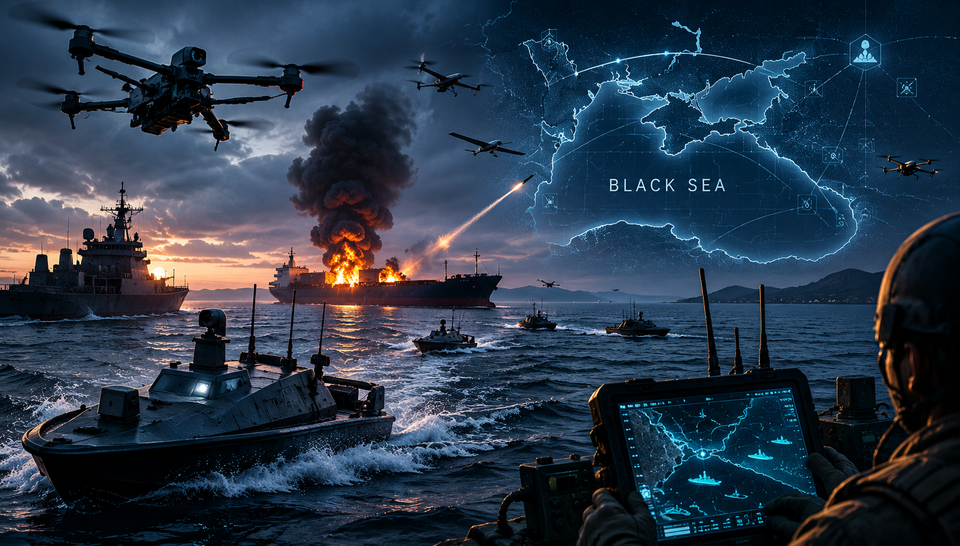
An Analysis of the Case for a Multi-Domain Alliance at the NATO Ankara Summit
June 11, 2026
Introduction: A Sea in the Crosshairs
The Black Sea is not a peripheral theatre. It is the geographic confluence of the war in Ukraine, Russia's militarised Crimean posture, Europe's energy dependency, NATO's eastern flank, and one of the world's most contested corridors for undersea infrastructure. In 2026, it is also an arena being watched by every major power that understands that whoever shapes the security architecture of the Black Sea shapes the security architecture of Europe.
Against this backdrop, a bilateral relationship is quietly becoming one of the region's most strategically significant: Türkiye and Romania. What began as a modest strategic partnership in 2011 has accelerated dramatically since Russia's full-scale invasion of Ukraine in February 2022, producing concrete defence cooperation, a landmark naval acquisition, and growing economic integration. But as analysts Antonia-Laura Pup and Zeynep Özharat argued in a recent op-ed, the partnership still has a critical blind spot — technology. And with the NATO Summit convening in Ankara on July 7–8, 2026, the window to close that gap is open.
This article examines why the technological dimension of the Türkiye-Romania partnership matters, what closing the gap would require, and what is actually at stake for Black Sea security if it is left underdeveloped.
The Relationship So Far: Strong Foundations, Incomplete Architecture
What Has Been Built
The pace of Türkiye-Romania cooperation since 2022 has been notable. The two countries have conducted joint naval demining operations in the Black Sea alongside Bulgaria — a direct response to Russian mine deployments that have disrupted shipping lanes for grain, oil, and energy. Trade has deepened enough that Türkiye now ranks among Romania's top commercial partners. Visa-free ID card travel for Romanian citizens, introduced in June 2024, has created a people-to-people infrastructure that complements the strategic relationship.
The most striking signal of the relationship's trajectory was Romania's December 2025 acquisition of the Hisar-class light corvette TCG Akhisar from Türkiye for €223 million — the first Turkish-built warship ever exported to a NATO and EU member state. That transaction is more than a procurement deal. It is a statement of strategic trust: Romania is not merely purchasing Turkish hardware, it is integrating into a Turkish-led defence industrial ecosystem. The acquisition also reflects Romania's 2025–2030 National Defence Strategy, which explicitly calls for intensified cooperation with Turkey and Bulgaria to protect critical energy and telecommunications infrastructure.
The Gap That Remains
Yet for all this momentum, the partnership has not extended meaningfully into the domains that will determine 21st-century security outcomes. Cooperation in artificial intelligence, cybersecurity, drone technology, space capabilities, and dual-use innovation remains — as the authors put it — "strikingly underdeveloped." This is an asymmetry that becomes harder to justify with each passing month, for a simple reason: in modern conflict, these are not supplementary capabilities. They are the capabilities that determine whether physical assets — warships, undersea cables, gas platforms, airbases — can be protected at all.
Why Technology Is No Longer Optional
The Hybrid War Lesson
Russia's conduct in the Black Sea region since 2022 has been a masterclass in hybrid operations. Russian drones have repeatedly violated Romanian airspace. Floating mines have disrupted vital trade routes. NATO officials have publicly warned that Russia has mapped critical undersea infrastructure in the Black Sea — the cables and pipelines that carry data and energy across the region.
The lesson of the Baltic Sea incidents — from the Nord Stream pipeline explosions to the severing of the Estlink-2 power cable by the Russia-linked tanker Eagle S in December 2024 — is that physical infrastructure is now a primary target of below-threshold aggression. Those risks are migrating south. The planned 1,100-kilometre Romania-Georgia submarine power and data cable, a cornerstone of the EU's Global Gateway strategy, will run within striking distance of Russian naval assets once operational. Protecting it requires not just warships, but surveillance satellites, AI-powered anomaly detection, and cyber defences capable of identifying and responding to threats at machine speed.
The US Drawdown Problem
The withdrawal of American troops from the Mihail Kogalniceanu air base in Constanta removes a critical deterrent layer from Romania's Black Sea flank precisely as threats are intensifying. The broader uncertainty about the long-term scale of US military presence in Europe — flagged at every recent NATO forum — forces European allies to think seriously about what they can provide for themselves.
This dynamic amplifies the case for the Türkiye-Romania technological axis. Türkiye fields NATO's second-largest army, a defence industrial base producing $10 billion in exports annually to allied states, and extensive cyber and drone capabilities developed through years of operating in contested digital and physical environments across Syria, the South Caucasus, and Libya. Romania brings the EU's Cybersecurity Competence Centre, hosted in Bucharest, alongside a growing ecosystem of cyber talent and firms. Neither country can fully substitute for the United States. But together, they can construct a layered regional capability that makes the Black Sea considerably harder to threaten than it would be if each operated in isolation.
The Four Pillars of a Technology Partnership
1. Cybersecurity: From Declaration to Operation
Romania's ambition to become a regional cyber hub is real but insufficiently operationalised in the bilateral context. The EU's Cybersecurity Competence Centre in Bucharest is an institutional asset with significant convening power. Türkiye's offensive and defensive cyber capabilities, developed in one of the world's most persistently contested digital environments, represent operational depth that Romania's institutions could meaningfully complement.
At the 2026 Black Sea and Balkans Security Forum, participants explicitly called for building a resilient technology and security ecosystem in the Black Sea region, with AI and cyber capabilities identified as priority areas. What is needed is movement from workshops to operational reality: systematic sharing of threat intelligence on state and non-state actors targeting Black Sea infrastructure; joint cyber exercises that stress-test critical systems under realistic attack conditions; and coordinated AI-assisted vulnerability management — harnessing machine-speed detection and patching to keep pace with adversaries who are already using AI offensively.
The cybersecurity domain is also where the EU-non-EU asymmetry in the partnership matters most. Romania, as an EU member and host of the Competence Centre, can serve as the bridge that connects Turkish cyber capabilities to broader EU frameworks — a role that benefits both countries and provides Türkiye with meaningful integration into European security architecture without requiring EU membership.
2. Drones: Where the Battlefield Already Is
Turkish drone technology — the Bayraktar TB2, Akıncı, and successors — has reshaped modern warfare's calculus from Azerbaijan to Ukraine to Libya. Romania's defence strategy explicitly identifies anti-drone technologies and deep-strike capabilities as priority investments. The two needs are complementary: Turkey's expertise in drone development and deployment doctrine can accelerate Romania's own unmanned systems capabilities, while joint exercises in the Black Sea environment would yield operational learning that benefits both navies.
Beyond offensive capabilities, maritime drone surveillance is one of the most pressing requirements for Black Sea infrastructure protection. Persistent, low-cost unmanned monitoring of the undersea cable route between Romania and Georgia could provide early warning of interference that no other system can deliver at scale. Joint Turkish-Romanian development of this capability — potentially under a bilateral working group with NATO endorsement — would produce a regionally relevant asset that neither country would need to develop alone.
3. Space: A New Bilateral Frontier
Romania's launch of the EMISAR satellite in March 2026 marked the country's emergence as an independent space operator. Türkiye has been building space capacity for a decade — from the Turkish Space Agency established in 2018 to the IMECE Earth observation satellite launched in 2023 with indigenously produced sub-metre resolution imagery. Turkey's hosting of the 77th International Astronautical Congress in October 2026 signals the ambition to be a shaping actor, not merely a consumer, in the global space order.
The most immediate bilateral application is maritime domain awareness. A bilateral working group on satellite-based intelligence, surveillance, and reconnaissance for the Black Sea could link both countries' space agencies, creating a shared picture of surface and sub-surface activity that would significantly enhance the security of undersea infrastructure. This is politically achievable — both countries are already cooperating under NATO's existing space infrastructure — and militarily valuable in ways that justify the institutional investment.
As Romania reassesses its commitments to certain European Space Agency programmes and looks to refocus its space investments on regionally relevant capabilities, a bilateral partnership with Türkiye offers a complementary pathway that does not require choosing between European and bilateral frameworks.
4. AI and Dual-Use Innovation: Shaping Standards Together
Perhaps the most forward-looking argument in the Türkiye-Romania technology partnership case is the opportunity to be standards-setters rather than standards-consumers. The global competition to define how AI is used in dual-use and defence applications is intensifying. The EU AI Act creates a regulatory framework that shapes member state practices; NATO is developing its own AI principles and implementation guidance; and individual nations are racing to deploy AI in ways that will create precedents others follow.
Romania and Türkiye sit at a unique intersection: one is an EU member at the frontier of European digital policy, the other is a NATO power with extensive operational experience in AI-augmented systems. A joint initiative to develop shared standards for AI use in Black Sea security — covering drone autonomy, cyber defence, intelligence fusion, and maritime surveillance — would position both countries as architects of regional norms rather than rule-takers. This is the kind of initiative that the Ankara Summit could formally launch and that could define the partnership's technological character for the decade ahead.
The Ankara Summit: A Narrow but Real Window
The NATO Summit on July 7–8, 2026 is an unusually loaded event. It comes during the fifth year of Russia's invasion of Ukraine, amid serious uncertainty about the scale of the US commitment to European security, with defence spending debates at a critical juncture and with Türkiye hosting for the first time since 2004. For Türkiye, the summit is simultaneously a showcase of strategic centrality and an opportunity to reshape how NATO's southern and eastern flanks are understood.
Within this broader agenda, a bilateral meeting between Presidents Erdoğan and Dan — specifically to launch a Multi-Domain Security Alliance with a dedicated technology pillar — would be proportionate to the moment. It would not require a new treaty. It would require:
- A formal bilateral working group on cybersecurity intelligence-sharing and joint exercises
- A joint statement of intent on satellite ISR cooperation for Black Sea maritime domain awareness
- A tasked study on joint AI standards for dual-use defence applications
- A roadmap for drone technology exchange within existing NATO export frameworks
None of these steps is beyond current political will. Romania's 2025–2030 defence strategy already names Türkiye as a priority partner for infrastructure protection. Türkiye's defence industry is actively seeking to deepen relationships with NATO allies who share operational environments. The institutional infrastructure — NATO, the EU Cybersecurity Competence Centre, the Turkish Space Agency, TUBITAK — exists. What is missing is the political decision to connect it.
The Broader Stakes
The argument for the Türkiye-Romania technology partnership is ultimately an argument about what kind of security actor the Black Sea region will have in the decade ahead.
Russia's strategy depends, in part, on the inability of NATO's littoral states to mount a coherent, multi-domain response to hybrid aggression below the threshold of Article 5 invocation. Undersea cable interference, drone incursions, cyber attacks on port infrastructure, and space-based surveillance disruption are all designed to operate in the grey zone where collective defence obligations are uncertain. The answer to grey-zone aggression is not only more frigates — it is persistent, multi-domain situational awareness, cyber resilience, and the capacity to detect and attribute hostile action quickly enough to deter it.
Türkiye and Romania are the Black Sea's two largest NATO coastal states. They have demonstrated, through the corvette acquisition, the demining cooperation, and the bilateral trade relationship, that they can move from aspiration to action. The technology dimension of their partnership is the next necessary step — and the Ankara Summit is the right moment to take it.
The window is open. The question is whether both capitals have the strategic foresight to walk through it.
Sources: Antonia-Laura Pup & Zeynep Özharat, "Black Sea security hinges on Türkiye-Romania tech partnership," Daily Sabah (June 10, 2026); NATO 77th Summit — Ankara (July 7–8, 2026); Army Recognition — Romania-Türkiye Akhisar Corvette (December 2025); Romania 2025–2030 National Defence Strategy; Atlas Institute — "The Black Sea in 2026" (April 2026); Modern War Institute — "NATO's Turkey Paradox" (June 2026); Daily Sabah — "NATO's Ankara Summit: Reckoning for the Alliance" (June 2026); Black Sea & Balkans Security Forum 2026 — New Strategy Center; EPC — "Countdown to the NATO Summit in Ankara."
Member discussion