
Bitchat: The Bluetooth App That's Becoming a Lifeline for Digital Resistance
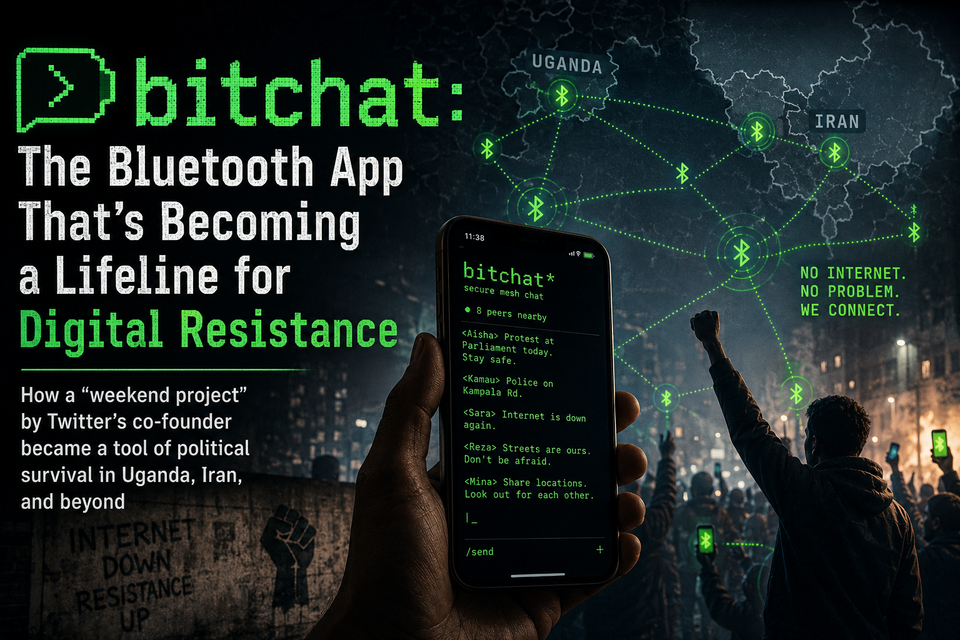
How a "weekend project" by Twitter's co-founder became a tool of political survival in Uganda, Iran, and beyond
When Uganda's government switched off the internet on January 13, 2026 — just two days before a contentious presidential election — millions of citizens found themselves cut off from the world. It was the third consecutive election in which the country's leadership had imposed a digital blackout. But this time, people were ready. Downloads of a little-known Bluetooth messaging app called Bitchat surged to over 400,000, catapulting it to the top of Uganda's App Store and Google Play charts virtually overnight.
The story of Bitchat is one of technology meeting political necessity — a tool built for curiosity that has become a symbol of digital resistance.
What Is Bitchat?
Bitchat is a peer-to-peer encrypted messaging application created by Jack Dorsey, co-founder of Twitter (now X) and founder of Block, Inc. Announced in July 2025, it was originally described by Dorsey as a "weekend project" to explore Bluetooth mesh networks, cryptography, and store-and-forward messaging.
What sets it apart from conventional messaging apps is simple but radical: it requires no internet connection, no cellular data, no user accounts, and no central servers. Instead, it operates over Bluetooth Low Energy (BLE) mesh networks, where each device acts as both a sender and a relay. Messages "hop" from phone to phone until they reach their destination — effectively creating a self-organising communication web among people in physical proximity.
Dorsey claims the app is functional up to 300 metres — significantly beyond the roughly 100 metres typical of Bluetooth devices. When internet connectivity is available, it also uses Nostr, a decentralised protocol, as a fallback for broader reach.
The app is free, open-source, and available on both Android and iOS.
A Tool Born for Crisis
While Bitchat's origins were experimental, its real-world application has been anything but. It quickly found a purpose in places where governments use internet shutdowns as instruments of political control.
In Uganda, the app surged as citizens braced for President Yoweri Museveni's bid for a seventh consecutive term. Uganda has a well-documented history of throttling or completely severing internet access during elections. When the blackout came, Bitchat gave journalists, civil society groups, and ordinary citizens a means of local communication that the state could not easily sever.
In Iran, the app gained traction as anti-government protests swept the country in early 2026. Amid state-imposed internet lockdowns, usage reportedly more than tripled in a matter of days. Iranian developers even created a locally adapted fork called Noghteha (meaning "points" in Farsi), tailored to the needs of users on the ground.
Beyond these two countries, Bitchat has also seen spikes in Nepal, Madagascar, and Indonesia during periods of social unrest and government-imposed communication restrictions.
The scale of the problem it addresses is staggering. According to Access Now's 2024 #KeepItOn report, 296 internet shutdowns were recorded across 54 countries — a dramatic rise from just 78 in 2016.
How It Keeps Users Safe
In high-risk environments, privacy is not a luxury — it's a matter of survival. Bitchat includes several features designed with this in mind:
- End-to-end encryption for direct messages, based on the Noise Protocol Framework.
- No accounts or identifiers required, reducing the risk of identity exposure.
- Panic mode: pressing the app's logo three times instantly erases all stored conversations, leaving no trace — a crucial feature in the event of a police check.
- Geohash-based location channels via Nostr allow users to communicate with others in the same geographic area when online.
Because Nostr is a decentralised protocol with thousands of relays worldwide, it is practically impossible for any government to shut it down entirely.
The Limits of a Digital Lifeline
Despite its promise, experts urge caution about treating Bitchat as a silver bullet.
Security researchers have identified significant vulnerabilities. Alex Radocea, a security researcher, found the potential for man-in-the-middle attacks stemming from weak identity authentication — meaning attackers could impersonate trusted contacts. The app also lacks robust forward secrecy: encryption keys remain static for entire sessions rather than being refreshed per message, as in more mature secure messengers like Signal.
In Iran, former political prisoner Ziya Sadr has warned of active countermeasures including phishing campaigns, fake download links, and paid influencers promoting compromised versions of protest apps. During internet blackouts, when users are forced to download apps through unofficial channels, verifying the integrity of what they install becomes nearly impossible.
Furthermore, Bluetooth signals are still a physical trace. While message content may be encrypted, the act of emitting a Bluetooth signal can still be detected — a fact that security-conscious users must not ignore.
Bitchat itself acknowledges it is a work-in-progress and has not yet undergone a full independent security audit.
A Precedent and a Pattern
Bitchat is not the first app of its kind. During Hong Kong's 2020 pro-democracy demonstrations, a similar Bluetooth mesh app called Bridgefy was widely used. However, subsequent research by Royal Holloway, University of London revealed serious flaws — including the ability for adversaries to track users, read messages, and impersonate contacts. The lesson was stark: ideological promise does not replace technical reliability.
Bitchat's developers and the broader security community are aware of this precedent. The open-source nature of the app allows independent developers to audit, improve, and adapt it — which is both its greatest strength and, in the wrong hands, a potential vulnerability.
What It Signals for the Future
The rise of Bitchat reflects a broader and deeply significant shift: citizens are finding ways to adapt faster than governments can restrict them. As one protest sign in Iran read: "They cut the net to cut lives." Tools like Bitchat challenge that logic by removing the dependence on centralised infrastructure that governments can switch off.
At the same time, states are not standing still. Analysts expect governments to increasingly experiment with Bluetooth detection, legal deterrence, and state-sponsored disinformation about the app's security. The cat-and-mouse game between digital repression and digital resistance is entering a new phase.
For now, in Kampala and Tehran and Kathmandu, Bitchat represents something simple but profound: the refusal to be silenced.
Sources: BBC News Africa, Reuters, Wikipedia, BISI (Bloomsbury Intelligence and Security Institute), InCyber News, Access Now.
Member discussion