
Brazil Goes to the Polls in October — and the Real Battle Has Already Begun Online
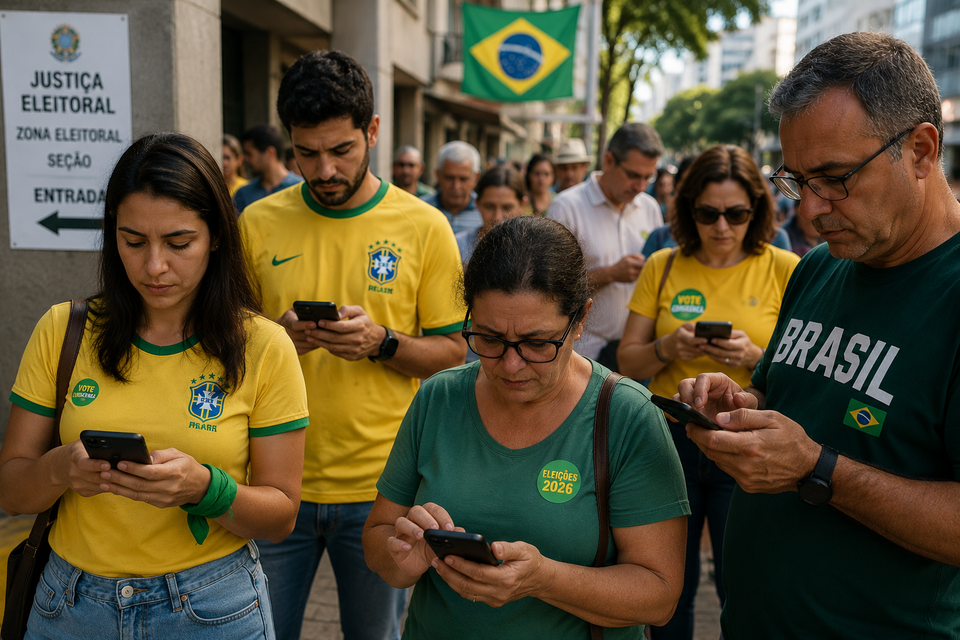
Deepfakes. AI-generated political characters. Ransomware gangs targeting government systems. State-sponsored hackers. A social media regulatory landscape still under construction. Brazil's October 2026 election will be the most digitally contested in the country's history — and the question is whether its institutions can keep pace.
On October 4, 2026, more than 155 million Brazilians will go to the polls to elect a president, state governors, senators, and federal deputies. The logistics of running the largest democracy in the Southern Hemisphere are formidable on their own. But in 2026, the organisational challenge is almost secondary to the information one. What voters see, read, and believe before they vote — on WhatsApp, on TikTok, on X, in AI-generated videos circulated in group chats — is increasingly the decisive terrain.
Brazil has been here before. The 2018 election was shaped by a coordinated WhatsApp disinformation campaign so large that researchers described it as an industrial operation. The 2022 election concluded with a democratic crisis: after Lula defeated Bolsonaro, thousands of the former president's supporters stormed the National Congress, the Supreme Court, and the presidential palace on January 8, 2023 — an event that Brazilian analysts now routinely describe alongside January 6, 2021 in the United States as a reference point for what organised online disinformation can produce in the physical world.
The question for 2026 is whether Brazil's institutions, regulations, and civil society have adapted fast enough to face a threat that has itself adapted dramatically — absorbing artificial intelligence, state-level hacking operations, and a platform environment in which the rules of content governance are being rewritten in real time.
The Threat Landscape: From Ransomware to State Espionage
Brazil is, by volume, Latin America's largest cybercrime target. Entering the second half of 2026 with a general election approaching, the country presents a target surface that security analysts describe as both broad and structurally under-defended.
Brazil's intelligence agency ABIN, in its annual "Intelligence Challenges for 2026" report published in December 2025, was explicit about the electoral threat: it warned of "malicious actions to delegitimise the electoral model, including cyber attacks, disinformation, external interference and attempts to deepen social polarisation." This is not a generic warning. It reflects a documented pattern of threat activity already underway.
The Superior Electoral Court — the TSE, which administers Brazil's elections — reinforced its security protocols and invested in transparent public communication following attacks on its systems in 2020. The Federal Justice network has invested in Security Operations Centres and incident response simulations. But the threat actors targeting Brazil's election infrastructure in 2026 are considerably more sophisticated than those the TSE faced six years ago.
Salt Typhoon, the Chinese state-sponsored group that has compromised telecommunications infrastructure across more than 200 organisations in 80 countries, has Brazil explicitly among its confirmed targets, spanning telecoms and government entities. The group specialises in long-duration, low-visibility intrusions using custom backdoors designed for persistent intelligence collection — not rapid disruption. The concern is not that Salt Typhoon would shut down Brazil's voting systems, but that it would quietly harvest communications from politicians, party officials, and advisers, producing intelligence that could be weaponised selectively at key moments in the campaign.
Meanwhile, financially-motivated ransomware operations continue to escalate. DragonForce, a ransomware-as-a-service group that absorbed displaced affiliates from the dismantled RansomHub operation, posted 101 victims in the first quarter of 2026 alone, with Brazilian government agencies and financial institutions among its known targets. The broader pattern, as assessed by Brazilian cybersecurity firm ViperX, is of a country that "has evolved technically, but is still reactive and dependent on poorly protected suppliers, which are now the main gateway for attacks." Supply chain vulnerabilities — compromised vendors with lower security maturity than the institutions they serve — are the primary entry point.
The ransomware risk carries a specific electoral dimension: in a polarised political environment, even a temporary disruption of government digital services in the weeks before an election can be weaponised as "evidence" of institutional incompetence or deliberate interference, regardless of the actual source.
The AI Disinformation Problem: Meet "Dona Maria"
Of all the threats Brazil faces ahead of October, the one analysts regard as most immediately dangerous — and most difficult to counter — is artificial intelligence-enabled disinformation.
Fifty-four percent of Brazilians used generative AI tools in 2024, according to an Ipsos and Google survey — higher than the global average of 48 percent. Among workers, Brazil's AI adoption rate is almost twice the global benchmark. The technology is already embedded in the communications habits of the electorate. That cuts both ways: it means AI-generated content circulates naturally and is treated as routine, and it means that AI-generated disinformation is correspondingly harder to identify and challenge.
The challenge was crystallised in a case that has become emblematic of what Brazil is up against. "Dona Maria" is an AI-generated character — a warm, grandmotherly Brazilian woman who shares political commentary on social media. Outlets linked to the Brazilian far right promoted her as a "persecuted" figure when a legal case was brought before the TSE. The court's Justice Estela Aranha, a digital law specialist who served on the UN's High-Level Advisory Body on Artificial Intelligence, faces a genuine dilemma: the existing definition of a "deepfake" — whether it covers any realistic AI-generated character, or only manipulations of real people's likenesses — is not clear enough under current law to make the determination straightforward. Banning Dona Maria raises freedom of expression concerns. Permitting her normalises a model of mass synthetic content production with no accountability.
As political scientist Gabriel Amaral has warned: "When everything can be fabricated to look like the truth, the voter stops asking 'is this real?' and starts questioning only whether it confirms what they already believe." At that point, the debate ceases to be about verification. It becomes about symbolic adhesion — and disinformation becomes structurally unchallengeable.
What the TSE Has Done — and What It Has Not
Brazil's Superior Electoral Court has moved more decisively than almost any equivalent institution in the world to regulate AI in electoral campaigns. The TSE's rules, finalised unanimously in early March 2026, represent what legal scholars have called one of the world's most detailed regulatory frameworks for artificial intelligence in elections.
The rules ban deepfakes outright. All AI-generated campaign material must carry mandatory labelling. AI tools are prohibited from recommending candidates to voters. A complete blackout on synthetic content is imposed near election day. The TSE has partnered with social media platforms to accelerate takedowns of misleading content and expanded citizen reporting mechanisms through its Electoral Disinformation Alert System.
The framework builds on Resolution 23.732/2024, which the TSE issued ahead of the 2024 municipal elections — making those polls the first in Brazilian history to be governed by explicit deepfake prohibitions. Penalties include fines, content removal, licence revocation, and in serious cases, ineligibility.
But the same experts who praise the ambition of this framework are candid about its limits. Detecting manipulated AI content is not always technically feasible within the timeframes that electoral campaigns demand. In many cases, judicial decisions are issued only after the content has already reached a wide audience. Private messaging platforms — particularly WhatsApp, which remains the primary channel through which disinformation spreads at scale in Brazil — sit in a grey zone: the TSE's rules create "the impression that these environments are also immune to electoral rules," as researcher Erick Beyruth of PUC São Paulo has noted.
Privately, TSE justices have acknowledged that the current rules are insufficient for 2026. The ease with which synthetic characters like Dona Maria can be produced and distributed by ordinary users — not just sophisticated operators — means that the volume of AI-generated content in this election cycle will exceed any monitoring authority's capacity to track and remove it consistently. Brazil's political polarisation and deep institutional distrust only compound this: in an environment where large segments of the electorate already doubt the legitimacy of the courts and the electoral system itself, contested content decisions by the TSE will inevitably be reframed as political censorship.
Brazil's Senate approved an AI regulatory framework in late 2024, modelled on the EU's AI Act. The bill is still pending before the Chamber of Deputies. It will not be law before October 4.
The Social Media Governance Gap
The regulatory framework directly relevant to social media platforms — distinct from the TSE's campaign-specific rules — is in an even more unsettled state.
Brazil's foundational internet law, the Marco Civil da Internet of 2014, established a liability regime for platforms under which they could not be held responsible for third-party content without a prior court order requiring removal. This standard — designed to protect a still-developing digital ecosystem — has proved increasingly inadequate as coordinated disinformation operations have matured.
Draft Bill 2.630, first introduced in 2020 and known as the "Fake News Bill," was the country's most ambitious attempt to modernise platform liability and impose transparency obligations on social media companies operating in Brazil. It passed the Senate but has faced sustained resistance in the Chamber of Deputies, fuelled in part by platform lobbying and right-wing opposition that has characterised it as a censorship instrument. It remains stalled.
The Federal Supreme Court has separately taken up questions about platform liability — specifically whether companies can be fined for illegal user content and whether they should be required to monitor and remove content without a prior court order. Its rulings, still pending, will constitute binding precedent for all social media platforms operating in Brazil. The outcome is expected at some point before the October election, but may arrive too late to affect the campaign.
Meanwhile, the global platform landscape has itself shifted in ways that are directly relevant to Brazil's situation. Meta, which owns Facebook and WhatsApp, announced at the start of 2025 that it would scale back third-party fact-checking, loosen automated content filters, and relax hate speech policies in a stated return to "free expression." For Brazil, where WhatsApp is the primary instrument of political communication and where a coordinated disinformation operation in 2018 helped elect one president and where the aftermath of 2022 led to an attempted coup, these changes carry specific and documented risks. President Lula has said a social media regulation proposal is ready for Congress — but getting it passed in an election year, against platform opposition and with a politically divided legislature, is another matter.
The Favelas Problem: Misinformation Where It Matters Most
Any analysis of Brazil's information environment that stops at the regulatory and institutional level misses the dimension where the impact is most acute and hardest to reach.
Research by Data Favela, published in 2024, found that 89 percent of Brazil's favela residents — approximately 94 million people — had been victims of fake news. The categories of misinformation most prevalent in these communities include false claims about public policy, health and vaccination, economic information, and public safety. During the Covid pandemic, disinformation about vaccines in favelas contributed directly to lower vaccination rates in communities already facing elevated health risk. During elections, false claims about candidates, voting procedures, and electoral integrity reach populations that disproportionately lack access to official information channels or the media literacy tools needed to evaluate what they receive.
These communities are not passive victims. Favela communicators, community media networks, and local health information organisations have developed grassroots fact-checking and media literacy programmes as direct responses to the 2022 experience. But their reach is structurally limited compared to the reach of coordinated disinformation campaigns operating through the same WhatsApp groups and social platforms.
Deep nude imagery targeting women candidates — a problem identified explicitly by digital rights organisations following the 2024 municipal elections — is a further dimension: AI-generated non-consensual intimate imagery has been deployed as a tool of political intimidation against women politicians, particularly those from marginalised communities. The TSE's framework does not yet specifically address this tactic.
Foreign Interference: A Documented Risk
ABIN and Control Risks assessments both flag foreign interference as a high-probability risk for the October 2026 election. "Potential foreign influence in the upcoming October 2026 election in Brazil — whether conducted by sophisticated nation-state actors or financially-motivated private entities — is highly likely to occur," Control Risks stated in April. "Previous efforts to tip the scales for one side or the other have been well-documented."
The geopolitical context adds texture. The 2026 election takes place against a backdrop of significant U.S.-Brazil tension: the Trump administration imposed 50 percent tariffs on Brazilian imports, linking the move explicitly to what it characterised as a "witch hunt" against Bolsonaro and unfair digital trade practices by Brazil targeting U.S. technology companies. This creates a charged environment in which platform content moderation decisions, regulatory enforcement, and campaign incidents can quickly acquire geopolitical dimensions that complicate attribution and response.
Russia's established toolkit of disinformation operations, tested against European elections, is available for deployment at relatively low marginal cost in new theatres. Brazil's deep political polarisation — between Lula's governing coalition and a Bolsonaro movement whose former leader faces ongoing legal proceedings and whose electoral eligibility until 2030 remains a charged political issue — provides pre-existing fault lines that external actors can exploit without needing to manufacture them.
What the Next Four Months Require
Brazil is not unprepared. The TSE's AI rules are among the most specific in the world. ABIN is engaged. The Federal Police is involved in enforcement. Civil society organisations, favela communicators, and fact-checking networks are active. The electronic voting system — which Bolsonaro spent years attacking without evidence — is technically robust and has been independently audited.
But the gap between what is legally mandated and what is operationally enforceable in real time remains wide. AI-generated content at scale will outpace any removal mechanism. WhatsApp's encrypted group architecture remains substantially opaque to regulatory intervention. Platform policy changes driven by global political dynamics may reduce the cooperation the TSE secured with social media companies for the 2024 municipal elections.
The political scientist's warning bears repeating: when everything can be fabricated to look like the truth, the question shifts from verification to belonging. Disinformation in that environment is not primarily an information problem. It is a social cohesion problem. And no court order removes it.
October 4 is 118 days away.
Sources: Control Risks, "Electoral Protection in Brazil" briefings (January–April 2026); ABIN, "Intelligence Challenges for 2026" (December 2025); TechPolicy.Press, "Brazil's 2026 Elections Are Its First Real Stress Test for AI Regulation" (May 2026); Rio Times, "Brazil Election AI Rules Ban Deepfakes" (March 2026); SOCRadar, "Top 10 Cyber Threat Actors Targeting Brazil" (June 2026); Frontiers in Computer Science, "Cybersecurity Threats in Brazil's Government Digital Transformation" (March 2026); RioOnWatch, "Favela Communicators Fight Misinformation" (February 2026); Poynter / GlobalFact 12 reporting (June 2025); Digital Action, "Post Elections Briefing: Brazil" (March 2025); ViperX/ViperX COO, Brazil cybersecurity projections (December 2025).
Member discussion