
China Has "No Cybercrime" — But 600 Million Cameras, $1.79 Trillion in Cyber Losses, and a Generation Being Hunted Online
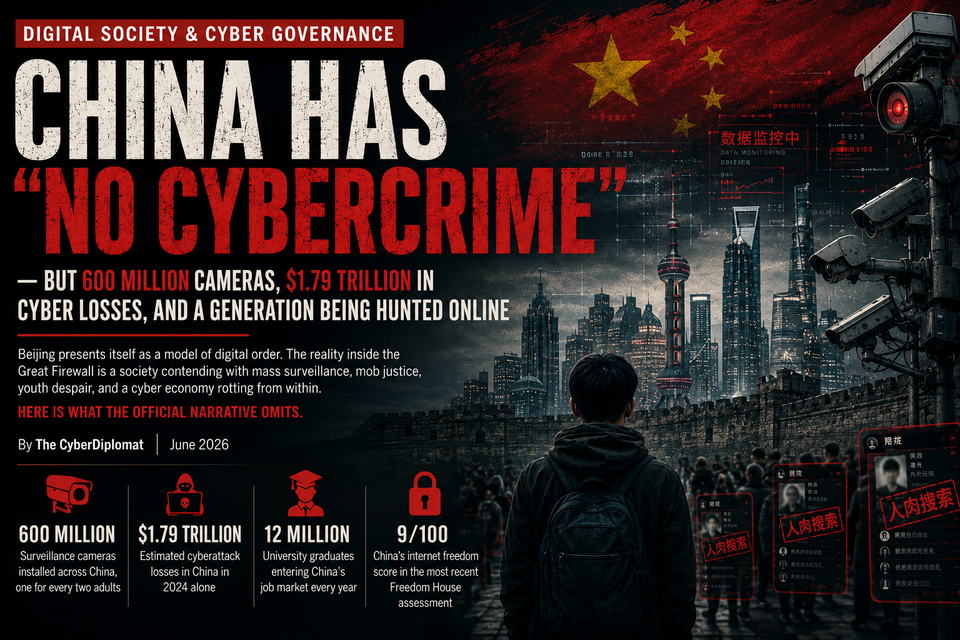
DIGITAL SOCIETY & CYBER GOVERNANCE
Beijing presents itself as a model of digital order. The reality inside the Great Firewall is a society contending with mass surveillance, mob justice, youth despair, and a cyber economy rotting from within. Here is what the official narrative omits.
By The CyberDiplomat | June 2026
600 million — Surveillance cameras installed across China, one for every two adults $1.79 trillion — Estimated cyberattack losses in China in 2024 alone 12 million — University graduates entering China's job market every year9/100 — China's internet freedom score in the most recent Freedom House assessment
The Narrative and What It Hides
China's government presents its digital environment to the world in a particular way: a tightly governed, orderly internet — free from the chaos of misinformation, cybercrime, and the foreign interference that plagues open societies. State media points to low reported domestic cybercrime rates. Officials cite the Great Firewall as a tool of stability. The implicit message is that control equals safety.
That narrative contains just enough truth to be misleading and enough omissions to be dangerous.
By 2024, China had installed more than 600 million surveillance cameras — roughly one for every two adults — making it the largest video surveillance system in the world. The state has consistently deployed technology to suppress opposing voices: from the Great Firewall, launched in the late 1990s combining censorship with multi-layered online monitoring, to Skynet, a mass video surveillance system introduced in 2005, later upgraded with big data, AI, facial recognition and cloud computing.
The system works — as a tool of state control. What it does not do is eliminate cybercrime, protect citizens from digital harm, or create the conditions for a healthy, innovative digital economy. What it does instead is something altogether more complicated, and considerably more troubling.
The Numbers Beijing Does Not Lead With
Start with the economic reality. Cyberattacks in China resulted in estimated losses of $1.79 trillion in 2024, with projections indicating a rise to $2.16 trillion in 2025. China accounted for approximately 17% of global data breaches in 2024, with nearly 1,800 accounts compromised per minute.
In 2023, China's Supreme People's Procuratorate reported a 36.2% rise in computer crimes including social media fraud, involving approximately 323,000 individuals. Telecom fraud indictments surged nearly 67% to about 51,000 cases in the same period.
In 2023, China reported a surge in crypto-related crimes, with illicit activities amounting to 430.7 billion yuan — approximately $59 billion.
These are not the statistics of a society without cybercrime. They are the statistics of a society with enormous cybercrime that is largely invisible in international discourse because Beijing controls the reporting, suppresses the evidence, and frames the narrative.
The low reported domestic crime rates are not evidence of digital safety. They are evidence of a state that decides what counts as a crime, who gets prosecuted, and what the public is allowed to know about either.
The Human Flesh Search Engine: When the Mob Is the Machine
Before examining what the state does to citizens, it is worth examining what citizens do to each other — often at the state's implicit encouragement.
The "Human Flesh Search Engine" — known in Chinese as renrou sousuo — refers to the massive collaborative effort of Chinese netizens to identify and release personal information on a targeted individual or group. Similar to the practice known as doxing, the Human Flesh Search Engine has been utilised for a wide range of purposes, including vigilant stalking of individuals.
The mechanism is powerful and fast. A perceived transgression — a video of someone behaving badly on public transport, a rumour of an official's corruption, a celebrity's personal scandal — is posted on Weibo or WeChat. Within hours, thousands of users are cross-referencing photos, tracking locations, identifying family members, contacting employers. The target's entire offline life is exposed and weaponised.
Researchers have documented how human flesh searching has been used to reveal norm transgressions by public officials, leading to their removal. But it has equally been used to harass private individuals — with collateral damage falling on family members and associates of targets, who face harassment at home and in the workplace regardless of their own culpability.
In one early and documented case, a 28-year-old named Wang Fei was hunted down after his deceased wife's journals were posted online, in which she reflected on her misery following his affair. The harassment extended to his family and workplace. In December 2008, Beijing's People's Court called human flesh searching an alarming phenomenon because of its implications for "cyberviolence" and privacy law violations.
Human flesh searches are technically banned. From March 2020, the Cyberspace Administration of China's regulations clarified that users and platforms must not engage in online violence, doxing, deep forgery, data fraud, account manipulation, and other illegal activities. The law exists. The practice continues. And crucially, when the state finds the target of a human flesh search politically convenient — a foreign national, a dissident, a journalist the party dislikes — enforcement becomes selectively absent.
The Human Flesh Search Engine is not a bug in China's digital system. It is a feature that the state tolerates when useful and suppresses when inconvenient.
The Great Firewall Is Not a Shield — It Is a Cage With One-Way Visibility
China scored just 9 out of 100 in Freedom House's most recent internet freedom assessment, due to widespread restrictions, state surveillance, and punishment for online speech critical of the government or considered a threat to public order.
The architecture of that control has been incrementally tightened. A new law that came into effect on January 1, 2026 expands police monitoring powers and allows detention for sharing prohibited online content — including in private communications. China's 2017 Cybersecurity Law compels all organisations and individuals to support state intelligence work, including mandatory data sharing and surveillance assistance. The 2021 Data Security Law classifies data by sensitivity and restricts the transfer of important or core data outside China without government approval.
The Communist Party has succeeded in creating a digital parallel universe shielded behind the Great Firewall. China's 1.4 billion citizens have largely been moved from Instagram, Twitter, and Reddit to WeChat, Weibo, and Rednote. American and Chinese tech firms alike collaborated with the Chinese government to enforce censorship and collect private information on dissidents. As part of Xi Jinping's drive to tighten government control, the party centralised the censorship bureaucracy and increased government cyber monitoring, launching a crackdown on the tech industry in 2021 and investigating dozens of companies.
The result is a walled internet that is simultaneously heavily surveilled by the state and dangerously under-protected from domestic criminal actors. Citizens cannot access foreign news or discuss political taboos, but they can be defrauded by telecom scammers and have their personal data harvested by state-adjacent platforms with impunity.
Pig Butchering, Scam Compounds, and the Export of Chinese Cybercrime
Where domestic cybercrime is suppressed internally, it has been exported externally — with significant global consequences.
As Beijing's domestic crackdowns made it more difficult to target people within China, Chinese criminal groups increasingly focused on scamming non-Chinese victims in wealthy countries including the United States. Sophisticated criminal organisations behind scam centres deploy an ever-evolving array of technologies to ensnare victims and evade detection. Perpetrators of what are known as "pig butchering" scams — long-horizon investment fraud — often reach out to potential victims on social media and dating applications before moving communication to encrypted messaging services.
To make up for the loss of Chinese workers following domestic crackdowns, criminal organisations turned to human trafficking as their main source of labour — forcing trafficking victims to work in scam compounds under conditions observers have described as modern slavery.
China's digital repression did not stop cybercrime. It redirected it outward. The fraud expertise, the social engineering infrastructure, and the cryptocurrency laundering networks developed inside China's grey economy now operate primarily against foreign victims — the United States, Europe, Southeast Asia — with Chinese criminal proceeds cycling back through networks designed to evade the very regulatory apparatus Beijing claims to operate.
The Structural Crisis: Youth, Despair, and Digital Withdrawal
None of the cyber dynamics described above can be separated from the social crisis unfolding among China's youth — a crisis that is itself deeply digital in character.
Over 12 million students enter China's workforce annually, far outstripping the number of suitable degree-requiring jobs. Youth unemployment has been hovering between 16% and 17% — a figure widely believed to be undercounted given the methodology the government uses to measure it. The result is a generation that was promised social mobility through education, entered the workforce to find the promise broken, and is now navigating its disappointment in a digital environment that offers no space for legitimate political grievance.
The social vocabulary that has emerged from this crisis is revealing. "Rotten-tail kids" describes highly educated graduates trapped in food delivery gigs and informal work. "Rat people" describes young Chinese who retreat into dark rooms, minimise energy expenditure, and subsist on their parents' pensions rather than engage with a system they believe has failed them. "Involution" — neijuan — describes the experience of relentless, meaningless competition that goes nowhere. "Lying flat" — tang ping — is the choice to simply stop participating: no marriage, no mortgage, no children.
These terms went viral on social media. And then, predictably, they were censored.
China's censorship apparatus is particularly sensitive to language that describes systemic failure. Demonstrators have held up blank sheets of A4 paper to symbolise stifled speech. Online, users changed their profile pictures to blank squares. Chinese netizens have developed sophisticated techniques for expressing dissent through coded language, memes, and subversive appropriation of official symbols — precisely because direct expression is monitored and punished.
A generation experiencing structural unemployment, broken social contracts, and political repression has retreated — not into revolution, but into digital withdrawal. The internet that was supposed to connect them has become the primary instrument of their surveillance.
The Innovation Paradox: Surveillance That Kills What It Claims to Protect
The deepest irony of China's digital control architecture is that it undermines the very economic dynamism it is designed to stabilise.
In 2021, the Communist Party launched a crackdown on the tech industry and opened investigations into dozens of companies. Jack Ma and others became examples of what happens to tech entrepreneurs who accumulate power independent of the party's blessing. The message to China's private sector was unambiguous: grow, but not too independently. Innovate, but not outside the party's comfort zone.
The result is the suppressed entrepreneurship documented by economists and researchers: private businesses at a structural disadvantage unless connected to state power, grassroots innovation crowded out by state-backed entities, and a white-collar job market too thin to absorb the graduates the education system produces. The surveillance infrastructure built to maintain social stability has also built a ceiling on the economic mobility that might have relieved the pressure fuelling youth despair.
The Great Firewall does not just censor news and block foreign platforms. It walls off the global digital economy, limits the cross-border collaboration that drives technology development, and ensures that Chinese companies building for global markets face constraints their competitors do not. The cage is real. And the people most confined by it are not the foreign adversaries it was ostensibly designed to keep out — they are the 1.4 billion people inside it.
Conclusion: What Order Actually Costs
China's digital environment is orderly in a very specific and limited sense: the state's control over political discourse is near-total, the infrastructure for monitoring citizens is the most extensive ever built, and official narratives about social stability are enforced with increasing legal aggression.
But beneath that surface, cyber losses run to trillions of dollars annually, state-backed espionage activity surged 150% in 2024, human flesh searches continue to destroy lives, scam compounds traffic human beings to defraud foreign victims, and a generation of educated young people have concluded that the system does not work for them and retreated from it entirely.
The question China's digital reality poses to the rest of the world is not simply about authoritarianism. It is about the relationship between control and resilience. A system optimised for top-down stability is also a system that cannot self-correct, cannot absorb dissent productively, cannot tolerate the creative disruption that generates real innovation, and cannot address the structural failures its citizens experience because acknowledging those failures is itself a threat to the order it is designed to protect.
The surveillance works. The censorship works. The control works.
And underneath all of it, the problems compound — invisible to outsiders, unspeakable to insiders, and growing with the quiet, relentless logic of things that are never allowed to be named.
Sources: Freedom House, The Conversation, Comparitech, Jacobin/Yi-Ling Liu, BrightDefense Cybercrime Statistics, Know Your Meme/IEEE, SSRN/Lennon Chang, US-China Economic and Security Review Commission, ResearchGate, Small Wars Journal, Atlantic Council China Dissent Monitor, Project Syndicate, The Diplomat, Economic Times.
© The CyberDiplomat, 2026. All rights reserved.
Member discussion