
Front pageCyber Attacks & Incidents
Cyberattack Disrupts Hospital Clínico Universidad de Chile Systems as Lawmakers Demand Answers
A cyberattack forced the Chilean hospital’s booking website and call centre offline, sparking urgent oversight letters and fears over patient record safety.
- Filed
- Read
- 3 min read
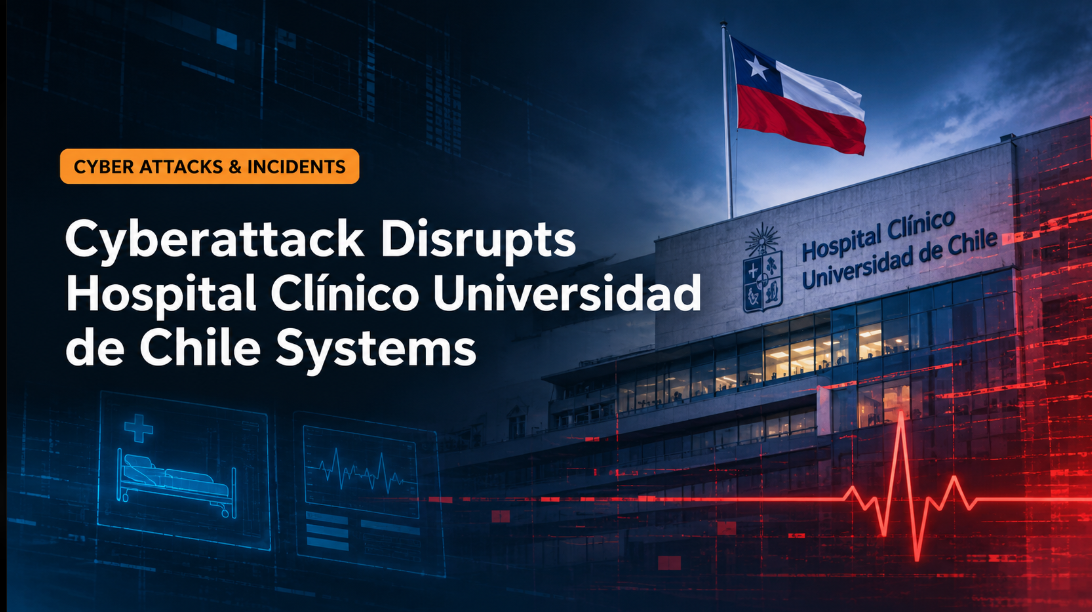
A cyberattack on Hospital Clínico de la Universidad de Chile has disrupted parts of its IT infrastructure, leaving patients unable to book medical appointments through the hospital's website and Contact Centre. The incident, detected on November 14, 2026, has also prompted parliamentary scrutiny over the security of patient information and the hospital's response.
The hospital confirmed the incident on November 16, stating that clinical care remains operational despite problems affecting certain administrative processes and support services. However, the disruption has raised questions that go beyond appointment availability, particularly whether sensitive patient information was affected.
What happened?
The hospital detected a cybersecurity incident on the morning of November 14, affecting the availability of some of its institutional IT systems.
In its November 16 statement, the hospital said its IT team had identified the incident and activated established security, response and containment procedures. It is also working with Chile's National Cybersecurity Agency (ANCI) and the University of Chile's Vice-Rectorate for Information Technology to assess the impact and restore affected systems.
The most visible disruption has been to medical appointment bookings. Both the hospital's website and its telephone-based Contact Centre have been affected, temporarily preventing patients from scheduling consultations through these channels.
There is an important distinction here: the cyberattack has disrupted hospital systems, but it has not stopped clinical care. The hospital has confirmed that patient care remains operational, although some care processes and support services have experienced difficulties.
Parliamentary scrutiny follows cyberattack
The incident has now drawn attention from Chilean lawmakers, who want clearer answers about the extent of the disruption and whether patient information has been compromised.
Deputy Lilian Betancurt, a member of Chile's Health Commission, submitted five formal oversight requests to government authorities and university officials.
The requests were directed to:
- National Cybersecurity Agency (ANCI): Information about the reporting and management of the incident.
- Superintendence of Health: Clarification on whether patient medical records were compromised or exposed.
- University of Chile Rectorate: Details about the extent of the incident and its effect on hospital operations.
- Undersecretariat of Healthcare Networks: Information about possible effects on patient referrals and preparedness across the public healthcare network.
- Health Service: Details about cybersecurity protocols, data backups and operational continuity plans.
The requests show that lawmakers are looking beyond the immediate service disruption. Their main concern is whether the incident affected sensitive medical information and whether existing safeguards were sufficient.
However, these are requests for information and oversight, not evidence that patient records were stolen.
Is patient information at risk?
This remains one of the biggest unanswered questions surrounding the incident.
The hospital said it activated security and containment measures to protect patient information and prevent further damage. It has not, however, publicly confirmed whether medical records were accessed, exposed or removed from its systems.
That distinction matters. A cyberattack can disrupt access to hospital systems without necessarily involving data theft.
Medical records contain highly sensitive information, including details about patients' health and treatment. Any confirmed exposure would therefore have implications beyond the hospital's IT infrastructure.
For now, there is no verified figure for potentially affected records, and no confirmed evidence of data exfiltration. The parliamentary requests are intended, in part, to establish whether patient information was compromised.
Recovery efforts and investigation
The hospital's technical teams are working with ANCI and the University of Chile's technology division to assess the incident and restore affected systems progressively.
According to the hospital, recovery is being carried out under security measures intended to protect information and maintain continuity of care.
The institution has not disclosed the technical cause of the incident, the method used to gain access or the total number of systems affected. It has also not provided a confirmed timeline for restoring appointment services.
This leaves two separate issues to track: restoring the services patients rely on and establishing whether the attack affected information beyond system availability.
What happens next?
The next developments will depend on the hospital's technical assessment and responses to the five parliamentary requests.
Authorities will need to establish how the incident occurred, whether patient information was affected and what additional security measures may be required.
For the healthcare sector, the incident highlights how disruption to digital infrastructure can affect essential hospital processes even when medical care continues. Appointment platforms, administrative systems and patient information services are all part of the infrastructure hospitals depend on to operate.
The confirmed facts remain limited: the hospital experienced a cybersecurity incident on November 14, some institutional systems and appointment channels were disrupted, and clinical care remained operational.
Whether patient information was compromised is still unresolved. That is likely to remain the most important question as the investigation and parliamentary scrutiny continue.
Sources
- T13 – Hospital Clínico confirms cybersecurity incident
- BioBioChile – Cyberattack prompts parliamentary scrutiny
- Cooperativa – Hospital appointment systems disrupted
This brief was prepared with AI assistance from the sources above and reviewed by our editors.
Sources
Keep reading

CISA Warns Critical Puppet Enterprise Flaw (CVE-2026-115731) Is Being Exploited, Sets 1 December Deadline
The deserialization bug in report handling scores 9.4 under CVSS 4.0 and can let a client with a signed agent certificate run code on the Puppet server.

South Korea's Yellow Umbrella Data Breach Exposes Information of 362,000 Members
The operator says an outside investigation found almost one in five members affected, up from about 205,000; names, partial ID numbers and contribution amounts were exposed.
Panzer Claims Theft of 296GB of Data From Indonesia's Bank BJB Syariah
Panzer claims to have exfiltrated 296 GB of customer data from Bank BJB Syariah, prompting warnings of phishing and fraud risks for its users in West Java and Banten.