
Democracy in the Digital Crossfire: Technology, Social Media, and Cyber Threats in Colombia's 2026 Elections
An Analysis | June 2026
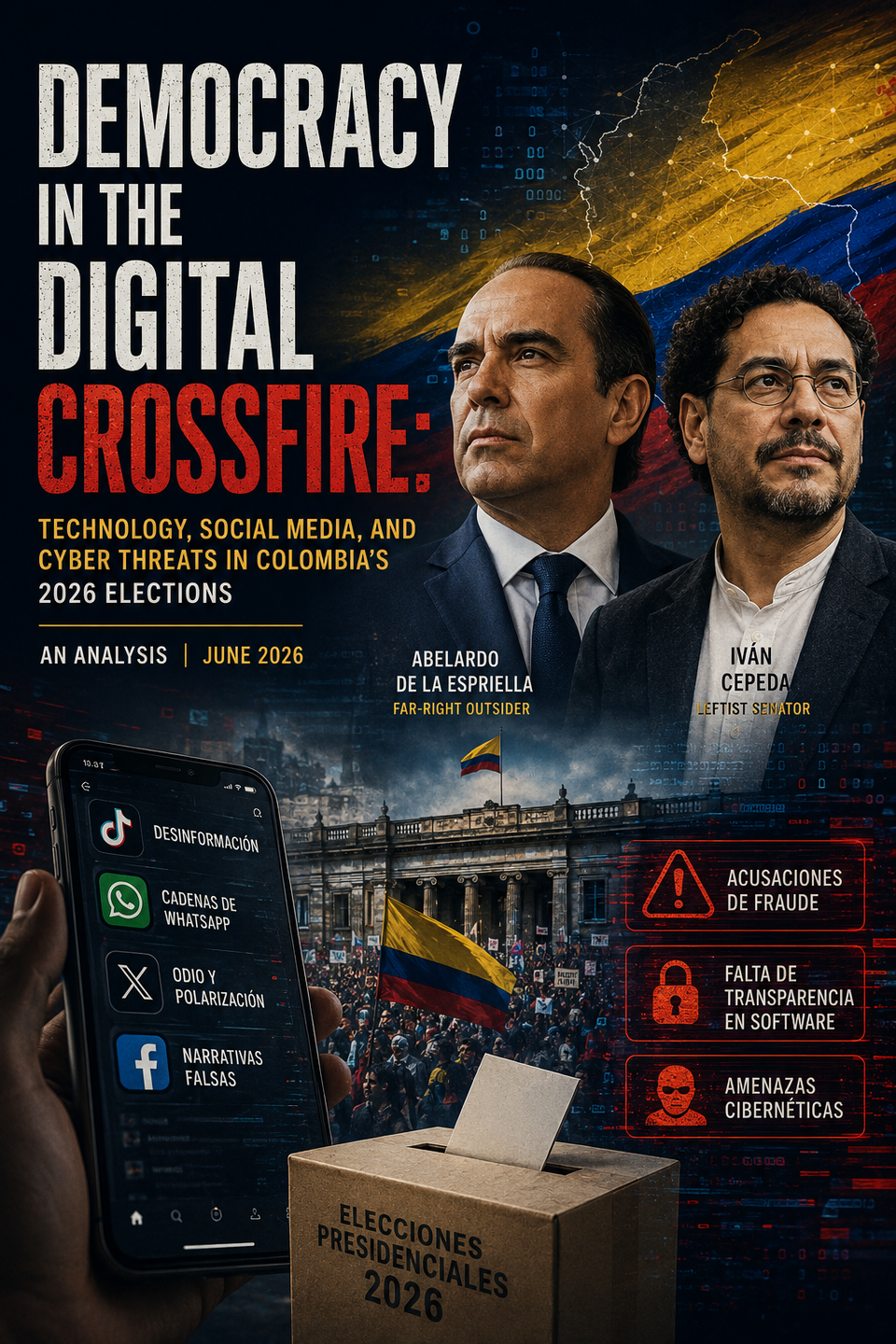
Colombia's 2026 presidential election is a case study in how digital forces now shape — and threaten — democratic processes across the developing world. With a polarizing June 21 runoff looming between far-right outsider Abelardo de la Espriella and leftist senator Iván Cepeda, the contest has been defined not only by its candidates' policy visions but by the parallel battle being waged on smartphones, encrypted messaging apps, and electoral software systems. The digital dimension of this election deserves close examination.
The Social Media Battlefield: Fear, Algorithms, and the Death of Debate
The most visible technological influence on the 2026 campaign has been the dominance of social media in shaping public opinion — largely at the expense of substantive political discourse. Analysts have noted that the absence of formal debates between candidates, combined with the algorithmic logic of platforms like TikTok, Instagram, and X (formerly Twitter), has left voters starved of policy information while being saturated with emotional content.
"The main emotion they are trying to awaken in people is fear," political analyst Bonilla observed, warning that "citizens have very little public information to guide them." She also flagged the pernicious role of algorithmic echo chambers in which "people mostly engage with those with whom they feel the strongest emotional affinity" — a dynamic that rewards outrage over reason.
This is not a new observation for Colombia, but the 2026 cycle has sharpened the problem. WhatsApp — which is effectively free on most Colombian mobile plans — remains a primary vector for political messaging, including disinformation. The platform's end-to-end encryption makes it nearly impossible for regulators or fact-checkers to monitor or intervene in the spread of false narratives. Historically, similar dynamics in Colombia have been used to smear candidates by linking them to guerrilla groups and criminal networks — associations that, amplified through viral chains, can effectively define a candidate's public image before any rebuttal is possible.
Colombia's Ombudsman's Office has documented campaigns of digital stigmatization, in which disinformation is deployed as "a tool of political delegitimization, through accusations that associate candidacies with illegality, criminality, or armed actors." The EU Election Observation Mission similarly found that disinformation had a measurable impact on the campaign, describing attacks on candidates as being of "extreme cruelty," enabled and amplified by social platforms during the final days of the electoral process.
A further structural problem is that digital political communication falls outside traditional campaign silence provisions — the regulatory gap that governs broadcast media does not extend to the internet, creating an uneven playing field in the final hours before polls open.
The Misinformation Crisis: Narratives That Undermine Institutions
One of the most dangerous features of Colombia's 2026 digital environment has been the spread of false narratives targeting the credibility of electoral institutions themselves. The International Republican Institute (IRI), which monitored the elections, warned that "misleading narratives about the National Electoral Council and National Civil Registry circulated widely on social media, heightened political tensions, and increased the risk of post-election disputes."
These narratives have found their most prominent voice in outgoing President Gustavo Petro, who — following the May 31 first round — refused to accept the preliminary count and publicly alleged that electoral software had been manipulated. Petro claimed the voter registry was improperly inflated by 885,409 records and that 1,493 additional unauthorized voting tables appeared in the private counting software, which he alleged was modified twice in the days before the election.
Both the OAS election mission (comprising 96 observers across 24 countries) and the EU Election Observation Mission rejected these claims. The official recount found a variation of only 0.06% from the preliminary count, and candidate Cepeda himself subsequently acknowledged there was no evidence of fraud. Yet the political damage of the allegations had already been done — spread and amplified across social media before any institutional rebuttal could take hold.
This pattern illustrates a well-documented vulnerability in the modern information ecosystem: the speed of accusation vastly outpaces the speed of correction. Unverified claims of electoral fraud, once seeded on social media, are nearly impossible to fully retract. The IRI warned explicitly that their "persistence risks undermining institutional credibility and could negatively affect voter participation" ahead of the June 21 runoff.
The Software Transparency Problem: A Genuine Structural Vulnerability
While Petro's specific fraud allegations were rejected by international observers, the controversy exposed a legitimate and serious structural weakness: the outsourcing of electoral software to private corporations without adequate public transparency mechanisms.
The electoral counting software and logistics for the May 31 vote were managed by Thomas Greg & Sons, a private company. At the center of the dispute was the Registraduría's refusal to provide the source code for public audit — a demand that, as Petro noted, aligns with a 2018 Council of State ruling that declared the software "vulnerable both from inside and outside."
Colombia's attempt to modernize its electoral framework through a new Electoral Code was blocked by the Constitutional Court on procedural grounds, forcing the 2026 elections to be conducted under regulations dating to 1986. The Registraduría remains entirely insulated from presidential authority, which is by design — but the lack of mandatory technological audits, combined with private-sector control over critical counting infrastructure, has created a transparency deficit that bad-faith actors can exploit to sow doubt.
The question of whether the software was, in fact, tampered with matters less to democracy's health than the question of whether the public can be given sufficient confidence that it was not. That confidence cannot be built without open, auditable systems.
Cyber Threats to the Electoral Process
Beyond the information warfare dimension, Colombia's 2026 elections unfolded against a global backdrop of escalating cyber threats to democratic infrastructure. Globally, deepfakes have "crossed a critical threshold," becoming nearly indistinguishable from reality according to a 2026 World Economic Forum analysis — and they are now accessible to anyone with a smartphone. The same report noted that during the 2024–2025 electoral cycle, AI systems were documented optimizing political content "for maximum emotional impact across multiple countries."
Colombia has not been immune. Armed groups in the country have been documented using social media platforms for recruitment, including of minors — a form of digital threat that has direct implications for political stability in regions where these groups exert influence over voting behavior. In areas where illegal armed groups control territory, journalists reported operating under severe constraints, limiting independent reporting on the ground.
More broadly, the delegation of critical electoral infrastructure to private software companies — without mandatory source-code transparency or real-time audit trails — represents a surface area that state and non-state actors alike could seek to exploit. Whether or not Colombia experienced any actual interference in 2026, the structural conditions for such interference exist and will need to be addressed.
State Media, Press Freedom, and Digital Manipulation
The digital battlefield in Colombia is further complicated by concerns about state influence over media coverage. The EU Election Observation Mission found that state-owned television and radio (RTVC Sistema de Medios Públicos) primarily covered executive activities in a positive tone while limiting coverage of opposition campaigns. Public authorities at multiple levels of government reportedly pressured media outlets to secure favorable coverage.
In this environment — where traditional media is subject to political pressure and digital media is dominated by algorithmic amplification — voters face a deeply distorted information landscape. The absence of formal candidate debates meant that social media was not merely supplementing political discourse; it was replacing it entirely.
The physical dangers for journalists further constrain independent digital coverage. High-profile incidents including the killing of journalist Óscar Gómez Agudelo in Quindío, the attempted killing of Gustavo Chicangana in Guaviare, and an explosive attack on a media facility in Cali created a climate of fear that inevitably shapes what gets reported and how.
The Institutional Response: Fact-Checking Alliances and Their Limits
Colombia has not been without institutional response. The Civil Registry launched an alliance with civic organizations, including the Electoral Observation Mission (MOE) and the fact-checking platform ColombiaCheck, to combat false narratives and promote responsible political debate. These efforts represent genuine commitments to preserving the integrity of the information environment.
But the structural asymmetries remain severe. Fact-checkers and official rebuttals operate at the pace of investigation and deliberation; disinformation spreads at the speed of a share button. Platform algorithms, optimized for engagement rather than accuracy, consistently favor emotional and outrage-inducing content over corrections. And the legal framework governing digital political communication has significant gaps — including the absence of any campaign silence provisions applicable to online content.
Looking Ahead to June 21: What Is at Stake
As Colombia approaches its June 21 runoff — a contest between de la Espriella's populist right and Cepeda's leftist continuity platform — the digital environment presents both a threat and an opportunity.
The threat is well-documented: further disinformation campaigns, potential fraud allegations amplified on social media regardless of their evidentiary basis, continued absence of substantive policy debate in the digital sphere, and the risk that post-election disputes fueled by social media narratives could undermine the legitimacy of whichever candidate prevails.
The opportunity lies in what transparency can still deliver. International observers are present in force. Independent fact-checkers are active. Civil society organizations are engaged. And a broader public conversation has now been opened — forcibly, through crisis — about the accountability of private electoral software vendors.
Conclusion: Technology as Both Threat and Mirror
Colombia's 2026 elections do not reveal anything fundamentally new about technology and democracy — but they provide an unusually sharp illustration of tensions that democracies worldwide are navigating. Social media does not merely reflect polarization; it manufactures and monetizes it. Algorithmic platforms do not merely distribute information; they select for the most emotionally potent and epistemically corrosive versions of it. And electoral infrastructure, once it is entrusted to private actors without mandatory transparency, becomes a vector for both genuine vulnerability and bad-faith allegation.
What Colombia's 2026 experience most clearly demonstrates is that the regulatory frameworks governing elections — designed for a world of broadcast media, paper ballots, and public counting rooms — have not kept pace with the digital realities of the campaigns being fought inside them. Closing that gap will require not only technical solutions, but political will: a willingness to subject electoral software to the same standards of public accountability that are applied to the ballot box itself.
The runoff on June 21 will decide who governs Colombia. But the broader contest — between democratic transparency and digital manipulation — will continue long after the votes are counted.
Sources: International Republican Institute (IRI) Pre-Election Assessment and Preliminary Statement, April–June 2026; EU Election Observation Mission findings; Americas Society/Council of the Americas; Euronews; Finance Colombia; ColombiaOne; World Economic Forum; Centre for Emerging Technology and Security (CETAS); UPI; teleSUR.
Member discussion