
Elizebeth Friedman: The Codebreaker Who Outwitted Rum-Runners and Nazi Spies
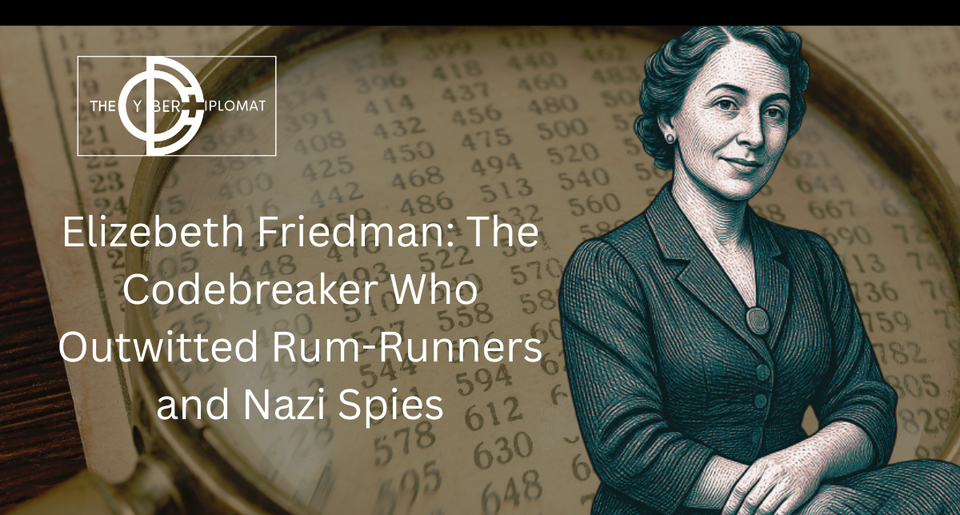
Long before cybercrime units and digital forensics teams existed, there was Elizebeth Smith Friedman — a poet-turned-codebreaker whose pencil-and-paper work helped dismantle Prohibition-era smuggling networks and, decades later, unravel Nazi spy rings across the Americas.
From Shakespeare to Secret Codes
Friedman's path into cryptology began almost by accident. Born in 1892 in Huntington, Indiana, the youngest of ten children in a Quaker family, she initially pursued literature and poetry before entering the field of codebreaking through a job at Riverbank Laboratories in 1916, where she was hired to analyze theories that Francis Bacon had hidden secret messages in Shakespeare's plays. It was there she met fellow cryptologist William Friedman, whom she married the following year, and together the pair helped lay the groundwork for modern American cryptanalysis.
Taking On the Rum-Runners
Friedman's defining early achievement came during Prohibition. In 1925, the Coast Guard — then part of the Treasury Department — recruited her to decipher coded radio messages sent by smugglers coordinating illegal liquor shipments along the coasts. At the time, the Coast Guard's entire cryptanalytic operation consisted of one codebreaker and one clerk, working with nothing more than pencil and paper.
The scale of the challenge was enormous. Smuggling rings used networks of boats and shore radio stations to coordinate shipments worth millions of dollars, and one operation alone, known as Conexco, ran as many as 100,000 crates of liquor at a time using dozens of vessels just outside U.S. territorial waters. Friedman worked through the backlog of intercepted transmissions, and by the early 1930s had solved roughly 12,000 rum-running messages across two dozen different code systems.
Her success didn't go unnoticed. Her growing reputation and the press coverage she received led to her being placed in charge of a newly formed cryptology unit, and she went on to testify as an expert witness in numerous federal smuggling trials. In one notable case, she deciphered messages proving that a rum-running schooner sunk by the Coast Guard was secretly owned by New York mobsters, a finding with real diplomatic stakes given the international dispute the incident had triggered.
A Career Defined by Institutional Recognition
Friedman's expertise didn't go unrewarded, at least professionally. As Cryptologist-in-Charge, her salary rose to a level considered virtually unheard of for a woman at the time. Yet much of her work was destined to remain in the shadows for decades.
Breaking Nazi Codes in World War II
As war loomed in Europe, Friedman's team shifted their focus from bootleggers to spies. By the late 1930s, her Coast Guard unit had become the first Americans to decode Germany's Enigma machine, and starting in 1940 she turned her attention to intercepting German communications broadcast from radio stations across South America. Her work fed directly into US and British efforts to track Nazi spy networks monitoring Allied shipping.
The scope of that wartime effort was substantial. Her team is credited with cracking three successive variants of the Enigma cipher by December 1942, each modified to evade detection, ultimately allowing decryption of the active Nazi spy codes operating in the region.
Hidden in Plain Sight
Despite the significance of her work, Friedman's contributions were largely erased from the public record during her lifetime — partly by circumstance, partly by design. Because she worked as a civilian, her name rarely appeared on official memos, and much of what historians now know about her role was pieced together from the initials "ESF" she left at the bottom of decoded messages.
The disparity in recognition between Friedman and her husband was stark. While William Friedman received the Presidential Medal for Merit and the Presidential National Security Medal and became celebrated as the father of the National Security Agency, an officer she had personally trained received the Legion of Merit and the Order of the British Empire for their unit's work — while Elizebeth received a raise. She titled the draft of her unfinished memoir "Footnote to History," a nod to both her humility and the obscurity that classification imposed on her career.
A Legacy Rediscovered
Friedman died in 1980, and it wasn't until the early 2000s, when Coast Guard Unit 387's wartime records were finally declassified, that the full picture of her contributions came into view. Today she's widely recognized as one of America's cryptologic pioneers — a trailblazer whose work bridged two of the twentieth century's defining law enforcement and national security challenges, and whose insistence on being credited under her own name, spelled with a distinctive "e," has become part of how she's remembered.
Sources: The Mob Museum, U.S. Naval Institute's Naval History Magazine, Smithsonian American Women's History Museum, National Women's History Museum, and the U.S. Coast Guard's "The Long Blue Line" historical series.
Member discussion