
EU Extends Emergency Cybersecurity Support to Ukraine
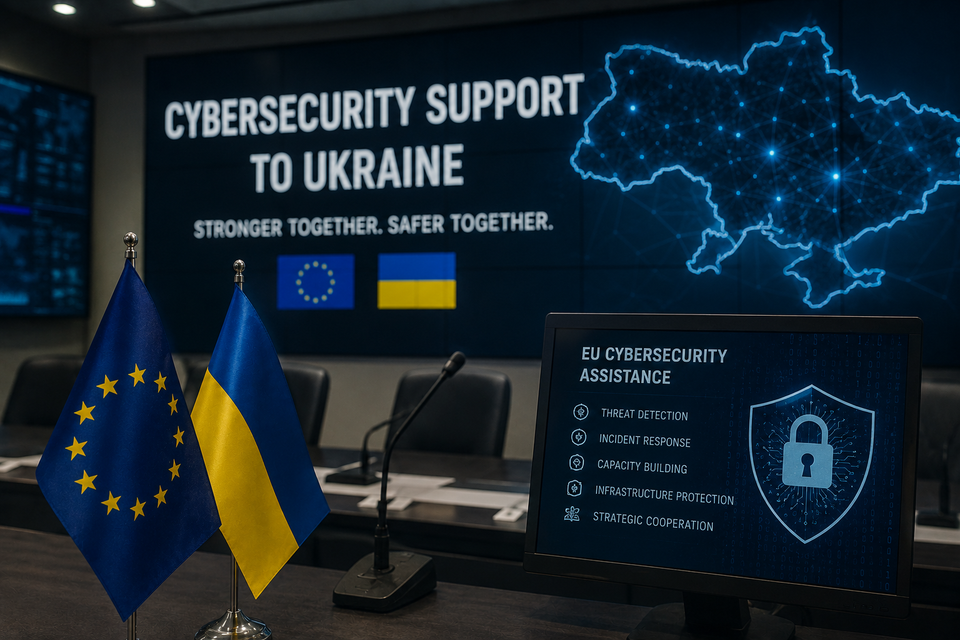
Brussels, June 16, 2026 — Ukraine has gained access to the European Union's emergency cybersecurity assistance mechanism, after the Council of the EU formally approved the country's inclusion in the bloc's Cybersecurity Reserve on June 15. The move gives Kyiv the ability to call on a network of vetted private-sector responders whenever it faces a major or large-scale cyberattack, marking one of the most concrete expansions of EU-Ukraine digital cooperation since Russia's full-scale invasion began in 2022.
What the Reserve Provides
The Cybersecurity Reserve sits at the center of the EU's Cyber Solidarity Act, legislation that entered into force in early 2025 to help the bloc detect, prepare for, and respond to escalating cyber threats. In practice, the Reserve functions as a pool of pre-vetted, trusted private companies that EU member states, EU institutions, and now select partner countries can call on for rapid incident-response services when hit by significant or large-scale attacks. The European Union Agency for Cybersecurity, ENISA, administers the program, drawing on its prior experience running similar support actions.
With Ukraine's accession, the country can now formally request these emergency services rather than relying solely on bilateral arrangements or ad hoc assistance. Moldova was the first non-member state added to the Reserve, back in 2024, also under the Cyber Solidarity Act framework.
A Commission Framed as Solidarity
European Commission officials framed the decision as both a practical security measure and a political statement. The Commission described Ukraine's inclusion as reflecting close EU-Ukraine cooperation and consistency with the bloc's strategic digital partnership agenda, while officials emphasized that opening the Reserve to Kyiv reinforces collective European cyber defenses and the broader principle of solidarity underpinning the EU's digital strategy.
The decision also follows procedural groundwork laid earlier: Ukraine's Minister of Digital Transformation, Mykhailo Fedorov, had previously signed an amendment to Ukraine's participation agreement in the EU's Digital Europe Programme, the funding vehicle that underpins much of this cooperation, with the European Commission's Directorate-General for Communications Networks, Content and Technology countersigning on the EU side.
Part of a Longer Pattern
Yesterday's announcement is not an isolated gesture but the latest step in a cybersecurity relationship that has deepened steadily since 2022. ENISA formalized a working arrangement with Ukraine's National Cybersecurity Coordination Center and the State Service of Special Communications and Information Protection early in the war, focused on capacity-building and situational awareness. The EU has also funded over €10 million in direct cybersecurity assistance to Ukrainian public authorities, channeled through Estonia's e-Governance Academy, covering everything from securing the Trembita data-exchange platform to replacing hardware destroyed in attacks on government infrastructure.
More recently, the two sides held their fourth EU-Ukraine Cyber Dialogue, where officials discussed sanctions regimes, cybercrime cooperation, and capacity-building efforts including the Tallinn Mechanism, alongside Ukraine's pending access to the Reserve. That dialogue brought together Ukraine's Ministries of Defence, Foreign Affairs, and Digital Transformation, its National Security and Defence Council, and its Security Service's Cybersecurity Situation Centre — underscoring how cyber defense has become woven into Ukraine's broader national security architecture.
Why It Matters
The stakes are tied directly to the war itself. EU and Ukrainian officials have repeatedly characterized cyberspace as an active front in Russia's aggression, with hostile cyber operations described as preceding and accompanying military action against critical infrastructure such as power grids and government information systems. Formal access to the Reserve gives Ukraine a standing channel to trusted European incident responders rather than having to negotiate support on a case-by-case basis during a crisis — a distinction that matters most in the early, chaotic hours of a large-scale attack.
It also reinforces a broader trend: EU cybersecurity policy, originally designed around member-state solidarity, is increasingly being extended to partner and candidate countries as Brussels treats cyber resilience as inseparable from its wider strategic and enlargement agenda. Ukraine's inclusion sits alongside its candidacy for EU membership and its participation in programs like Digital Europe, reinforcing the message that digital integration is advancing in parallel with — and sometimes ahead of — formal accession talks.
What Comes Next
For now, the practical effect is that Ukrainian authorities can activate the Reserve's incident-response services on request when facing incidents serious enough to meet the EU's threshold for "significant or large-scale." Officials on both sides have signaled this is unlikely to be the final step, with continued dialogue expected on deepening cooperation across sanctions enforcement, cybercrime investigations, and capacity-building. Given the pace of cyber activity tied to the war, how quickly and effectively Ukraine draws on this new access may become an early test of the Reserve's value as a wartime tool rather than a peacetime contingency.
Member discussion