
Fighting Counterfeit Medicine: How Blockchain, AI, and Machine Learning Are Reshaping Pharmaceutical Supply Chains
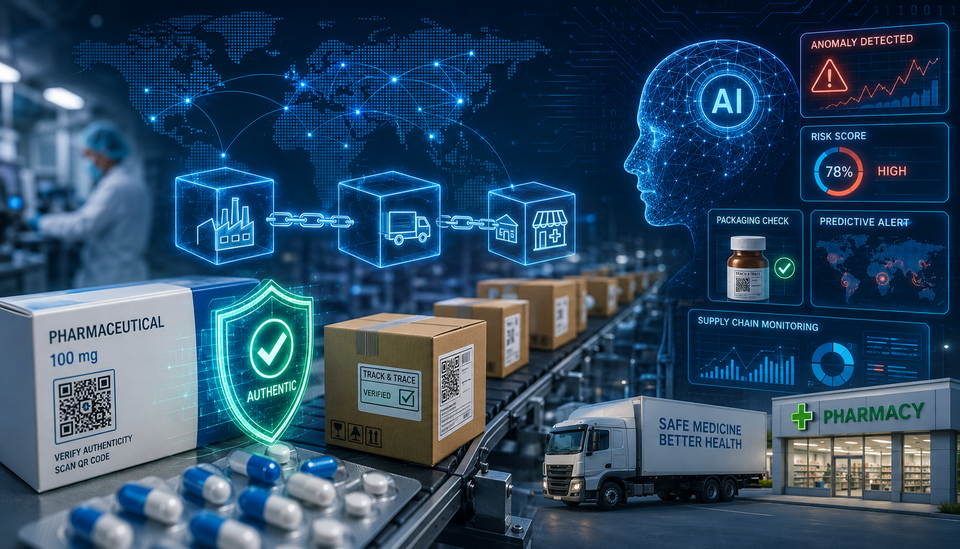
Counterfeit medicine is one of the more quietly devastating problems in global healthcare. It doesn't make headlines the way a disease outbreak does, but its reach is enormous: the World Health Organization has estimated that counterfeit or substandard drugs make up somewhere between 1 in 10 medicines sold worldwide, with the burden falling hardest on low- and middle-income countries in Africa, Asia, and Latin America. Some industry estimates put the annual cost to legitimate manufacturers in the hundreds of billions of dollars. Behind those numbers are real patients receiving drugs with no active ingredient, the wrong ingredient, or the wrong dose — effectively unregulated, unpredictable medicine sold as the real thing.
For years, the tools available to fight this were mostly physical: holograms, tamper-evident seals, and serial numbers printed on packaging. Those measures help, but they can be replicated by sophisticated counterfeiters, and they do little to address the deeper problem — that pharmaceutical supply chains are long, fragmented, and often opaque, running through manufacturers, distributors, wholesalers, and pharmacies that don't always share data with each other. That's the gap a newer generation of technology is trying to close.
Blockchain: A Shared, Tamper-Resistant Ledger
Blockchain's appeal in this context comes down to one property: once a transaction is recorded on a properly designed blockchain, it's extremely difficult to alter without everyone in the network noticing. Applied to pharmaceuticals, that means every step a drug takes — from raw ingredient sourcing, to manufacturing, to each change of ownership as it moves through distributors and into a pharmacy — can be logged in a shared, verifiable record that no single party controls or can quietly edit.
That matters because one of the chronic weaknesses in pharmaceutical logistics is exactly the kind of fragmentation blockchain is built to solve: manufacturers, wholesalers, and dispensers often run incompatible internal systems with little visibility into what happens once a product leaves their hands. A blockchain-based ledger gives every legitimate participant — manufacturers, regulators, distributors, and increasingly patients themselves — a way to verify a product's history before it's dispensed. If a counterfeit does slip into the chain, the same ledger makes it far easier to pinpoint exactly where the breach happened and quarantine the affected batch before it reaches more patients.
Pilot projects have already tested this in practice. The MediLedger Network, for instance, ran an FDA-recognized pilot demonstrating that blockchain could handle the kind of package-level tracing and verification the U.S. now requires by law. More recent academic proposals go further, pairing blockchain with unique cryptographic keys or product tokenization so that authenticity can be verified at the individual package level rather than just the batch level.
Where AI and Machine Learning Come In
Blockchain gives the supply chain a trustworthy record. Machine learning and AI are what make sense of that record — and increasingly, what catch problems blockchain alone can't.
A few applications stand out:
- Anomaly detection in supply chain data. Machine learning models trained on shipment, inventory, and transaction patterns can flag deviations that suggest diversion or tampering — a shipment routed through an unusual path, a batch that appears in two places at once, or sales volumes that don't match expected demand for a region.
- Predictive risk management. Rather than only reacting after counterfeits are discovered, AI models can assess risk factors continuously — transportation delays, environmental conditions during shipping, or historical patterns tied to specific routes or partners — and flag high-risk shipments for extra scrutiny before problems occur.
- Image and packaging recognition. Computer vision models, including convolutional neural networks, are increasingly used to compare a product's packaging, printing, and even pill markings against verified references, catching visual discrepancies that are invisible or easy to miss for a human inspector.
- Automated compliance checks. When combined with blockchain smart contracts, AI systems can automatically verify that a batch meets required quality and regulatory checkpoints before it's allowed to move to the next stage of distribution, reducing reliance on manual audits.
Recent research frameworks describe this as a layered approach: a real-time monitoring layer that watches supply chain data as it flows, a "proactive agent" layer using AI to flag risks before they materialize, a blockchain layer that anchors the tamper-resistant record, and an interface layer that lets manufacturers, regulators, and pharmacies interact with the system. The general direction across recent academic and industry work is toward integration — blockchain, AI, IoT sensors, and serialization all feeding into a single verification ecosystem rather than operating as separate tools.
The Regulatory Backdrop
Technology adoption in this space has been pushed along by regulation as much as by the technology itself. In the United States, the Drug Supply Chain Security Act (DSCSA) set out a decade-long path toward a fully electronic, interoperable track-and-trace system for prescription drugs, and after several delays, its enhanced requirements are now largely in force: manufacturers and repackagers had to comply by May 2025, wholesale distributors by August 2025, and larger dispensers by November 2025, with only small pharmacies still under a temporary exemption through November 2026. Paper and spreadsheet-based tracking are no longer acceptable — trading partners must exchange serialized transaction data electronically, typically through EPCIS-standard systems, and be able to verify that physical barcodes match the corresponding digital record.
The European Union has run a parallel system since 2019 under its Falsified Medicines Directive, requiring unique identifiers and tamper-evident features on prescription packaging, verified through the European Medicines Verification System. Dozens of other countries have adopted their own serialization mandates, creating a genuinely global — if still uneven — push toward electronic traceability.
What's Still Missing
None of this makes counterfeiting solvable overnight. Blockchain systems are only as trustworthy as the data entered into them — a corrupt actor can still record false information at the point of entry, a limitation sometimes called the "garbage in, garbage out" problem. Interoperability between different companies' and countries' systems remains a persistent headache, and rolling out this kind of infrastructure is expensive, which can put smaller manufacturers and pharmacies, especially in lower-income countries, at a disadvantage — the very markets where counterfeit drugs are already most prevalent.
Even so, the trajectory is clear. What began as isolated pilot projects a few years ago has become, for major pharmaceutical markets, close to a regulatory baseline. The combination of blockchain's tamper-resistant recordkeeping with AI's ability to spot patterns humans would miss represents the most credible technical answer yet to a problem that has quietly undermined trust in medicine for decades — even if closing the remaining gaps, particularly in the parts of the world hit hardest by counterfeiting, will take considerably longer than closing them in wealthier markets.
Member discussion