
Hong Kong's Export Control Gap: Why a Non-Member of Wassenaar Has Become a Flashpoint in the Tech Trade Debate
A Regime Hong Kong Follows but Doesn't Belong To
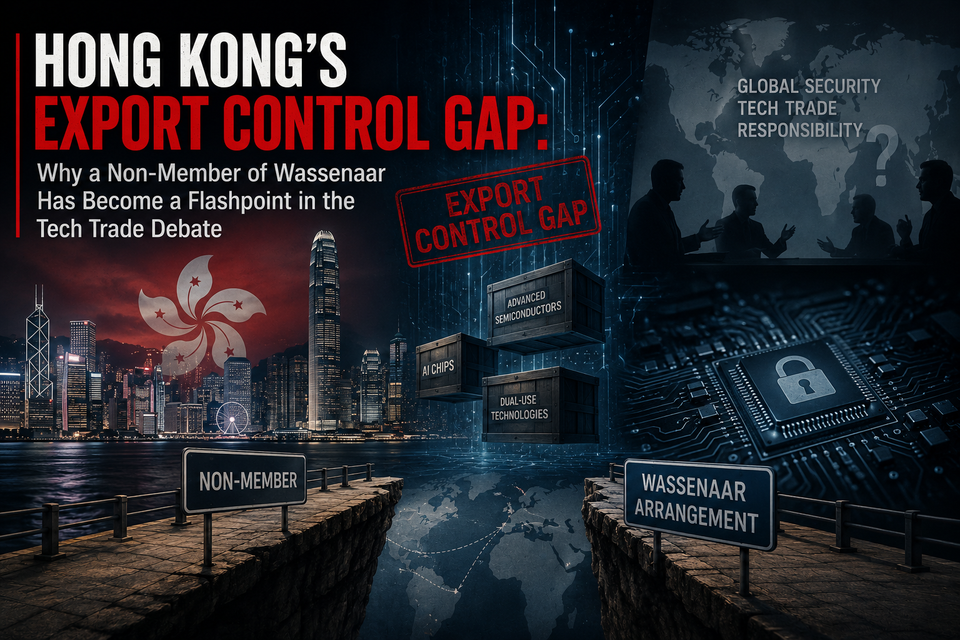
Hong Kong is not a member of the Wassenaar Arrangement, the 42-nation regime that governs export controls on conventional arms and dual-use goods and technologies. Neither is mainland China. Membership is restricted to sovereign states, and as a Special Administrative Region, Hong Kong has no path to join independently of Beijing — which itself has never been admitted.
Instead, Hong Kong runs a parallel, self-administered system. Under its Import and Export (Strategic Commodities) Regulations, traders need a license from the Trade and Industry Department to move controlled items in or out of the territory. The list of what counts as "controlled" is not Hong Kong's own invention — it mirrors the control lists set by Wassenaar, the Nuclear Suppliers Group, the Missile Technology Control Regime, the Australia Group, the Chemical Weapons Convention, and the Arms Trade Treaty. When Wassenaar updates its list, Hong Kong typically follows with its own legislative update, as it did in 2021 and again in 2025.
On paper, this looks like compliance. In practice, it's something narrower: Hong Kong has copied the rulebook without joining the league. It has no seat at Wassenaar's table, no vote on what gets added to the control lists, and — more importantly — no binding obligation to participate in the information-sharing that members are expected to do, such as notifying other states when an export license is denied to a buyer of concern. Wassenaar's value lies partly in that transparency between members; a jurisdiction that adopts the list but sits outside the reporting structure gets the appearance of alignment without the verification mechanism that makes the system work.
Why This Distinction Matters to Washington
This gap hasn't gone unnoticed by U.S. regulators. Hong Kong has historically been treated by the U.S. Bureau of Industry and Security as an "A:6" country, a designation that made it eligible for streamlined export treatment under License Exception STA (Strategic Trade Authorization) — the kind of fast-track status normally reserved for trusted, Wassenaar-aligned destinations. There has been ongoing discussion in U.S. policy circles about stripping Hong Kong of that preferential treatment and reclassifying it alongside mainland China for export control purposes. If that change goes through, items that currently move to Hong Kong with minimal friction would require individual licensing, and Hong Kong would lose the re-export privileges it currently enjoys from other Wassenaar member states.
The underlying concern isn't abstract. It reflects a growing view among U.S. and allied regulators that Hong Kong's licensing system, however closely it mirrors Wassenaar's paperwork, isn't functioning as an effective firewall against goods reaching restricted end users.
The Transshipment Evidence
That concern has been reinforced by independent investigative reporting. A 2026 investigation by the International Consortium of Investigative Journalists, drawing on research from the Committee for Freedom in Hong Kong Foundation, found that Hong Kong and mainland China-based traders had shipped military-use technology — sourced from more than 20 Western electronics manufacturers — to Russian importers, including sanctioned entities, largely without drawing scrutiny from international authorities. The researchers concluded that Hong Kong functions not merely as a permissive business environment but as a systemic hub for routing sanctioned goods and payments to Russia, and identified it as the single largest global transshipment node for procuring Western technology destined for Russia, Iran, and North Korea.
The goods involved in that reporting were semiconductors, sensors, electrical connectors, and microchip components — dual-use hardware with both civilian and military applications, not offensive cyber tools or malware. That distinction matters for accuracy: the well-documented pattern is sanctions evasion and physical-component transshipment exploiting Hong Kong's trade and customs infrastructure, not a marketplace where hacking tools or exploits are bought and sold. Conflating the two overstates what the public record currently shows, even though the hardware-transshipment finding is itself a serious and substantiated problem.
A System Built for Trade, Now Tested by Geopolitics
Hong Kong's strategic trade control regime wasn't designed with today's geopolitical pressures in mind. It was built to keep the territory's customs and licensing framework broadly compatible with the major non-proliferation regimes while preserving Hong Kong's identity as a low-friction global trading hub — separate customs status, separate currency, and a corporate registration system that makes setting up trading entities fast and cheap. Those same features, which made Hong Kong attractive to legitimate commerce for decades, are exactly what make it structurally useful for actors looking to obscure the ultimate destination of restricted goods.
Since the 2020 National Security Law extended Beijing's political and security reach into Hong Kong's governance, Western regulators have increasingly questioned whether the territory's nominally separate trade administration can be trusted to act independently of mainland interests when those interests conflict with international sanctions regimes. Hong Kong's government maintains that its strategic trade control system remains robust and aligned with international standards; outside investigators and a growing number of U.S. policymakers argue the enforcement gap is real and widening.
The Bottom Line
Hong Kong's role in the global technology trade sits at an uncomfortable intersection: a jurisdiction that voluntarily mirrors the world's leading export control rulebook without being bound by its membership obligations, operating inside a political system increasingly aligned with a government that has clear interests in acquiring restricted Western technology. The strongest, most defensible characterization of Hong Kong's role — based on current public evidence — is that of a dual-use hardware and sanctions-evasion transshipment hub, not a marketplace for offensive cyber weapons. Whether Hong Kong's licensing system gets meaningfully reformed, or whether trading partners like the United States respond by simply downgrading its trade status to match mainland China's, is likely to be one of the more consequential open questions in the broader tightening of the global technology export regime over the next few years.
Member discussion