
Keyboard Criminal, International Manhunt: The SPOX Case and the Global War on Cybercrime
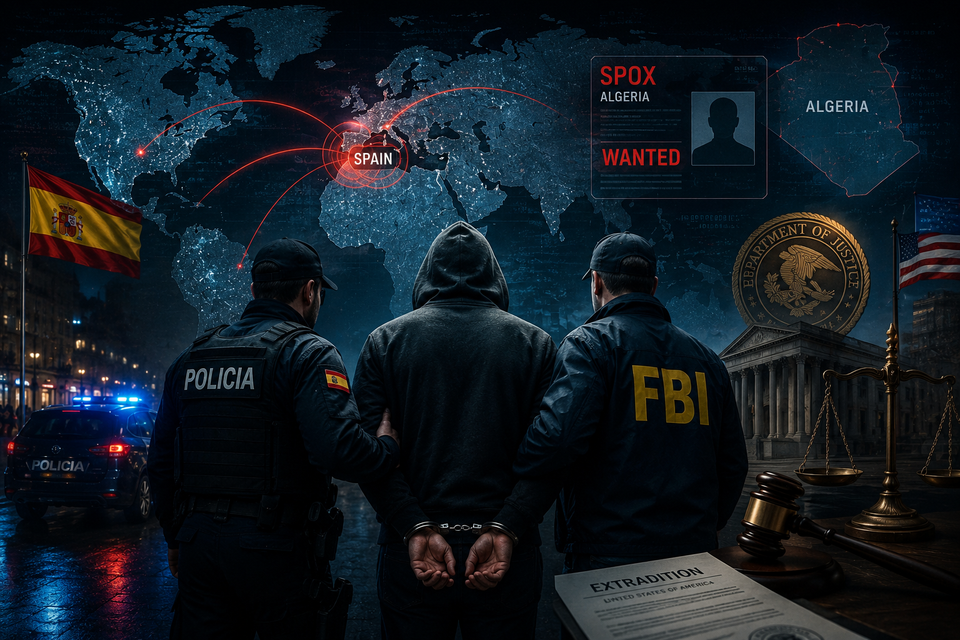
An Algerian hacker's arrest in Spain and extradition to the United States exposes the legal fault lines, diplomatic machinery, and enforcement asymmetries that define the fight against cross-border cybercrime.
The Case
Abdellah Belmili, a 26-year-old Algerian national operating under the alias "SPOX," was arrested and extradited to the United States on June 18, 2026, to face charges of conspiracy to commit bank fraud. He now faces a maximum penalty of 30 years in prison.
According to federal prosecutors, Belmili ran an online black-market platform — market0day.com — where cybercriminals could buy and sell stolen banking credentials, phishing kits, email server access, and website control panels. Major U.S. financial institutions including American Express, Bank of America, JP Morgan Chase, and Wells Fargo were targeted, as were banks in the United Kingdom. Between January 2020 and January 2023, approximately $900,000 flowed through an account under Belmili's control, and investigators identified around 5,600 victims across the U.S. and internationally.
When customers complained that purchases weren't delivered, Belmili simply rebranded — shutting down market0day.com and launching spoxy.us as a "new store for bulk SMS," a platform for sending fraudulent phishing messages at scale. He was ultimately apprehended not in Algeria, but in Spain — and it was Spain that handed him over to American justice.
What Is Conspiracy to Commit Bank Fraud?
Bank fraud under U.S. federal law (18 U.S.C. § 1344) makes it a crime to knowingly execute a scheme to defraud a financial institution or to obtain money from one by false pretenses. A conspiracy charge doesn't require the accused to have personally drained a single account — it requires only that they agreed with others to carry out such a scheme and took steps toward it.
In Belmili's case, the "scheme" was the marketplace itself: a commercial infrastructure purpose-built to sell the tools and credentials that enable bank fraud. Running the storefront, providing customer support via Telegram, and facilitating anonymous bitcoin transactions all constitute acts in furtherance of the conspiracy. The exposure is severe — up to 30 years — reflecting the scale and sophistication of the operation.
Algeria's Cybercrime Laws: A Framework on Paper
Algeria is not a lawless state when it comes to cybercrime. Algeria's Penal Code includes provisions for offenses such as unauthorized access to computer systems, online fraud, identity theft, phishing, cyberbullying and defamation, and the creation and distribution of malicious software.
The more significant law is Law No. 09-04, enacted on August 5, 2009. This law established a set of preventive and procedural measures to prevent and combat crimes related to information and communication technologies, including electronic surveillance, the use of service providers to prevent cybercrime, and search and seizure of information systems. Crucially, Article 15 of Law 09/04 stipulates that Algerian courts have jurisdiction over ICT-related crimes committed outside Algerian territory when the perpetrator is a foreigner and the crime targets Algerian state institutions, national defense, or the strategic interests of the national economy.
Algeria also has a data protection framework. Law No. 18-07 of 2018 on the protection of personal data was passed to safeguard citizens' privacy, ensuring data is collected for legitimate purposes, processed transparently, and protected against unauthorized access or misuse.
More recently, Presidential Decree No. 26-07 of January 7, 2026 established dedicated cybersecurity units within public institutions, and Presidential Decree No. 25-321 approved Algeria's national information systems security strategy for 2025–2029.
So the legal architecture exists. The enforcement, however, is another matter.
The Asymmetry Problem
This is where the Belmili case exposes a structural tension in global cybercrime enforcement. The problem is not unique to Algeria — but it is very real.
Laws exist; enforcement does not always follow. Algeria's cybercrime laws are largely oriented toward protecting Algerian state interests — national defense, government infrastructure, and strategic economic targets. Article 15 of Law 09/04 explicitly extends Algerian court jurisdiction to extraterritorial cybercrimes when they target Algerian state institutions or national defense. But attacks on American banks by an Algerian citizen sitting in Algeria fall outside this priority.
The non-extradition of nationals principle. The principle of non-extradition of nationals is enshrined in constitutions and regional instruments, including Article 698 of the Algerian Code of Criminal Procedure. This means Algeria would typically not hand over one of its own citizens to a foreign country for crimes committed abroad, even serious ones. Belmili wasn't caught in Algeria — he was caught in Spain, which is why extradition was possible. Had he never left Algeria, the legal path to bringing him to American justice would have been far murkier.
Dual criminality requirements. Many extradition treaties require that the charged conduct be a crime in both countries before surrender is permitted. While Algeria criminalizes online fraud in principle, the dual criminality requirement can create challenges for the United States in facilitating cooperation with countries where national laws have not been updated to criminalize different forms of cybercrime. The specifics of running a dark-web marketplace selling phishing kits may not have a neat parallel in Algerian law.
Enforcement capacity gaps. Despite Algeria's legislative progress, it faces several challenges in fully implementing and enforcing cyber laws, including the rapid pace of technological change, cybersecurity skills and resource gaps, and the challenge of balancing individual rights protection with necessary surveillance.
The result is an asymmetry: a cybercriminal in Algeria targeting American financial institutions faces far greater practical risk if they travel abroad than if they stay home.
How Diplomacy Closed the Net
The fact that Belmili is now in a Buffalo courtroom, and not sitting in Algiers, is a product of layered international legal machinery — and one crucial geographic misstep on his part.
The U.S.-Algeria Mutual Legal Assistance Treaty (MLAT). A treaty between the United States and Algeria on Mutual Legal Assistance in Criminal Matters was signed in Algiers on April 7, 2010, and entered into force on April 20, 2017. This treaty creates formal channels through which the two countries can share evidence, financial records, and digital data in criminal investigations — even without extradition. It is the mechanism that allows the FBI in Buffalo to legally obtain cooperation from Algerian authorities in building a case.
Spain as the pivot point. Algeria does not extradite its own nationals to the United States, and the U.S.-Algeria relationship does not include a bilateral extradition treaty in the traditional sense. But Spain does. Spain is among the countries known for returning fugitives even without an official extradition treaty, and it has a formal extradition relationship with the United States. When Belmili traveled to Spain, he stepped out of the legal shelter that remaining in Algeria might have provided. The Justice Department's Office of International Affairs coordinated his arrest and extradition from Spanish soil.
INTERPOL's role. Both Algeria and the United States are INTERPOL member states. INTERPOL's red notice system is the closest thing that exists to an international arrest warrant, and through it, the United States can circulate notices for wanted cybercriminals so that other countries can locate and detain them. A red notice for Belmili would have made him a wanted person in all 195 INTERPOL member countries — making any international travel dangerous.
The FBI's reach. The investigation was led by the FBI's Buffalo Field Office, which tracked Belmili's digital fingerprints — his Telegram handle (@SpoxCoder), his marketplace activity, his bitcoin transactions — across years and international boundaries. The case is a demonstration of how U.S. law enforcement has built significant capability to identify individuals behind pseudonyms and encrypted platforms, even when those individuals are physically offshore.
What This Case Tells Us About the Future of Cybercrime Enforcement
Geography is no longer a reliable shield. Belmili operated from behind a keyboard, used aliases, accepted only bitcoin, and presumably believed the anonymity of the dark web protected him. It did not. The FBI identified him, tracked him, and waited. When he crossed the wrong border, the net closed.
The travel mistake is the most common undoing. Cybercriminals who operate from countries with weak extradition relationships to the U.S. face dramatically elevated risk the moment they travel — for vacation, for business, or for personal reasons. Spain, France, Germany, the UK, and most of Europe will extradite. This has become a known pattern in international cybercrime enforcement.
Diplomatic frameworks matter enormously. The MLAT between the U.S. and Algeria, the U.S.-Spain extradition relationship, the INTERPOL network, and the Justice Department's Office of International Affairs all played distinct roles in this outcome. No single treaty made this arrest possible — the layered architecture of international legal cooperation did.
The asymmetry persists, but it is shrinking. Countries that provide de facto safe harbors for cybercriminals — whether by design or by enforcement gap — are coming under increasing diplomatic pressure. The United States has been actively pursuing a UN Cybercrime Treaty to add a global dimension to these efforts and have all UN member states participate in international cooperation against cybercriminals. The direction of travel, diplomatically and legally, is toward fewer sanctuaries, not more.
The Bottom Line
The SPOX case is not just a story about one fraudster who ran a digital black market. It is a case study in how the global legal architecture for cybercrime enforcement actually works in practice — with its seams and its strengths visible in equal measure. Algeria has cybercrime laws. The U.S. and Algeria have a legal assistance treaty. But it took Belmili boarding a flight to Spain to make prosecution in America possible.
For cybercriminals, the lesson is increasingly clear: the borders that once offered protection are narrowing. For policymakers, the lesson is just as important — every gap in the global enforcement framework is an invitation to exploit it.
Member discussion