
NATO Turns to Industry to Keep the Alliance's Digital Backbone Running
At its annual Cyber Defence Conference in Brussels, the Alliance made the case that defending cyberspace is now a shared job with the private sector, in peacetime, in a crisis and in war.
- Filed
- Desk
- NATO
- Read
- 4 min read
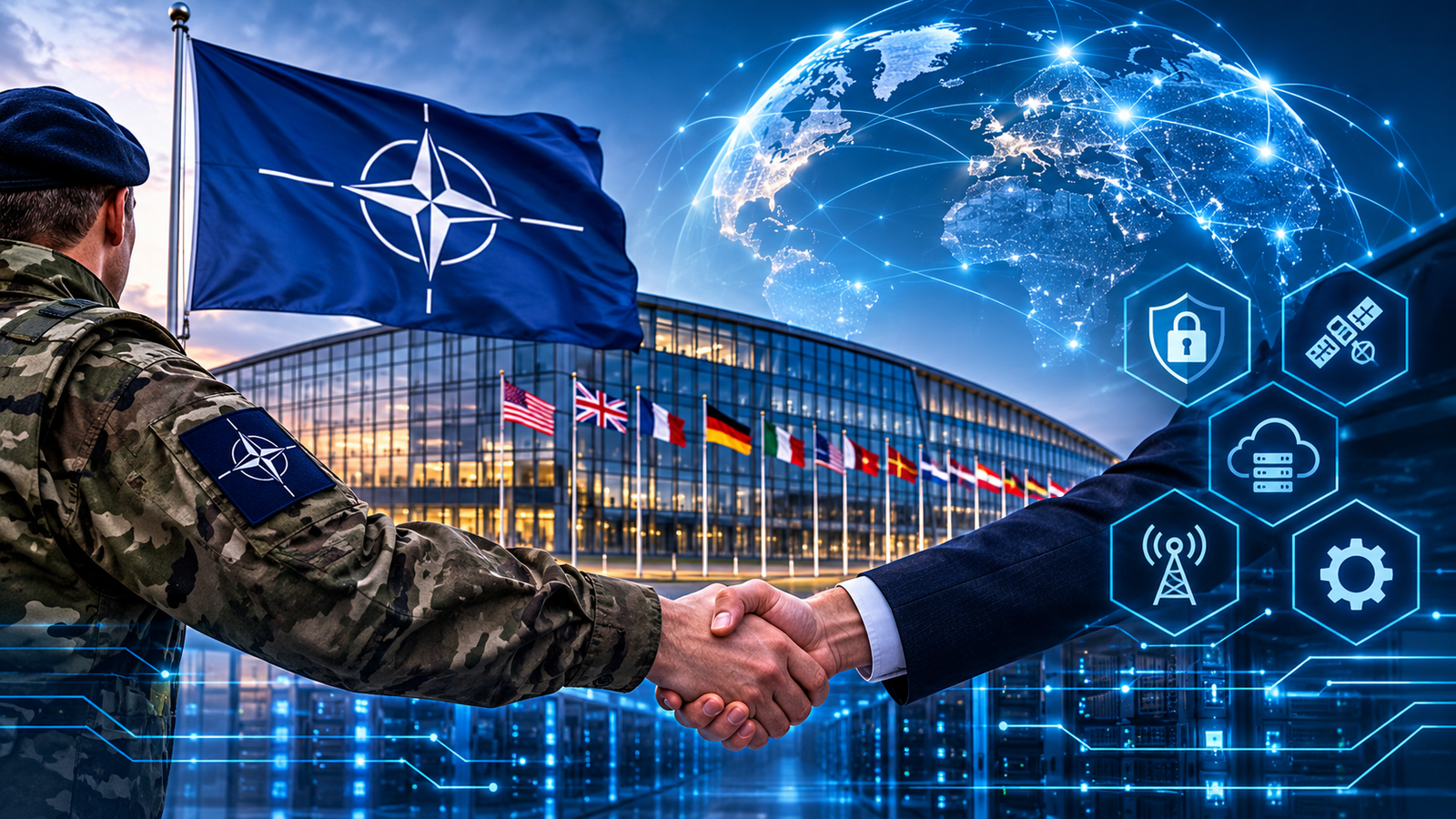
At its annual Cyber Defence Conference in Brussels, the Alliance made the case that defending cyberspace is now a shared job with the private sector, in peacetime, in a crisis and in war.
NATO has never fought a war it did not plan for, but the next one may hinge on networks it does not own. That was the message from NATO Headquarters in Brussels on Wednesday, 18 November 2026, when Allied officials and leaders from the cyber industry met for the Alliance's annual NATO Cyber Defence Conference. The conclusion was clear: NATO intends to deepen its cooperation with the cyber industry in support of Alliance deterrence and defence, through peace, crisis and conflict.
A dependency NATO cannot wish away
The discussion began from a blunt observation. Digital systems and services now underpin collective defence, so they have to keep working when they are needed most. Yet much of what keeps them working sits outside NATO's control.
The Alliance's ability to communicate, to move forces and to sustain operations increasingly relies on civilian and commercial digital infrastructure: cloud platforms, telecommunications networks, undersea cables, satellite services and the software that runs on all of them. Most of it is owned and operated by private companies. A cyber attack that takes down a commercial logistics platform or a regional telecoms provider could slow a military deployment as effectively as a damaged bridge.
Participants drew the obvious conclusion: closer cooperation with the private sector is no longer optional. When the infrastructure is privately run, so is much of the expertise, the threat visibility and the ability to restore service quickly after an incident.
Rehearsing the crisis before it arrives
Jean-Charles Ellermann-Kingombe, NATO's Assistant Secretary General for Cyber and Digital Transformation, focused on preparation. To be ready for a real crisis, he argued, NATO and its partners should "realistically exercise prioritisation, information-sharing, surge support and continuity."
Each of those four words points to a hard practical question:
- Prioritisation: when a provider is under attack and serving thousands of customers, whose systems are restored first, and who decides?
- Information-sharing: how fast can threat indicators move between a company's security operations centre and NATO's cyber defenders, and under what legal and classification rules?
- Surge support: can industry put extra people, tools and capacity at the Alliance's disposal in a crisis, and how is that arranged in advance rather than improvised?
- Continuity: which services must keep running no matter what, and what fallback options exist if they fail?
Ellermann-Kingombe added a fifth element that has quickly moved up the agenda: exercises should also cover the secure use of AI-enabled capabilities and how resilient those capabilities are to disruption. As AI tools are built into both military and commercial systems, they create new dependencies and new points of attack.
Building on a year of closer ties
The Brussels conference did not announce new agreements, programmes or timelines. It is better read as the next step in a relationship NATO has been formalising throughout 2026.
The most concrete milestone came in May. At the International Conference on Cyber Conflict (CyCon) in Tallinn, organised by NATO's Cooperative Cyber Defence Centre of Excellence, the Alliance announced strategic, non-commercial partnerships with Microsoft, Palo Alto Networks and ESET. These cover threat intelligence sharing, best practices and coordinated cyber defence activities. NATO linked the move to the 2023 Vilnius Summit, where Allies agreed to expand cooperation with the private cyber sector.
On the procurement side, the NATO Communications and Information Agency (NCIA) launched a Cybersecurity Dynamic Marketplace in August. The framework is intended to let NATO buy cyber capabilities from industry more quickly as requirements change, across areas such as identity and access management, endpoint protection, cloud security and threat detection.
NATO's cyber outreach also extends beyond industry. In March, Allies met Indo-Pacific partners Australia, Japan, New Zealand and the Republic of Korea in Prague and agreed to deepen cyber defence cooperation, including a shift from "reactive defence" towards "anticipatory resilience."
Why it matters
The Brussels meeting reflects a change in how NATO thinks about cyber defence. For years the debate centred on protecting the Alliance's own networks. The focus now is wider: keeping essential services running across the whole system NATO depends on, much of which belongs to companies rather than governments.
That shift brings real challenges. Companies serve many customers, operate across borders and answer to shareholders and regulators, not to military commanders. Partnerships described as "non-commercial" still have to fit around commercial realities. Sharing sensitive threat information both ways requires trust, legal clarity and secure channels that take time to build. And realistic exercises involving private firms, of the kind Ellermann-Kingombe described, are hard to organise at scale.
NATO's message from Brussels is that this work cannot wait for a crisis. If the Alliance's ability to deter and defend depends on civilian networks, the arrangements for protecting them have to be agreed, tested and practised in peacetime.
What to watch
- Exercises with industry: whether upcoming NATO cyber exercises, such as the annual Cyber Coalition, bring private partners in more fully to test prioritisation, surge support and continuity.
- More partners: whether the May partnerships with Microsoft, Palo Alto Networks and ESET expand to other providers, especially in telecoms, cloud and space services.
- AI security: how NATO turns its attention to AI-enabled capabilities into concrete standards or testing requirements.
- Procurement speed: whether tools such as NCIA's dynamic marketplace actually shorten the time it takes to get industry capabilities into use.
Source: NATO, "NATO and cyber industry leaders discuss enhanced cooperation for cyberspace defence" (19 November 2026). Background drawn from NATO, NCIA and press reporting on CyCon 2026.
Sources
Keep reading
Africa's Cyberdiplomacy at ITU PP-26
From connectivity asks to seats at the table: how African delegations used Doha to push for affordable, secure and fairly governed digital networks, and what they gained.
Just Cyberwar? Applying Just War Theory to State-Sponsored Cyberattacks
Can a cyberattack ever be morally just? Since Stuxnet was discovered sabotaging Iranian centrifuges in 2010, states have increasingly used offensive cyber operations as instruments of statecraft, often as an alternative to,

CBFC Data Breach: What Leaked, What Didn't, and Why It Matters
Confidential scripts, censor cut orders, and private distribution deals linked to 500+ film titles were reportedly exposed online for weeks. Who was responsible? And what does this mean for the security of government portals? #CyberSecurity #DataBreach #CBFC #FilmIndustry #India #CyberDelegate