
Front pageCyber Attacks & Incidents
Port of Santos Nears Administrative System Recovery After Cyberattack
Brazil's main port authority says ship and cargo operations were never halted, while Federal Police investigate the 6 November intrusion into its SAP and document systems.
- Filed
- Read
- 3 min read
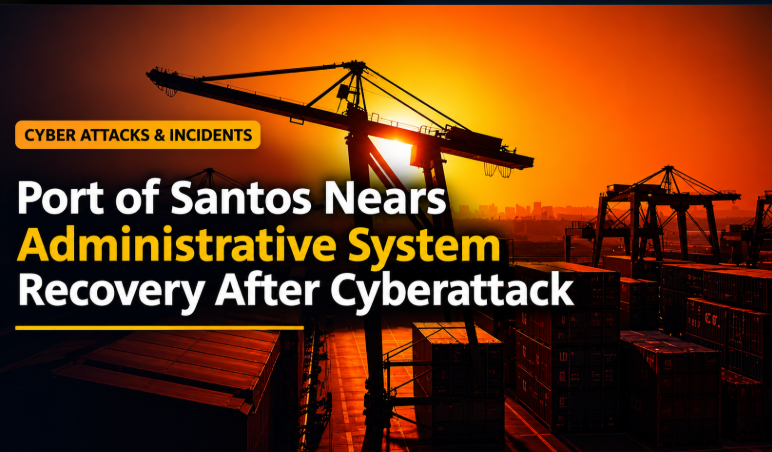
Brazil's Port of Santos is approaching the restoration of its administrative IT infrastructure after a cyberattack disrupted digital services used by the port authority. Ten days after the incident, the recovery process has reached its final testing stage, although some services are still being handled through alternative channels.
The Santos Port Authority (APS) announced on 16 November that its main administrative systems were undergoing final tests. Their restoration is expected to improve communication and service delivery for companies, port operators and service providers that depend on the authority's digital platforms.
Disruption extended beyond the initial outage
The incident affected the digital infrastructure managed by APS, rather than the independent operating systems used by individual port terminals.
Among the affected platforms were SAP, the authority's administrative management software, Docas Digital for internal document circulation, its customer protocol system and the official port website.
Internet and telephone services were unavailable for three days before being restored on 9 November. The institutional website returned with limited functionality on 12 November, while internal systems continued to undergo recovery.
APS had previously reported recovering approximately 70% of the affected file backups. This figure referred to backup recovery, not the proportion of operational systems restored.
The authority has been using email and other alternative communication channels to maintain contact with businesses and service providers while the remaining systems undergo testing.
Port operations continued, but administrative processes slowed
Despite the disruption to its IT infrastructure, APS maintained that vessel movements and access to the port complex continued without interruption. The authority said there was no risk of a shutdown.
However, reports from companies operating at the port indicated that additional security procedures slowed some cargo-handling activities. According to Folha de S.Paulo, tasks including route scheduling, vessel arrival records and billing had to be processed manually.
The distinction is important: the cyberattack did not bring the port's maritime operations to a halt, but the loss of administrative systems created additional work for businesses coordinating activities through the authority.
APS introduced contingency procedures and reinforced Port Guard personnel to maintain security and access arrangements during the recovery period.
Federal Police investigate the incident
Brazil's Federal Police opened an inquiry on 10 November to investigate the suspected intrusion.
The initial investigation has not established the full extent of the incident or whether information was accessed without authorisation. APS has also not confirmed the attackers' identity or their objectives.
The National Data Protection Authority (ANPD) is reviewing the measures adopted by APS, particularly those concerning transparency and the mitigation of potential harm to individuals whose information may have been affected.
Separately, CNN Brasil reported that an internal investigation found malicious software was already present on the APS network before the power outage on 6 November. According to the authority, the malware was activated following the interruption in electricity supply. When it first entered the network remains unknown.
Why it matters
The incident illustrates how disruptions to administrative IT infrastructure can create operational complications even when the physical movement of goods continues.
Major ports depend on interconnected administrative services to coordinate documentation, scheduling, billing and communication with businesses. The unavailability of these systems can force organisations to rely on manual processes, increasing workloads and slowing coordination across the logistics chain.
For critical infrastructure operators, the Santos incident reinforces the importance of maintaining recoverable backups, tested contingency procedures and alternative communication channels. Restoring access to systems is only part of the challenge; ensuring that essential business processes can continue during an extended outage is equally important.
- APS recovery update and affected systems
- Folha – System recovery and operational impact
- Folha – Manual procedures and ANPD response
- CNN Brasil – Malware timeline and contingency measures
- Agência Brasil – Port operations and APS statement
This brief was prepared with AI assistance from the sources above and reviewed by our editors.
Sources
Keep reading
Japan’s Fugaku supercomputer hit by cyberattack, credentials of 4,597 users potentially exposed
RIKEN says attackers breached Fugaku’s OS, potentially exposing data of nearly 4,600 users, prompting a shutdown of operations.
South Korea investigates SSO attack after abnormal access to 300+ government email accounts
The interior ministry says attackers entered via weak local-government networks and exploited a single sign-on weakness; personal data leakage has been reported to regulators.
Kempinski Guests Targeted by Payment Scams After Reservation Data Breach
Attackers used a technology partner’s login to reach guest booking data at Kempinski hotels, then posed as hotel staff to demand payments.