
Ransomware Attack Halts Smart-Meter Production at Japan's Osaki Electric
Japan's Osaki Electric has halted smart-meter production and shipments following a ransomware attack, raising concerns over potential supply-chain impacts on the electricity sector.
- Filed
- Desk
- Ransomware
- Read
- 4 min read
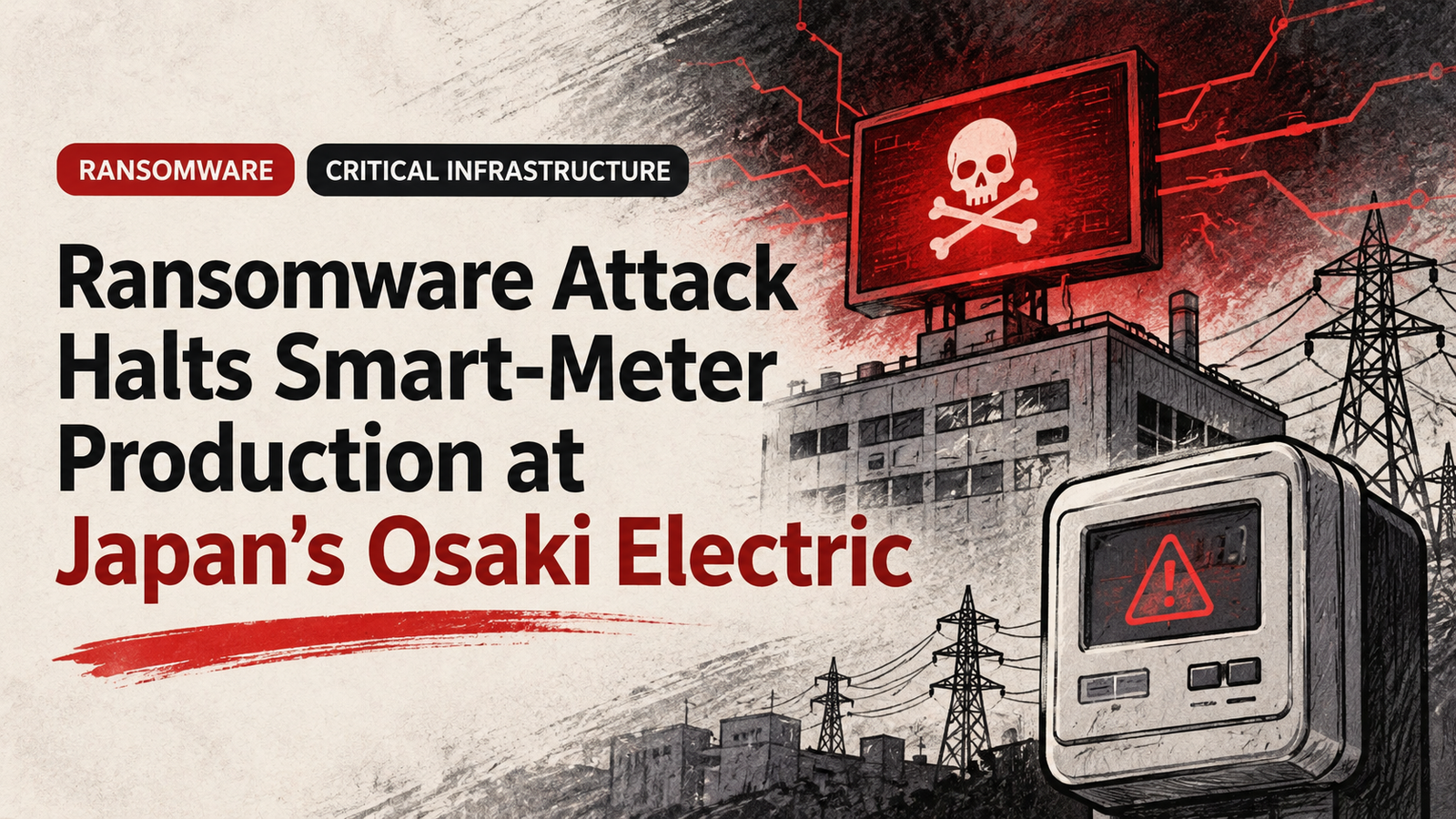
Osaki Electric Co., Ltd., a Japanese manufacturer of electricity meters and smart-meter equipment, has suspended production and shipments following a ransomware attack that encrypted data on its servers.
The company disclosed the incident on 18 November 2026, stating that production-related systems had been shut down at its Saitama facility and two affiliated manufacturing sites. The disruption was discovered on 17 November, and the company has not yet announced when production or shipments will resume.
The incident is significant beyond the company's immediate operations. Osaki manufactures equipment used in electricity measurement and monitoring, placing it within a supply chain that supports the wider energy sector. Although there has been no reported interruption to electricity supply, the manufacturing shutdown raises questions about the potential consequences for equipment availability and delivery schedules.
When the Factory Goes Offline
According to Osaki's disclosure, the company discovered that data on its servers had been encrypted at approximately 10:35 a.m. Japan time on 17 November.
By noon that day, it had disconnected its systems from external networks as part of its response to the incident.
Production-related systems were subsequently shut down at three locations:
- Osaki Electric's Saitama R&D and Manufacturing Center.
- Iwate Osaki Electric Co., Ltd.
- Osaki Platech Co., Ltd.
The company suspended production and shipments of smart meters and other products.
Osaki has established an emergency response headquarters headed by its President and COO. It is working with external specialists on the investigation and recovery process and has informed the police and relevant authorities.
Customers and business partners are also being informed individually.
One distinction worth noting is that 10:35 a.m. represents the time when Osaki discovered the encrypted data. The company has not disclosed when the attackers initially gained access to its systems.
Why a Smart-Meter Manufacturer Matters
For readers unfamiliar with the technology, a smart meter is an electricity-measuring device that automatically records consumption and communicates readings to utility providers.
Unlike traditional meters that often require manual readings, smart meters allow electricity providers to monitor usage remotely and manage billing and distribution more efficiently.
Manufacturers such as Osaki therefore occupy an important position in the infrastructure supply chain.
The production shutdown does not mean that electricity supply to households has been interrupted. Existing installed meters do not automatically stop functioning because their manufacturer's production systems have been compromised.
The potential concern lies further down the supply chain. A prolonged manufacturing and shipment suspension could affect equipment availability for new installations, replacement programmes and electricity infrastructure modernisation.
This is an important distinction in understanding the incident. The attack has disrupted a manufacturer supplying equipment to the energy sector; it has not, based on currently available information, disrupted the electricity network itself.
Qilin's Claim Adds Another Dimension
On 20 November, The Asahi Shimbun reported that the ransomware group Qilin had claimed responsibility for the attack by listing Osaki Electric on its leak website.
The reporting also described sample images allegedly published by the group, reportedly containing company documents and names believed to belong to employees.
However, a ransomware group's leak-site publication should not automatically be treated as independently verified evidence of data theft.
Osaki's original disclosure does not identify Qilin as the attacker. The company has stated that it is investigating the possibility of external data leakage with specialist organisations.
The actual scope of any information exposure remains unknown. There has been no definitive public confirmation of what information, if any, was successfully taken from the company's systems.
The distinction matters because server encryption and information theft are separate aspects of a ransomware incident. While attackers may carry out both, confirmation of encryption alone does not establish that sensitive information was exfiltrated.
For now, Qilin's claim remains part of the developing story rather than a confirmed finding from the company.
A Familiar Problem for Japan's Manufacturing Sector
Japan has experienced other ransomware incidents in which the consequences extended well beyond encrypted computers.
In September 2025, Asahi Group Holdings suffered a ransomware attack that disrupted ordering and shipment operations across much of its Japanese business. The company subsequently confirmed unauthorised access, server encryption and the theft of certain information.
The comparison with Osaki is not about establishing a connection between the attackers or their methods. Rather, both incidents demonstrate how disruptions to supporting IT systems can affect the physical operations of major manufacturers.
There is a tendency to associate ransomware primarily with data breaches and financial extortion. Manufacturing incidents reveal another dimension: when business systems become unavailable, production, distribution and commercial relationships can all be affected.
Osaki's case brings that issue into the context of equipment used by the electricity sector.
The Situation Remains Developing
As of 20 November 2026, Osaki has not announced a production restart date or quantified the financial impact of the incident.
The company is still investigating the possibility of information leakage, while the Qilin attribution and alleged published material remain separate claims requiring further confirmation.
The immediate developments to watch are the restoration of production and shipments, the outcome of the company's investigation and any further disclosure concerning potentially affected information.
For now, the confirmed story is already significant: a ransomware incident has brought production operations at three manufacturing locations to a halt, interrupting the supply of equipment used in electricity measurement.
The broader implications will depend on how long the disruption lasts and what the ongoing investigation ultimately reveals.
Sources
- Osaki Electric – Original ransomware disclosure (Japanese)
- Osaki Electric – Official English investor disclosure
- NOVAIST – Qilin Claims Responsibility for Osaki Electric Attack
This brief was prepared with AI assistance from the sources above and reviewed by our editors.
Sources
Keep reading

Trust and Oversight at the Centre of India's Business Payment Security Concerns
CERT-In highlights how manipulated business records and weaknesses in payment oversight can expose organisations to unauthorised transactions, alongside separate concerns over the growing use of AI-driven offensive frameworks.
FBI Probes Suspected Intrusion Into National Crime Information Center
The FBI is looking into a suspected cyber intrusion involving its National Crime Information Center (NCIC), with details about the affected systems, possible data exposure and those responsible yet to emerge

WhatsApp Fixes Android Flaw That Could Expose Users’ IP Addresses Through Ad Replies
A WhatsApp update closes CVE‑2026‑23871, a bug that let crafted ad‑reply links expose users' IPs and was allegedly used by scammers to boost credibility.