
Sophos Plants Its Flag in Africa — And the Timing Is Not Accidental
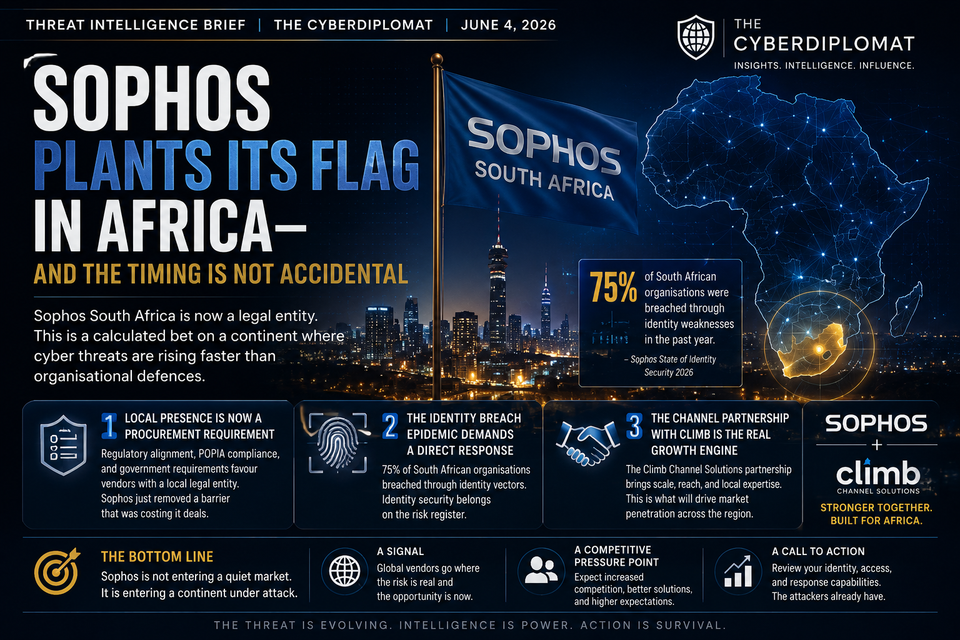
THREAT INTELLIGENCE BRIEF | THE CYBERDIPLOMAT | JUNE 4, 2026
The establishment of Sophos South Africa as a legal entity is more than an administrative milestone. It is a calculated bet on a continent where the cyber threat environment is outpacing organisational defences — and where global vendors are now competing for position.
What Happened
Sophos has formally established Sophos South Africa, a dedicated legal entity to anchor its operations in the country and serve as a launchpad for broader sub-Saharan African growth. The move enables local invoicing, streamlined vendor registration, and in-country hiring — removing friction that has historically slowed enterprise procurement across the region. It coincides with a recently announced distribution partnership with global technology distributor Climb Channel Solutions, which will be managed under the new entity.
Why This Matters Beyond the Press Release
Sophos framing South Africa as a "gateway into Africa" is not marketing language — it reflects a genuine structural reality. South Africa remains the continent's most mature cybersecurity market, with the deepest pool of qualified practitioners, the most developed regulatory environment, and the strongest concentration of multinational enterprises. For a vendor looking to scale across sub-Saharan Africa, Johannesburg is the logical beachhead.
But the timing is what deserves scrutiny. Sophos is not entering a quiet market. It is entering one in active crisis.
The company's own State of Identity Security 2026 report — a vendor-agnostic survey of 5,000 IT and security leaders across 17 countries — found that 71% of organisations globally suffered at least one identity-related breach in the past year. In South Africa, that figure rises to 75%. Three in four South African organisations breached through identity weaknesses in a single year is not a statistic that calls for cautious, incremental investment. It calls for urgency — and Sophos appears to recognise that.
The CyberDiplomat's Assessment
Three dynamics make this move strategically significant for executives to watch.
1. Local presence is now a procurement requirement, not a preference
South African enterprises — particularly in financial services, healthcare, and the public sector — are under increasing pressure to work with vendors that have verifiable in-country presence. Regulatory alignment, POPIA compliance, and government vendor registration requirements all favour locally established entities. Sophos has removed a barrier that was quietly costing it deals. Executives evaluating security vendors should now add "local legal entity" to their procurement checklist — it signals long-term commitment and reduces supply chain risk.
2. The identity breach epidemic demands a direct response
A 75% breach rate through identity vectors in South Africa is an indictment of the current approach to credential and access management across the region. Attackers are not breaking in — they are logging in, using legitimate credentials obtained through phishing, social engineering, or credential stuffing. Sophos's stated focus on AI-powered threat intelligence and expert-led services is positioned directly at this problem. For executives, the lesson is not which vendor to choose — it is that identity security can no longer be treated as an IT sub-function. It belongs on the risk register.
3. The channel partnership with Climb is the real growth engine
The establishment of the legal entity matters, but the Climb relationship is what will determine Sophos's actual market penetration. Climb brings established distribution infrastructure and reseller relationships that Sophos would take years to build independently. Managing that relationship under a local entity — with local invoicing and compliance alignment — significantly lowers the barrier for mid-market and enterprise partners to transact. Watch this space: the partners that move quickly to formalise their Sophos relationship under the new structure will be better positioned as regional demand accelerates.
What Executives Should Take Away
The Sophos move is a signal, not just a news item. Global cybersecurity vendors do not establish legal entities in markets they consider marginal. They do it when they see pipeline, regulatory tailwinds, and a threat environment serious enough to drive spending. South Africa currently has all three.
For business leaders, this raises a practical question: is your organisation's security posture keeping pace with the vendors now investing to address it? If 75% of South African organisations suffered an identity breach last year, the odds are not in your favour — regardless of which vendor you use. The arrival of more sophisticated, locally embedded security providers raises the bar for what "good" looks like. Organisations that have not reviewed their identity and access management controls, credential governance, or incident response capabilities in the past 12 months are already behind.
Bottom Line
Sophos's South Africa entity is a measured, well-timed move into a market that badly needs what it is selling. For competitors, it is a competitive pressure point. For partners, it is a procurement opportunity. For executives, it is a reminder that the global security industry is converging on Africa — because the threat actors already have.
Member discussion