
Starlink-Enabled Drones: The Counter-UAS Fight Is Becoming a Cyber Fight
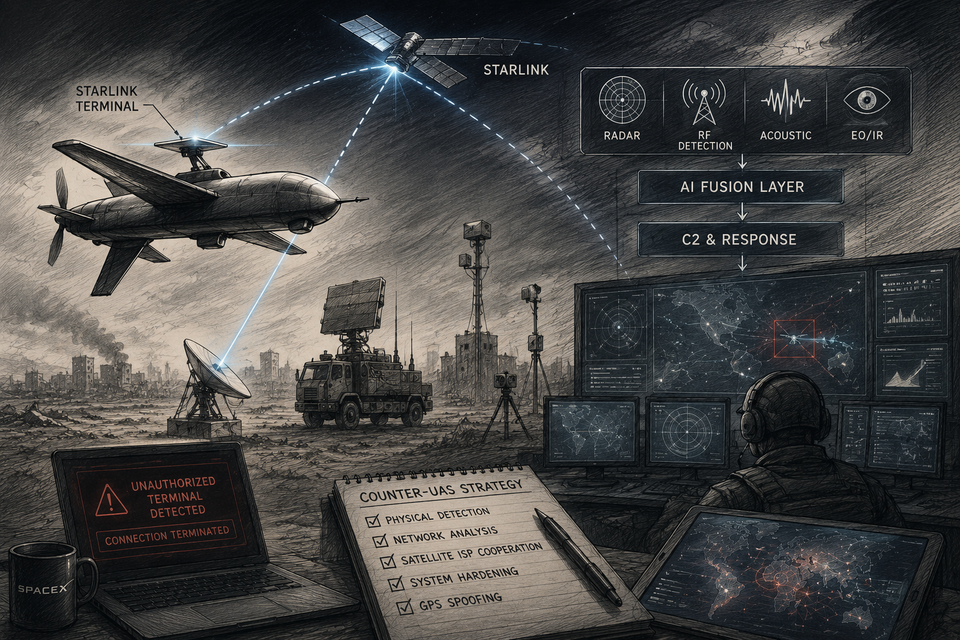
A recent infographic on Starlink-enabled drones lays out the physical-layer case clearly: swapping a drone's 2.4/5.8 GHz radio link for a Starlink terminal turns a short-range, line-of-sight system into one with beyond-line-of-sight range, real-time high-bandwidth data, and no dependence on a nearby ground operator. The counter-UAS response it recommends — radar, RF detection, acoustic sensing, EO/IR, and an AI fusion layer to tie them together — is the correct physical-layer answer. But the more consequential shift is happening a layer up, in the cyber domain, and it is already visible in the war where this technology has been tested at scale.
From RF problem to network problem
Traditional drone counter-measures treat the drone as an RF emitter to be located and disrupted. A Starlink-enabled drone breaks that model in two ways. First, its uplink is a phased-array antenna aimed at the sky, not the horizon, so ground-based jammers sitting outside the antenna's reception cone often can't reach it — which is part of why Ukrainian forces have struggled to jam Russian Geran/Shahed-series drones retrofitted with Starlink terminals. Second, and more importantly, the drone is no longer just a radio-controlled airframe; it is an internet-connected endpoint. Its command-and-control link routes through a consumer satellite ISP, which means the drone inherits every property, and every vulnerability, of that network: authentication to the constellation, firmware on the terminal, encryption (or its absence) on the data path, and dependence on a company's backend to keep the connection alive at all.
That last dependency is the most interesting development so far. When SpaceX discovered Russian forces were using Starlink terminals on strike drones, it pushed emergency software updates to detect and cut off unauthorized use — effectively fighting a battlefield weapons system with an account-suspension mechanism. That is a genuinely new category of counter-UAS tool: not a sensor or a jammer, but backend access control exercised by a private company thousands of miles from the fight. It is also a fragile one. It depends on SpaceX's willingness and ability to keep identifying misuse, and adversaries have already begun adapting, including reports of Russian-developed jamming systems purpose-built to target Starlink's satellite links rather than the drone's downlink.
The exploitable surface nobody drew on the infographic
The physical detection stack — radar, RF, acoustic, EO/IR — answers "where is the drone." It does not answer "what is talking to the drone, and can we get into that conversation." A Starlink terminal is a general-purpose networked device running its own software and firmware, and by default it does not ship with strong encryption on top of the base link; that has to be added by the integrator. Recovered hardware from downed Russian drones has shown miniaturized Starlink terminals paired with embedded computers running full commercial operating systems, which is a meaningfully larger and messier attack surface than a purpose-built military data link. Every one of those components — the terminal's management interface, the onboard computer's OS, the pairing between the two — is a potential point of exploitation, spoofing, or intelligence collection, independent of whether anyone ever jams the RF signal.
This cuts both ways operationally. Defenders who can compromise the terminal or the onboard software gain a route to geolocation, deception, or even control that no amount of radar coverage provides. But the same openness means a defender's own counter-UAS network — sensor arrays, the AI fusion/C2 system depicted in the infographic, and any friendly systems using commercial satellite links for connectivity — face the identical exposure. An AI-driven C2 system that fuses radar, RF, acoustic, and EO/IR feeds is itself a networked target; poisoning or degrading its sensor fusion input is a lower-cost attack than physically destroying a drone.
What this means for counter-UAS strategy
The practical implication is that counter-UAS programs built purely around detection hardware are already fighting the previous generation of the threat. A next-generation approach needs three additions the infographic's framework doesn't cover: network-layer analysis of satellite-terminal traffic patterns (distinct from classic RF signal detection, since a Starlink uplink doesn't look like a conventional drone control signal to a spectrum analyzer), cooperation with satellite ISPs as an active counter-UAS partner rather than a passive infrastructure provider, and hardening of the defender's own fused sensor/AI network against the same class of intrusion the adversary's drone link is vulnerable to. GPS spoofing adds a fourth dimension: because Starlink-enabled platforms often rely on the same satellite-derived positioning data, feeding a spoofed location into the phased-array controller or the drone's navigation system is a viable non-kinetic defeat mechanism that sits entirely in the cyber and signals domain, not the kinetic one.
The infographic's core point still holds: Starlink does not make drones invisible, and physical-layer detection still works because the drone still needs power, navigation, flight capability, and a physical platform. But "detectable" and "governable" are different things. As satellite-relayed drones proliferate beyond the Ukraine conflict into commercial, criminal, and other state actors' hands, the decisive advantage will likely go to whoever treats the counter-UAS problem as what it has actually become: an intrusion-detection and network-security problem wearing an air-defense uniform.
Sources: Unmanned Airspace, Inside Unmanned Systems, Tom's Hardware, CyberDelegate, arXiv (Cyber Threat Landscape Analysis for Starlink), Wikipedia (Starlink in the Russo-Ukrainian War)
Member discussion