
The Dark Side of New Technology
When innovation cuts both ways
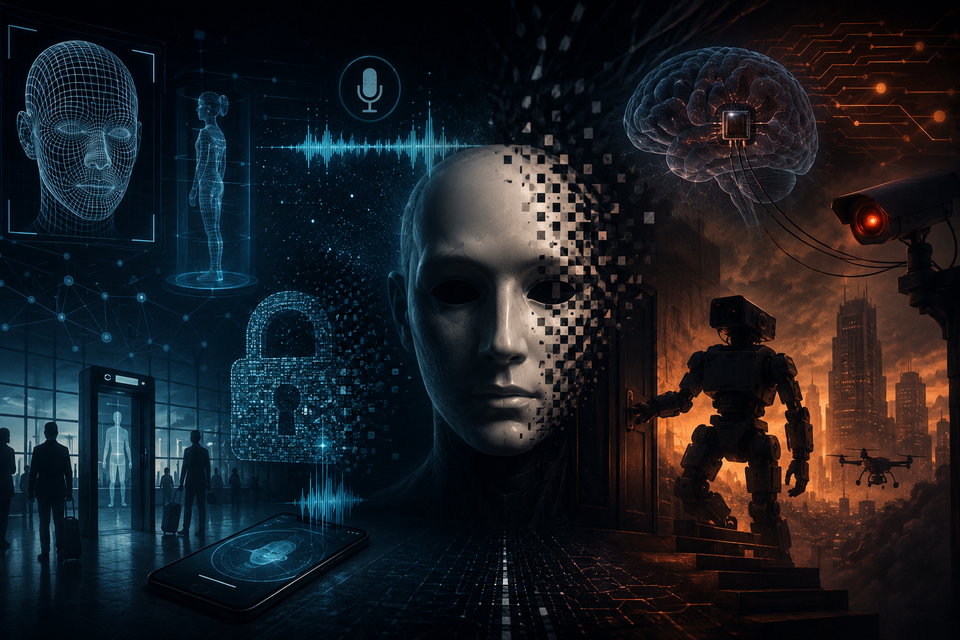
Every generation of technology arrives with a promise: better health, safer cities, more convenient lives. But the same tools that make our world more efficient often carry a second, less comfortable use case. Below are six technologies that were built with good intentions — and the unsettling ways they can be turned against the people they're meant to serve.
Deepfakes: When seeing is no longer believing
Deepfake technology uses machine learning to swap one person's face and voice onto another person's body in video, often with startling realism. Originally explored for film production and dubbing, the same tools can now fabricate speeches, confessions, or scandals that never happened.
The danger isn't just the fake itself — it's the erosion of trust that follows. Once people know convincing fabrications are possible, they can dismiss real footage as fake too, a phenomenon researchers call the "liar's dividend." That corrosion of shared reality may end up being more damaging than any single forged video.
3D body scanning: Convenience with a catch
Body scanners promise a better fit — whether at airport security or in a retailer's fitting room. Companies have experimented with scanning customers to recommend custom-sized clothing, and airports use similar technology to detect concealed items.
The catch is that a 3D body scan is an intimate, permanent data point. Once your exact measurements exist in a database, they're subject to the same risks as any other stored data: breaches, resale, or use in ways you never agreed to. In an era of routine corporate data leaks, handing over a digital replica of your body is a bigger ask than it first appears.
Anonymized data isn't as anonymous as it sounds
Companies and researchers routinely strip names and identifiers from datasets before sharing or selling them, under the assumption that "anonymized" means safe. Repeated studies have shown this assumption is shaky at best. Cross-referencing a handful of details — a birth date, a zip code, a purchase history — is often enough to re-identify a specific individual, even from incomplete records.
This matters because so much of the data economy rests on the idea that anonymization protects privacy. If a supposedly anonymous medical record or shopping history can be traced back to a real name, the entire premise of "de-identified" data sharing starts to look like a legal fiction rather than a genuine safeguard.
Voiceprint recognition: Convenient until it's cloned
Voiceprints let banks and call centers verify a customer's identity by the unique sound of their voice, skipping tedious security questions. It's faster and, in theory, harder to fake than a password.
Except AI-driven voice cloning has caught up. A short recording — sometimes just a few seconds pulled from a voicemail or social media clip — can be enough to synthesize a convincing copy of someone's voice. A security feature designed to stop impersonation has, ironically, created a new one.
Defeating pixelation and blur
Pixelation and blurring have long been the default way to protect someone's identity in photos or video — license plates, faces, sensitive documents. But neural networks trained to "see through" blur have gotten remarkably good at reconstructing what's underneath, including defeating the privacy blurring tools used by major video platforms.
The implication is uncomfortable: a privacy technique millions of people rely on without a second thought may already be obsolete against a well-resourced adversary.
Brain-computer interfaces: Access to the last private space
Brain-computer interfaces (BCIs) were once purely the stuff of science fiction; now companies are racing to build devices that restore movement or sensation to people affected by strokes, paralysis, or neurological disease. The medical potential is enormous.
But a direct line into the brain is also a direct line into a person's thoughts, emotions, and intentions — arguably the last truly private space a person has. If that interface can be compromised, the threat isn't just data theft; it's a form of access that has no real historical precedent, touching cognition and identity rather than just information.
Robots built to open doors — and worse
Robotics companies have made remarkable progress on machines that can navigate stairs, open doors, and search rooms — capabilities pitched for warehouses, disaster response, and search-and-rescue. Some of these same robots, however, are also physically capable of being weaponized or used for surveillance and control rather than rescue, a possibility that unsettles even people who aren't especially prone to dystopian thinking.
The common thread
None of these technologies were built to cause harm. Each solves a real problem: authentication, fit, research, privacy, mobility, physical labor. But every one of them shares a common weakness — they were designed around a best-case user, not a worst-case one. The lesson isn't to fear innovation, but to demand that privacy, security, and misuse-resistance be built in from the start, rather than patched on after the damage is already done.
Member discussion