
The Digital Battleground: Cybersecurity, Fake News, and Kenya's 2027 Election — A Warning for the Continent
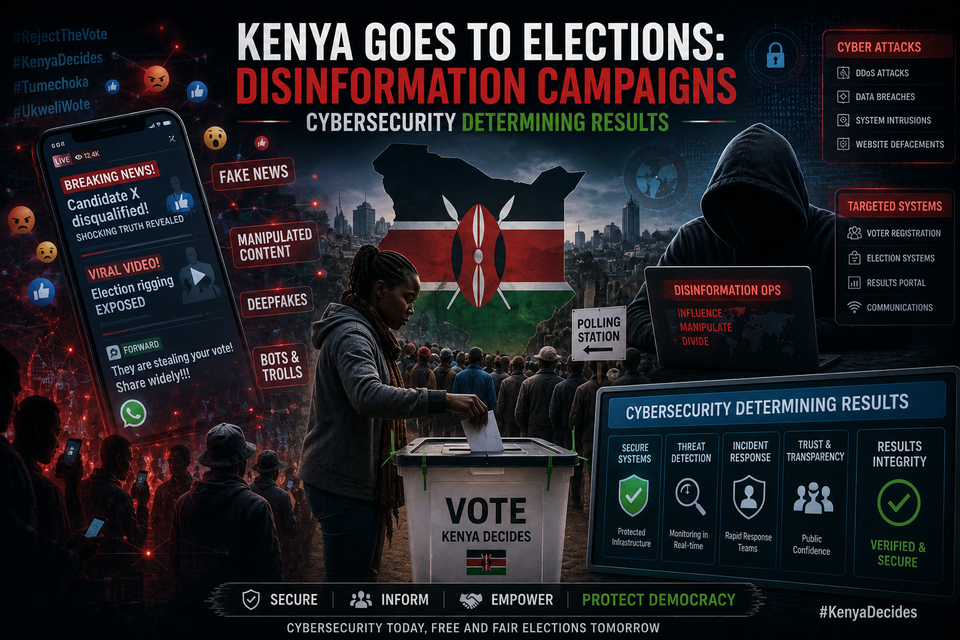
Kenya has never held a clean election in the digital age. Every cycle since 2013 has been shadowed by allegations of hacked servers, coordinated disinformation campaigns, and foreign interference. But 2027 is shaping up to be categorically different — not because the threats are new, but because the tools being used to execute them have become dramatically cheaper, faster, more convincing, and almost impossible to attribute. As Kenya enters the final stretch before its next general election, cybersecurity and information warfare are no longer peripheral concerns. They are the central battlefield.
And what happens in Kenya matters far beyond its borders. East Africa's most digitally connected democracy has long served as a template — for better and worse — for how technology interacts with electoral politics across the continent. The lessons being written right now in Nairobi, in Telegram channels, in AI-generated video studios operating from undisclosed locations, are lessons that will be read in Lagos, Kampala, Accra, Harare, and Dakar.
The Ground Has Already Shifted
The race for Kenya's 2027 general election is already being fought, not on the campaign trail, but in the dark corners of the internet. This year, a wave of coordinated influence operations swept across X, targeting Kenya's political figures and ethnic groups.
An analysis of the 2025 digital ecosystem by the Trust Lab — an EU-funded project involving DW Akademie, Code for Africa, and Siasa Place — documented what is arguably the most sophisticated pre-election disinformation campaign Kenya has seen. Out of 17 major campaigns identified, significant overlap among participating accounts pointed to highly coordinated networks. The operations featured smear campaigns and ethnically charged hashtags vilifying the Kikuyu community, with one campaign generating 6,172 mentions and over 163,000 views, pushing the narrative that the "tyranny of numbers" — the voting strength of large tribes — was dead. Actors circulated forged documents to back the claim, including a fabricated confidential memo from a political party warning of bloc "disintegration" and a fake technical note attributed to the International Foundation for Electoral Systems.
This is not amateur content farming. This is industrial-scale political sabotage.
Deepfakes Enter the Kenyan Campaign
The most alarming development of the current cycle is the deployment of AI-generated synthetic media in active political operations. Two viral videos circulating on social media have sparked debate over the growing role of artificial intelligence in Kenya's political landscape. The first showed Interior Cabinet Secretary Kipchumba Murkomen appearing to admit he was unprepared for the role, calling himself a failure, and announcing his resignation. The second showed an AI-generated image of the Communications Authority Director General allegedly defending a media shutdown during the June 25 protests.
Neither video was real. Both were convincing enough to circulate widely before fact-checkers could respond. This is the fundamental asymmetry of the deepfake problem: production is cheap, detection is slow, and the damage — especially in the highly charged atmosphere of Kenyan ethnic and political identity — is often permanent. The National Intelligence Service Director-General Noordin Haji warned that malicious actors, both domestic and foreign, are weaponising social media and AI to destabilise Kenya, linking the spread of false information to the June 2024 Gen Z protests, which began as demonstrations against proposed tax laws but were allegedly infiltrated by political elements.
TikTok has emerged as the leading platform for the dissemination of misinformation and disinformation in Kenya — a shift from the Facebook and WhatsApp ecosystems that dominated earlier cycles. The platform's algorithmic design, which rewards emotional virality over accuracy, has made it the preferred medium for coordinated operations targeting younger voters, who represent Kenya's fastest-growing electoral bloc.
The Legislative Response: Security or Suppression?
Kenya has moved aggressively on the legal front. President Ruto signed the Computer Misuse and Cybercrimes (Amendment) Act, 2024, at State House on 15 October 2025. The law expands definitions of phishing, cyber harassment, and identity theft, mandates data localisation for Critical Information Infrastructure (CII), requires annual risk assessments, and establishes Cybersecurity Operations Centres.
According to Cabinet Secretary William Kabogo, the 2025 amendment modernises the law to address risks created by Kenya's dramatically expanded digital landscape since the original 2018 act — broader fibre coverage, expanded digital services, thriving fintech, and millions more citizens online. Kenya lost Sh10.71 billion to cybercriminals in 2023.
But the law has generated fierce pushback. There are concerns that the amendment is a knee-jerk reaction to unfavourable social media comments about the government. Shortly after the President assented to the amendments, multiple petitioners including Reuben Kigame and the Kenya Human Rights Commission filed constitutional petitions challenging sections of the Act, arguing that expanded definitions of "publication of false information" and broader investigative powers for law enforcement could infringe on freedom of expression and privacy.
This is the core tension that Kenya — and Africa more broadly — has not yet resolved: the same legal instruments required to combat genuine disinformation and electoral interference can, in the wrong hands or with ambiguous drafting, become tools for suppressing legitimate political opposition and journalism. The line between protecting electoral integrity and criminalising dissent is dangerously thin.
The government has also gone directly to the platforms. Information, Communications, and Digital Economy CS William Kabogo met with TikTok's leadership to demand transparency regarding the app's internal defences against fake news and organised disinformation campaigns, seeking a firm guarantee that the platform would protect Kenya's information landscape during the 2027 election. Kabogo noted that social media giants must take more responsibility for content they host, especially when citizens head to the polls.
The Electoral Infrastructure Problem
Disinformation is only one dimension of Kenya's cyber-election challenge. The integrity of the physical and digital infrastructure of the vote itself remains an open wound from previous cycles.
In the 2017 general election, the opposition alleged that the IEBC's database had been hacked, creating an 11% gap in favour of the incumbent President. The court petition that followed resulted in the nullification of the presidential election — a historic first in Africa. In 2022, allegations of server interference surfaced again, and while the IEBC uses both digital and physical forms to make the final presidential declaration, the dual system has not fully resolved public confidence questions about the digital layer.
As 2027 approaches, civil society is pushing for transparency. An activist has petitioned the IEBC to publicly acknowledge spyware and AI-driven interference risks and to outline the threat model applicable to all electoral assets, including the Kenya Integrated Election Management System (KIEMS) kits. The petition also calls for a published cybersecurity framework covering asset inventory, penetration testing, independent code review, supply-chain controls, incident response, and post-election audits — within 60 days.
The IEBC has not yet publicly responded to the petition with the detail it demands. That silence is itself a political signal.
Kenya's broader cyber exposure is significant. The Communications Authority reported 2.54 billion cyber threat incidents in the first quarter of 2025 alone — a 201.7% increase from the previous quarter. In 2023, Kenya lost an estimated $83 million to cybercrime, placing it second in Africa behind Nigeria. A country processing that volume of threats in ordinary times faces a qualitatively different challenge when election season drives up the targeting of government, media, and electoral systems simultaneously.
What This Means for Africa
Kenya is not an outlier. It is a preview.
What is emerging across the continent is a framework of "disinformation disparity," where polarising domestic rhetoric is harvested, amplified, and redistributed at scale through networks involving political actors, influencers, consultants, bot systems, and external digital ecosystems. The doctrine is straightforward: discredit candidates, attack institutions, delegitimise electoral processes, and create confusion during elections.
The infrastructure for this already exists across Africa. In Uganda ahead of the 2021 elections, campaigns deployed doctored images, falsified videos, and untrue text to pollute democratic debate. In Angola in 2022, the ruling party deliberately deployed digital disinformation to smear the opposition's presidential candidate through malicious hashtag campaigns. In Nigeria in 2023, concerns arose about manipulated videos circulating during the presidential elections.
Deepfakes have also been specifically weaponised against women in politics and journalism during elections in Ghana, Senegal, and Namibia, with findings indicating that deepfake attacks inflict lasting socio-cultural, professional, and psychological harm — with violence often spilling over into offline spaces.
The continent's response has been uneven. In August 2025, representatives of Electoral Management Bodies and regional economic communities gathered in Abuja for a Regional Workshop on Protecting Elections in the Information Environment, hosted by ECOWAS and supported by the EU, acknowledging that African elections are increasingly shaped by narratives in the digital space rather than decisions at polling stations. But workshops and frameworks are not enforcement. The ECOWAS region alone encompasses more than a dozen states with vastly different cybersecurity capacities, legal frameworks, and platform accountability regimes.
Both Kenya and Nigeria were beachheads for Cambridge Analytica, the British political consultancy that attempted to influence elections in both countries — Nigeria in 2015, Kenya in 2017. The ecosystem that made those operations possible has not been dismantled; it has evolved.
The Three Structural Vulnerabilities
Across Kenya and the continent, three structural vulnerabilities stand out.
The first is platform impunity. Social media companies operate largely without enforceable accountability in African jurisdictions. Content moderation resources — human reviewers with local language expertise, algorithmic tools trained on African political context — are thin compared to European and North American markets. The same operation that might be detected and removed within hours in Germany can circulate for weeks in Kenya.
The second is attribution asymmetry. Coordinated disinformation campaigns are, by design, difficult to trace. Deepfake political clips, fabricated leaks, imitation news websites, manipulated videos, and bot-driven outrage are increasingly likely to become routine features of election campaign cycles — and in most African states, no agency has the forensic capacity to trace their origins quickly enough to matter.
The third is the trust deficit. Kenya's elections have never fully escaped suspicion of manipulation since the disputed 2007 vote that led to post-election violence killing over 1,000 people. When faith in leadership is eroded by lies, social cohesion unravels. In 2027, the contest may not merely be at the ballot box — it could be a struggle for truth itself, between credible information and a relentless tide of fabrications designed to mislead. In that environment, even accurate information becomes suspect, and that epistemic chaos is itself the objective.
What Needs to Happen
Kenya's 2022–2027 National Cybersecurity Strategy provides a viable framework for bolstering a secure and resilient cyberspace, emphasising government commitment to working with national and international stakeholders given the cross-cutting nature of cyber threats. That framework now needs to be operationalised specifically around the election cycle, with the IEBC as a designated critical information infrastructure asset receiving the same protection as financial systems and government servers.
Across the continent, what is needed is not another framework document but enforceable platform obligations — requiring companies operating in African markets to invest in local-language content moderation, to report coordinated inauthentic behaviour proactively to electoral commissions, and to provide electoral bodies with real-time transparency data during campaign periods. The EU's Digital Services Act model offers a reference point, even if adaptation to African contexts is necessary.
The deepfake challenge, specifically, requires investment in public media literacy at scale — not pamphlets and workshops, but structural changes to how schools, public broadcasters, and community media organisations equip citizens to interrogate what they see and share. Policymakers must strengthen legal frameworks to require labels for AI-generated content and mandate disclosure of political advertising sources.
Kenya is, in many respects, better positioned than most African states to confront this challenge. It has a functioning judicial system willing to nullify an election. It has a civil society sector with real digital forensic capacity. It has a history of media institutions willing to do serious fact-checking work. What it lacks is speed — the speed to match the velocity at which AI-generated lies can now be produced and distributed.
In 2027, that speed gap may be the deciding factor. And if Kenya cannot close it, the continent is watching, and learning the wrong lessons.
Member discussion