
The Hidden Camera in Whitehall: Why Diplomatic Impunity Is Becoming the West's Most Dangerous Blind Spot
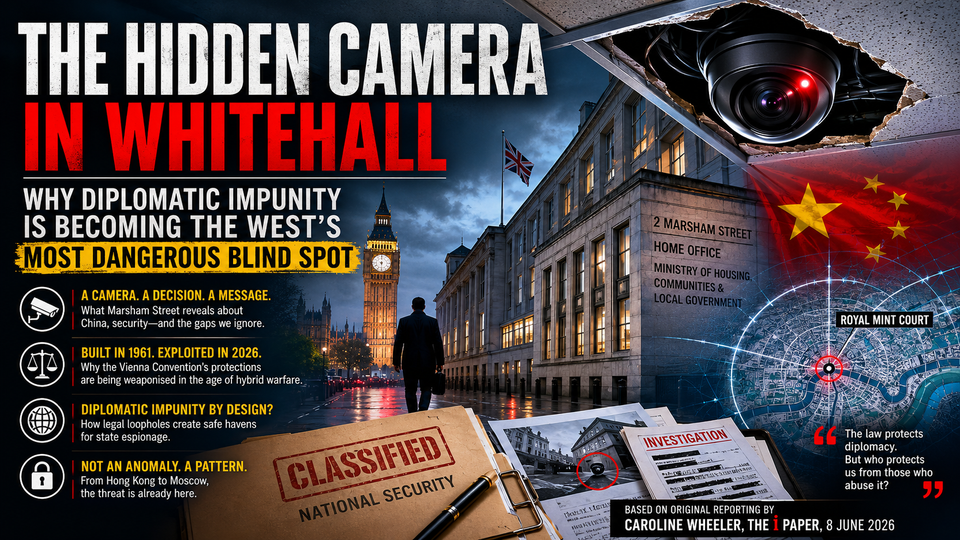
The discovery of a hidden camera in the ceiling panels of a building housing both the Home Office and the Ministry of Housing, Communities and Local Government is not, in isolation, a shocking event. Espionage has been a fact of statecraft since long before the Vienna Convention codified the rules of diplomatic conduct in 1961. What makes this incident striking — and deeply uncomfortable — is not the camera itself, but the specific context in which it was found, and what that context exposes about the widening gap between international law and the realities of modern intelligence warfare.
The Location Is the Message
The Marsham Street building was not chosen at random — if, indeed, it was chosen at all. Among the most consequential decisions taken there in recent months was the approval of China's proposed new mega-embassy at the Royal Mint Court site in London. As the i Paper has reported, that site sits in proximity to fibre-optic cables carrying vast quantities of sensitive financial data out of the City of London. Intelligence officials had flagged the cables as potentially vulnerable. A camera placed in a communal area of that very building, during the period in which those deliberations were taking place, raises questions that go far beyond a routine security breach.
The precise origin of the device remains unknown. There is, as the i Paper makes clear, no confirmed attribution to any state actor. But the context — a building at the nerve centre of decisions touching on national security, Chinese diplomatic ambitions, and infrastructure protection — means that questions of attribution will not go away, however long investigators take to answer them.
Diplomatic Impunity: A 1961 Framework for a 2026 Problem
The Vienna Convention on Diplomatic Relations, adopted sixty-five years ago, was designed for a world of paper files and face-to-face meetings. At its heart is a principle of international law granting foreign diplomats protection from legal action in the host country, ensuring they can perform their duties without fear of coercion or harassment. That principle remains broadly sound. What has collapsed is the assumption that the activities it might inadvertently shield would remain within recognisable limits.
The 1961 structure did not foresee cybercrime, electronic espionage, or international organisational networks. Consequently, the provisions of immunity can unintentionally establish safe havens for operations that do not fit within traditional diplomacy.
In plain terms: the legal architecture protecting diplomats was built before it was possible to plant a surveillance device the size of a coat button in a ceiling tile, transmit footage wirelessly to a foreign capital, and leave no fingerprints. The Vienna Convention was not designed for miniaturised hardware or the kind of hybrid intelligence operations — blending human assets, cyber intrusion, and covert physical surveillance — that characterise state espionage today.
The Persona Non Grata Problem
When a diplomat is caught spying, the host country's legal options are limited. The ordinary response is rarely prosecution, because immunity will usually block criminal jurisdiction over a serving diplomatic agent. The common legal route is persona non grata under Article 9. That mechanism allows the host state to expel the individual — but only if they can identify who placed the device in the first place, and only if that person holds diplomatic status.
A covert camera in a ceiling panel is precisely the kind of operation designed to evade that threshold entirely. If the device was placed by a contractor, a cleaner, a maintenance operative, or anyone without diplomatic accreditation, the Vienna Convention offers the host state no special remedy at all. The suspected beneficiary — a foreign intelligence service operating through cutouts — remains entirely insulated.
Diplomatic and consular personnel remain immune from prosecution for espionage because of their privileged status — a protection which encourages the illegal act. If the receiving state is to remedy the situation, it must first demonstrate that diplomatic personnel have abused their status. Such a showing could create a conflict with domestic statutes and would be in itself a breach of treaty law.
The result is a structural deadlock. Suspected state actors cannot be prosecuted. Non-diplomatic operatives cannot claim state backing without exposing their handlers. And the political calculus of formally accusing a sovereign government — particularly a permanent member of the UN Security Council — is so complex that attribution is often quietly buried.
The Chinese Embassy Dimension
The overlap with the Royal Mint Court decision is impossible to ignore. The UK government approved the mega-embassy despite sustained intelligence community concern. The Government agreed with China that the publicly accessible forecourt of the embassy grounds would not have diplomatic immunity — an unusual concession that itself acknowledges how the immunity framework can be weaponised when attached to physical real estate.
That negotiation reflects a growing awareness in Whitehall that diplomatic premises are not simply spaces for protocol and representation. They are, in the assessment of multiple intelligence agencies, potential platforms for surveillance, signal interception, and the projection of foreign state power into the host nation's critical infrastructure. The agreement to carve out a diplomatic immunity exemption for a forecourt is, in its way, an admission that the framework needs to be actively managed — not assumed to be self-regulating.
A Pattern, Not an Anomaly
The camera at Marsham Street does not sit in isolation. It is one data point in a pattern that includes the prosecution of individuals charged with assisting Hong Kong intelligence services to conduct surveillance against exiled activists on British soil; the discovery of a hidden Chinese tracking device in a UK government vehicle; the Ministry of Defence's ban on Chinese-component electric vehicles from sensitive military sites; and the alleged Kremlin-linked hacking of then-Foreign Secretary Liz Truss's phone, which was reportedly so compromised it had to be placed in a secure safe.
Russia expelled a British diplomat on espionage allegations as recently as March 2026 — a reminder that this dynamic runs in both directions, and that the tit-for-tat expulsion of diplomats under Article 9 has become a regular feature of UK-Russia relations. What is less visible, and more corrosive, is the activity that never reaches the threshold of expulsion. newsonair
What Accountability Looks Like — and What It Doesn't
The shadow minister Alex Burghart has called for an urgent investigation, asking who was responsible, how long the device was in place, and whether classified information was compromised. These are the right questions. But they assume that accountability is available if only the political will exists to pursue it.
The harder truth is that a receiving state may suspect espionage, propaganda, abuse of premises, or serious private misconduct by diplomatic personnel. Even then, the basic prohibitions against arresting diplomats, entering mission premises, or seizing archives remain central to international order. The law, as currently constructed, prioritises the stability of diplomatic relations over the prosecution of those who abuse them.
While immunity is intended to protect diplomacy, it has led to situations where governments are often powerless to intervene, creating a legal grey area where diplomatic privilege meets moral and legal controversy.
The Whitehall camera is a physical manifestation of that grey area. Whether it was placed by a state actor, a rogue operative, or someone else entirely, it represents the logical endpoint of a world in which the infrastructure of diplomatic impunity has outpaced the political resolve to reform it. Until that changes — through either multilateral treaty reform, bilateral security agreements with enforceable teeth, or a fundamental rethinking of what counts as a "diplomatic function" in the age of hybrid warfare — the ceiling tiles of Whitehall will remain a vulnerability that no amount of CCTV can fully address.
The i Paper's original reporting by Caroline Wheeler, published 8 June 2026, formed the basis for the factual account of the Marsham Street incident in this article.
Member discussion