
The Mediators' Bargain: Qatar, Pakistan, Iran and the Coming Storm for FATF and the Parallel Economy
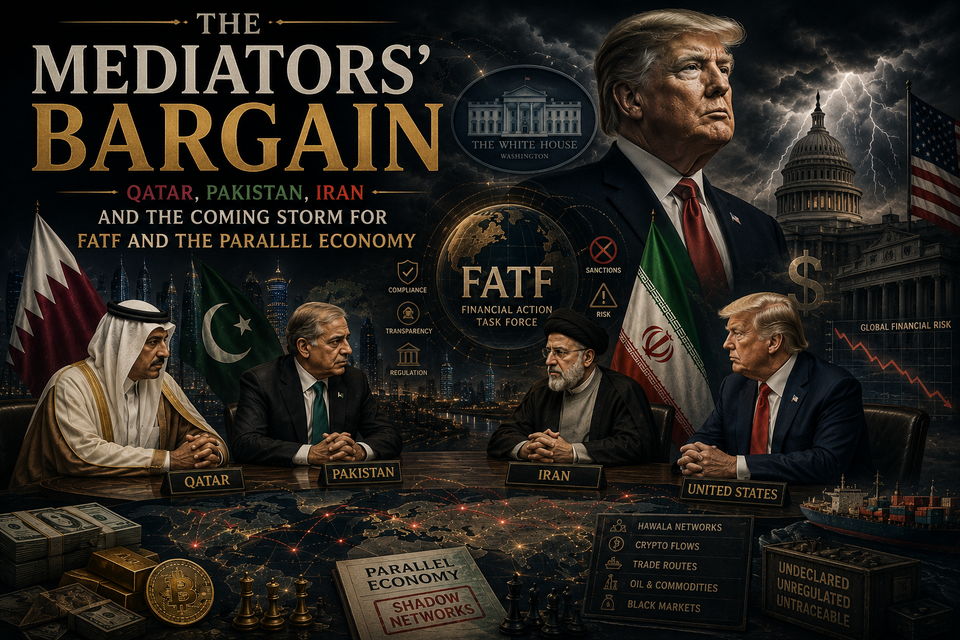
A follow-up analysis to the G7 Évian Summit, June 2026
Introduction: The Deal Made in the Shadows of the G7
While world leaders gathered at Évian-les-Bains for the 52nd G7 Summit, a parallel diplomatic drama was unfolding 400 kilometres away at the Bürgenstock Resort in Lake Lucerne, Switzerland. On June 21, 2026 — the very day the G7 summit was concluding — a quadrilateral meeting convened between the United States, Iran, Pakistan, and Qatar. The format was deliberate: Pakistani Prime Minister Shehbaz Sharif, Army Chief Field Marshal Asim Munir, and Qatari mediators sat alongside JD Vance and Special Envoy Steve Witkoff to negotiate an end to the 111-day US-Iran war.
Iranian Foreign Minister Abbas Araghchi declared "major progress," including the establishment of a de-confliction cell for Lebanon, a sanctions moratorium on Iranian oil exports, and — most consequentially for the global financial system — agreement to make Iran's frozen overseas assets "fully available" to Tehran's central bank, subject to benchmarks. Those assets are estimated at between $124 billion and $167 billion.
On June 22, 2026, the same day President Trump signed Executive Order 14409 on post-quantum cryptography, OFAC issued General License X, authorising transactions ordinarily incident to Iranian crude oil exports through August 21, 2026. The diplomatic and financial architecture was shifting simultaneously on multiple planes.
This analysis examines what the triangular mediation role of Qatar and Pakistan — both deeply embedded in Iran's parallel financial ecosystem — means for FATF's enforcement architecture, the cybersecurity of illicit financial networks, and the governance of the shadow economy that has flourished precisely because Iran remained on the FATF blacklist for nearly two decades.
Part I: Understanding the Mediators — Who Qatar and Pakistan Are in This System
Qatar: Trusted Broker, Dual-Use Financial Hub
Qatar occupies a uniquely paradoxical position in global financial governance. It is not a full FATF member in its own right — it participates through the Gulf Co-operation Council — yet it has served as the world's most indispensable backchannel for negotiations with sanctioned and blacklisted states, including Iran, the Taliban, and Hamas. Doha has hosted Hamas's political bureau for years and served as the primary conduit for the $6 billion in Iranian frozen funds that were unlocked under the Biden administration's 2023 hostage-for-funds framework.
Qatar's financial system has attracted sustained scrutiny. The UAE was added to the FATF grey list in 2022 partly for failures in monitoring Gulf financial flows — flows in which Qatari intermediaries play a substantial role. Nations such as Bahrain, Egypt, Saudi Arabia, and Qatar have been repeatedly identified as insufficiently preventing the flow of funds for terror financing in other nations, though Qatar has avoided formal listing.
Qatar's role as mediator is not merely diplomatic. It is financial. Doha controls the pipes through which frozen Iranian assets flow, through which Qatari-based exchanges and funds facilitate transactions that formal banking cannot, and through which the informal bridge between Iranian state finance and the global economy has been maintained. The Bürgenstock mediation formalises Doha's position as Iran's financial gateway — with Western acquiescence.
Pakistan: The Hawala Backbone and the Crypto Pivot
Pakistan's role is structurally different but equally consequential. The country shares a 900-kilometre border with Iran and has served for decades as a primary corridor for informal value transfer into and out of the Iranian economy. Pakistani hawala networks — built on centuries-old hundi trust relationships — move billions in remittances and trade finance that never touch the formal banking system.
Pakistan itself was removed from the FATF grey list in 2022, after sustained reform efforts. But its financial system remains deeply vulnerable to hawala misuse, particularly along the Iran-Pakistan corridor. FinCEN's October 2025 Financial Trend Analysis identified $9 billion of potential Iranian shadow banking activity in 2024 alone, with significant flows routed through Pakistani and Afghan intermediaries.
Now Pakistan has made a pivotal move. In April 2026 — weeks after signing a cryptocurrency agreement with World Liberty Financial, the Trump family's DeFi company — the State Bank of Pakistan rescinded its 2018 ban on cryptocurrency, authorising regulated financial institutions to serve licensed Virtual Asset Service Providers. Pakistan simultaneously drafted the Virtual Assets Act 2026 and established the Pakistan Virtual Assets Regulatory Authority (PVARA).
The sequence is striking: deal with a Trump-aligned crypto firm → new crypto laws → banking access for crypto providers. Field Marshal Asim Munir, who led Pakistan's delegation at Bürgenstock, is simultaneously the man who negotiated Pakistan's crypto opening with the Trump administration. He now sits at the centre of two intersecting systems: the diplomatic mediation framework for Iran's financial rehabilitation, and the new infrastructure through which digital assets will flow through Pakistan's economy.
Part II: FATF — What the Iran Deal Does to the Architecture
The Blacklist Problem That Won't Disappear Overnight
Iran has been on the FATF blacklist continuously since 2008. As of the June 19, 2026 FATF Plenary — held in Paris just days after the G7 summit — Iran remains on the blacklist alongside North Korea and Myanmar. FATF explicitly confirmed at the June plenary that Iran "continues to fail in criminalising and prosecuting terrorist financing adequately, poses ongoing proliferation financing risks, and has not implemented targeted financial sanctions or ratified key international instruments."
This creates an immediate and severe legal problem for the sanctions relief architecture being constructed at Bürgenstock. OFAC General License X authorises certain Iranian oil transactions for US-nexus purposes. It does not dissolve the FATF blacklist designation. It does not obligate European banks, Asian correspondent institutions, or Gulf financial intermediaries to engage with Iranian entities. And it does not remove the criminal liability exposure that any financial institution faces when dealing with a FATF-blacklisted counterpart.
In other words, the diplomatic deal is running approximately two to three years ahead of the financial infrastructure needed to implement it. Banks remain reluctant. As former IMF Deputy Director Adnan Mazarei noted in June 2026: "There's vagueness and ambiguity. Banks are unwilling to take risks because many have been heavily penalised by the US for doing business with Iran."
The FATF Blacklist-Removal Timeline and Its Implications
For Iran to be removed from the FATF blacklist, it must ratify the Palermo Convention and the Terrorist Financing Conventions, implement targeted financial sanctions, demonstrate credible prosecution of terrorist financing, and pass a FATF mutual evaluation — a process that typically takes years. Even countries that have made genuine reforms have spent 18-36 months navigating the removal process.
This timeline mismatch is not a technical inconvenience. It is a governance catastrophe in waiting. If Iran gains access to $124-167 billion in frozen assets and restored oil revenues while remaining on the FATF blacklist, the result will be the largest single injection of capital into a FATF-blacklisted economy in the organisation's history. The $300 billion reconstruction fund envisioned in the MoU — funded by "investment from other countries" per JD Vance — would, if realised while Iran remains blacklisted, create compliance obligations that virtually no major financial institution can meet without violating their own AML frameworks.
The practical result: formal institutions will stand aside, and the parallel economy will step forward to fill the gap.
How the Grey-Listed and Non-Listed Mediators Fill the Vacuum
This is where Qatar and Pakistan's mediation roles become financially structural, not merely diplomatic. If formal banking cannot service Iranian reconstruction finance because of FATF constraints, the capital flows through the systems that have always served Iran: hawala networks, cryptocurrency rails, Gulf-based exchange houses, trade finance mis-invoicing, and the constellation of Qatari, Pakistani, and Emirati intermediaries who have managed Iran's shadow economy for decades.
The Global Initiative Against Transnational Organized Crime described these systems precisely in March 2026: "These flows are sustained by illicit finance and laundering networks, including hawala systems, trade-based money laundering and cryptocurrency — through Gulf intermediaries. Together these function as a parallel treasury."
The MoU does not dismantle this parallel treasury. It validates the states that operate it as legitimate interlocutors — and potentially directs billions of dollars of newly unlocked Iranian capital through its channels by default.
Part III: The Cybersecurity of the Parallel Economy
The Digital Infrastructure of Iran's Shadow Finance
Iran's parallel economy does not operate through interpersonal trust alone. It has, over the past decade, built a sophisticated digital infrastructure for moving value outside the formal banking system — and that infrastructure is now deeply integrated with the IRGC's cyber capabilities.
The Australian Government's Department of Foreign Affairs and Trade catalogued Iran's shadow banking toolkit in late 2025: hawala-style transfers, informal money transfer networks, cryptocurrency channels (particularly Bitcoin and Tether mined domestically), front-company invoicing, barter and oil-for-goods schemes, and peer-to-peer unlicensed lending. The common thread is that technological revolutions like AI, cryptocurrency, and blockchain have made these transactions increasingly untraceable.
TRM Labs' 2026 Crypto Crime Report confirmed that Iran and Venezuela relied on crypto for sanctions-constrained payments and financial services at scale in 2025. Cryptocurrency addresses have been attributed to the Islamic Revolutionary Guard Corps itself, as well as to Houthi financing network Ansarallah, Hamas-linked entity Herzallah Exchange and General Trading Company, and North Korea's Cheil Credit Bank. The IRGC is not merely a user of the crypto parallel economy; it is an architect of it.
The Convergence: Cyber Operations and Financial Flows
The most significant and underappreciated risk emerging from the Bürgenstock framework is the convergence between Iran's offensive cyber capabilities and its parallel financial infrastructure. These are not separate systems. They are the same system, viewed from different angles.
As established in our previous analysis, the IRGC's 3,000 cyber battalions — trained and equipped with Chinese advisers and Chinese technology — operate across both domains. IRGC cyber units embed access inside targeted networks months or years before any overt operation. The same patient, pre-positioned methodology applies to financial networks: front companies, exchange houses, and hawala brokers establish relationships inside compliant jurisdictions long before capital flows are needed.
The result is that the cyber and financial parallel economies are mutually reinforcing. Cyber operations generate intelligence about vulnerabilities in financial institutions. That intelligence informs which hawala nodes are safe to use and which are under surveillance. Cryptocurrency wallets controlled by IRGC-affiliated entities sit on the same blockchains as legitimate commercial transactions. The enforcement challenge is not merely identifying suspicious transactions — it is distinguishing them from legitimate activity on infrastructure that has deliberately been designed to blur that line.
Pakistan's crypto opening makes this problem geometrically more complex. A newly regulated VASP ecosystem in Pakistan, operating on the same blockchains as IRGC-attributed wallets, creates vectors for layering that did not exist under the 2018 ban. The fact that Pakistan is now both a FATF-compliant country (removed from the grey list in 2022) and a primary diplomatic and informal financial intermediary for Iran creates a compliance paradox: enhanced due diligence on Pakistani crypto entities is difficult to justify under formal FATF frameworks, even as the risk of Iranian fund flows through those entities is elevated.
Qatar's Digital Financial Infrastructure
Qatar operates one of the Gulf's most sophisticated digital financial sectors, hosting numerous cryptocurrency exchanges, digital payment platforms, and financial technology companies. The Qatar Financial Centre (QFC) provides a regulatory framework that has attracted a growing cohort of virtual asset service providers.
In the context of Iranian sanctions relief, Qatar's digital financial infrastructure performs a dual function. On the surface, it provides a compliant, regulated environment for legitimate capital flows. Beneath that surface, the same infrastructure — the same banks, exchange houses, and digital platforms — has historically served as the conduit through which Iranian frozen assets move, through which Hamas operational financing flows, and through which the Gulf's various shadow finance networks settle accounts.
FATF's July 2025 comprehensive report on terrorist financing risks specifically highlighted the role of Gulf intermediaries in enabling terrorist financing through a combination of unlicensed remittances, hawala networks, and mobile money platforms. Qatar's exemption from formal FATF listing does not resolve this structural reality.
Part IV: What Happens When the Money Starts Moving
The Frozen Assets Problem: $124-167 Billion Looking for a Channel
The MoU's commitment to make Iran's frozen assets "fully available" to its central bank represents a technical, legal, and financial governance challenge of extraordinary scale. For context: the entire annual illicit financial flows attributed to Iran by FinCEN in 2024 were estimated at $9 billion. The frozen assets represent 14-18 times that figure.
These assets exist in banks across Asia, Europe, and elsewhere. They have been frozen not merely by OFAC designation but by the intersection of US secondary sanctions and FATF blacklisting, which together have created a compliance environment where the reputational and legal risk of transacting with Iranian entities is prohibitive for any institution that operates in dollar-clearing markets.
Releasing these funds while Iran remains on the FATF blacklist does not create a functioning channel. It creates pressure on informal channels. Hawala brokers in Karachi, Dubai, Istanbul, and Kuala Lumpur will be the first to move capital that formal banks cannot touch. Cryptocurrency platforms — particularly those operating from jurisdictions with lighter AML enforcement — will provide the rail for layering. Trade-based money laundering through mis-invoicing will be the mechanism for bringing oil revenues into the Iranian economy while concealing their origin.
The scale of this activity, if the MoU is implemented, will exceed anything FATF or its member states' financial intelligence units have previously encountered from Iran.
The AI Acceleration
One additional dimension makes this picture more dangerous than historical precedent suggests. As TRM Labs and multiple intelligence agencies have documented, AI tools are now deeply embedded in Iran's financial evasion ecosystem. AI-generated synthetic identities create the beneficial ownership shells that front companies require. Machine learning optimises the structuring of cryptocurrency transactions to stay below reporting thresholds. Natural language AI enables more convincing invoice fraud in trade-based money laundering.
The same Chinese AI infrastructure that is being transferred to IRGC cyber units — described in the previous analysis in this series — is available for financial evasion operations. The line between cyber-enabled intelligence operations and financial crime is dissolving. The IRGC cyber battalions that penetrate financial institution networks are, in effect, conducting reconnaissance for the parallel financial system's next move.
Part V: What FATF Must Do — and What the G7 Should Have Said
The Governance Gap
The G7 summit in Évian and the Bürgenstock quadrilateral talks occurred without any apparent coordination on the FATF dimension of Iranian financial rehabilitation. The June 19, 2026 FATF plenary — held in Paris, the same city hosting the G7 preparatory discussions — confirmed Iran's continued blacklisting without reference to the diplomatic track unfolding simultaneously. The left hand and the right hand of Western financial governance are not talking to each other.
This is not merely an administrative failure. It is a strategic one. If the United States is going to negotiate sanctions relief for Iran — including a $300 billion reconstruction framework — it needs to simultaneously drive an accelerated FATF compliance pathway for Tehran. Diplomatic normalisation without financial normalisation simply redirects capital through the informal channels that FATF was created to constrain.
Five Recommendations for FATF and G7 Finance Ministers
1. Establish a G7-FATF Iran Financial Transition Framework. A dedicated working group of G7 finance ministers and FATF should develop a binding timeline for Iranian FATF compliance as a condition precedent to the full release of frozen assets. Release of capital should be staged against verifiable compliance milestones, not diplomatic promises.
2. Issue enhanced guidance on Pakistani and Qatari VASP risk. Given the mediators' dual roles as diplomatic interlocutors and informal financial conduits, FATF should issue enhanced typologies guidance on VASP and hawala risk in Pakistan and Qatar specifically in the context of Iranian sanctions relief. The guidance should be granular enough to be operationalised by compliance teams at correspondent banks and digital asset platforms.
3. Mandate AI-powered transaction monitoring for the Iran relief corridor. Any financial institution licensed to process Iranian oil revenues or frozen asset releases under OFAC General License X should be required to deploy AI-powered transaction monitoring capable of identifying the layering typologies Iran's shadow banking network uses. The monitoring requirement should extend to cryptocurrency platforms.
4. Require crypto-KYC harmonisation between Pakistan's PVARA and FATF standards. Pakistan's new Virtual Assets Regulatory Authority should be formally evaluated against FATF Recommendations 15 and 16 within 12 months of its establishment. Any VASP licensed in Pakistan that accepts deposits from Iranian-origin wallets should be subject to immediate enhanced due diligence obligations under FATF countermeasures.
5. Extend FATF's Iran monitoring to cover reconstruction finance. The $300 billion reconstruction fund envisioned in the MoU, if realised, will be one of the largest capital movements in the Middle East's history. FATF should designate reconstruction finance involving Iran as a specific high-risk category and develop reporting standards for the private investors — Gulf sovereign wealth funds, regional banks, and international development finance institutions — expected to participate.
Conclusion: Diplomacy Has Moved Faster Than Governance
The Bürgenstock quadrilateral meeting represents a genuine diplomatic achievement. After 111 days of war, Qatar and Pakistan delivered a framework for de-escalation, sanctions relief, and reconstruction. JD Vance reported major progress. Iran's foreign minister spoke of a "first real test" for the de-confliction cell. The Strait of Hormuz remains open.
But the financial and governance architecture that must underpin any durable deal is, at best, two years behind the diplomacy. Iran remains on the FATF blacklist. Its parallel financial ecosystem — hawala networks, cryptocurrency rails, Gulf-based exchange houses — has grown more sophisticated, not less, during its sanctions era. The mediators who brokered the deal are themselves deeply embedded in that ecosystem. Pakistan has simultaneously opened its crypto economy to dollar-denominated digital assets, creating new layering infrastructure at precisely the moment when billions in Iranian capital may need to find informal channels.
The cybersecurity dimension compounds every financial governance risk. The IRGC's cyber units are not separate from its financial evasion apparatus. They are the intelligence backbone that makes it work. As AI accelerates both the offensive cyber capabilities and the financial evasion toolkit, the window for effective governance intervention is narrowing.
The G7 convened at Évian to forge new partnerships and rebuild international solidarity. If those partnerships do not include a coordinated approach to FATF compliance, AI-enabled financial monitoring, and the governance of the parallel economy that has served Iran for nearly two decades, then the Bürgenstock deal — whatever its diplomatic merits — will have created the conditions for the largest unregulated capital movement of the decade.
The money will move. The question is whether governance will move with it.
This analysis is the third in a series covering cybersecurity, financial governance, and geopolitical risk from the G7 Évian Summit and related diplomatic developments in June 2026. It draws on public reporting from FATF, OFAC, FinCEN, TRM Labs, the Global Initiative Against Transnational Organized Crime, Mondaq, Iran International, Gulf News, and the Australian Department of Foreign Affairs and Trade.
Member discussion