
The Spy in Your Chat Window
SUNDAY SPECIAL | Cyber Intelligence Review | 12 July 2026
THREAT ALERT · RUSSIAN INTELLIGENCE · SOCIAL ENGINEERING
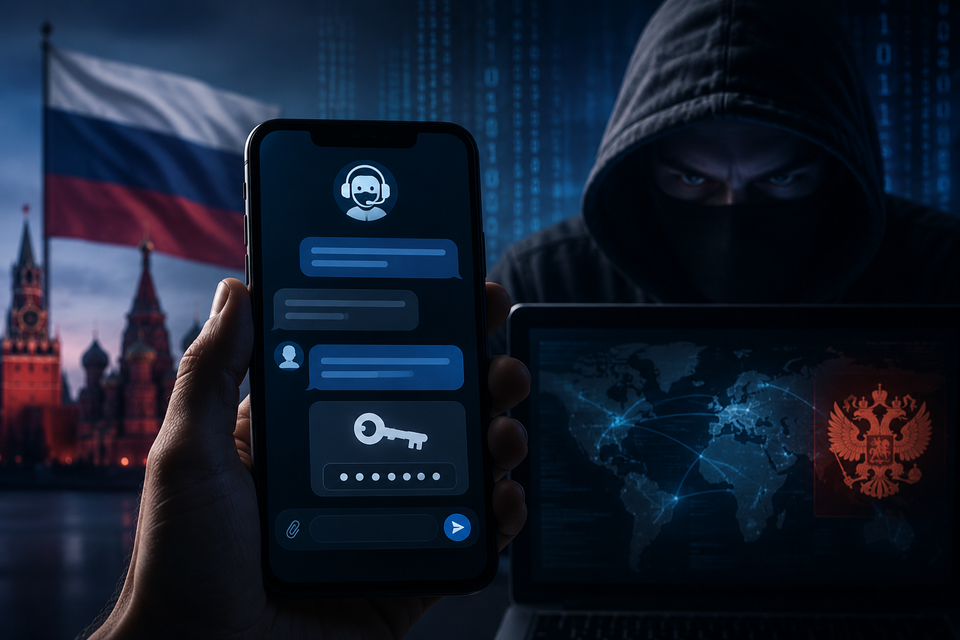
Russian intelligence services are impersonating tech support bots to seize control of your private messages — permanently. The FBI says the attack is evolving, and the key they're after unlocks everything you've ever sent.
Imagine receiving a message inside your encrypted chat app. It looks like an automated notification from the platform itself — your account needs verification, a backup is due, security settings require an update. The instructions are clear, the branding looks right, and a simple step is all that stands between you and a restored, secure account. You follow them. You share the key. And from that moment, Russian military intelligence has full, permanent access to everything you have ever written.
This is not a hypothetical. It is an active operation, documented and formally warned about by the FBI and the Cybersecurity and Infrastructure Security Agency in an updated advisory issued on 28 June 2026 — and it is targeting some of the most sensitive people in the world.
Who is behind it
Federal investigators have traced the campaign to multiple clusters of Russian Intelligence Services cyber threat actors — a term that covers a great deal of institutional weight. The operation involves FSB officers embedded within Russia's Border Guards, alongside actors operating under the direction of the Russian military. The cybersecurity industry tracks these groups under the designations UNC5792 and UNC4221, names that represent years of documented, sophisticated intrusion activity against Western targets.
INTELLIGENCE RECORD · FBI / CISA Advisory · June 28, 2026
Operators: Russian Federal Security Service (FSB) · Russian Military Intelligence Industry tracking: UNC5792 · UNC4221 Targets: US and international government officials · Military personnel · Political figures · Journalists · Ukraine officials Method: Fake in-app support accounts · Social engineering · Backup Recovery Key theft Assessment: Campaign is active, evolving, and escalating in sophistication
The targets are not random. The operation is specifically designed to go after high-value individuals: current and former US and international government officials, military personnel, political figures, journalists, and key people working in Ukraine. The common thread is access to sensitive information that Russia's intelligence apparatus would pay considerable resources to obtain — and in this case, is obtaining through a remarkably low-cost social engineering trick.
How the attack works
The FBI and CISA were careful to note that the underlying encryption of targeted messaging platforms has not been broken. The apps themselves remain secure. What the attackers are exploiting is not a flaw in technology — it is a flaw in human trust. The entire campaign rests on social engineering: creating fake accounts that impersonate official platform support, then manipulating users into handing over the one thing that makes encryption irrelevant.
Step 1 — The approach Hackers create accounts inside the messaging app that mimic automated tech support profiles. The branding, the language, and the format are designed to look indistinguishable from genuine platform notifications.
Step 2 — The request Historically, these fake accounts tried to steal verification codes and account PINs. The tactic has now evolved: attackers are instructing targets to "back up" their messages and, in doing so, to share their Backup Recovery Key.
Step 3 — The handover If the target follows these instructions, they hand Russian intelligence a master key to their entire account history — every private message, every group conversation, every document shared. The encryption that protected those messages becomes meaningless.
Step 4 — The permanence This is where the attack becomes particularly insidious. The stolen Backup Recovery Key does not expire. Even if the victim discovers the breach, deletes their account, and creates a new one using the same phone number, the original stolen key can still be used to seize the new account. The intrusion outlives the response.
⚠ CRITICAL: Changing your password or even deleting your account does not stop the attack. The only action that neutralises a compromised Backup Recovery Key is manually generating a new one inside the app's Settings menu. Even then, the FBI warns, this only protects future messages — it cannot undo access already taken to previously downloaded backups.
Why this campaign is different
Phishing is not new. Impersonation attacks are not new. What makes this campaign notable is the specific target of the theft and the permanence of its consequences. Most data breaches are snapshots — a password stolen, an account accessed at a moment in time, a trove of emails exfiltrated during a window of access. The Backup Recovery Key attack is different in kind: it creates a persistent, renewable claim on a target's communications that survives the target's own attempts to close it down.
"A stolen password gives access to an account. A stolen Backup Recovery Key gives access to an identity — and it never expires unless the victim takes the exact right technical step."
The choice of targets also signals strategic intent. Government officials, military personnel, journalists covering Ukraine, and officials working directly on Ukraine's defence represent exactly the population whose private communications Russia has the strongest interest in monitoring. This is not a criminal operation aimed at financial fraud. It is an intelligence collection programme running through a social engineering vector — spycraft conducted through a chat window.
The FBI's acknowledgement that the campaign is "evolving" is also significant. The shift from stealing PINs and verification codes to targeting Backup Recovery Keys represents a deliberate upgrade in ambition. The attackers have moved from seeking account access to seeking permanent, total account control. That progression suggests an operation that is learning, adapting, and being resourced to do so.
How to protect yourself
Real support never uses in-app chat Legitimate platform support only contacts you via official company email — never through a message inside the app itself.
Never share your recovery key No genuine support service will ever ask for your Backup Recovery Key. A request for it — from any source, in any format — is an attack.
Never share verification codes Verification codes sent to your phone are for your use only. Any request to share them should be treated as hostile, regardless of how legitimate the request looks.
Ignore external verification links Real support services do not send external links to verify or restore your account. Any such link should be assumed malicious until independently confirmed.
Rotate your recovery key now If you believe you may have been targeted, generate a new Backup Recovery Key in your app's Settings immediately. This invalidates the old key for any future backup downloads.
Verify independently before acting If you receive any security alert, contact the platform directly through their official website — not through any link or contact provided in the message itself.
Encryption is only as strong as the person holding the key
There is a lesson here that extends far beyond this specific campaign. End-to-end encryption is, at present, mathematically robust. The contents of a properly encrypted message cannot be meaningfully intercepted in transit. That is a genuine and important achievement in the technology of privacy. But encryption protects the channel, not the person. The moment a user can be persuaded to hand over the key — through deception, through urgency, through the simple appearance of legitimacy — the mathematics become irrelevant.
Russian intelligence services, like their Chinese and Iranian counterparts, have understood this for years. The weakest point in any security system is the human being who operates it. A phishing message that successfully impersonates a trusted source costs almost nothing to send. A fake support account on a messaging platform requires no technical sophistication whatsoever. Yet either can yield access that would take millions of dollars and years of effort to obtain through technical means alone.
The FBI's updated advisory is a reminder that the most consequential cyber threats are rarely the most technically complex. They are the ones that exploit the one vulnerability no software patch can fix: the instinct to trust something that looks trustworthy. Against an operation run by professional intelligence officers with years of experience in manipulation and deception, that instinct needs to be deliberately overridden — every time, for every request, regardless of how legitimate it appears.
The spy in your chat window does not look like a spy. That is precisely the point.
Sources: FBI / CISA Joint Public Service Announcement (June 28, 2026) · Original PSA (March 20, 2026) · Threat actor tracking: UNC5792, UNC4221 (Mandiant / Google Threat Intelligence)
Member discussion