
Trapped Behind the Scam: Why This Year's Trafficking Day Is a Cybercrime Story
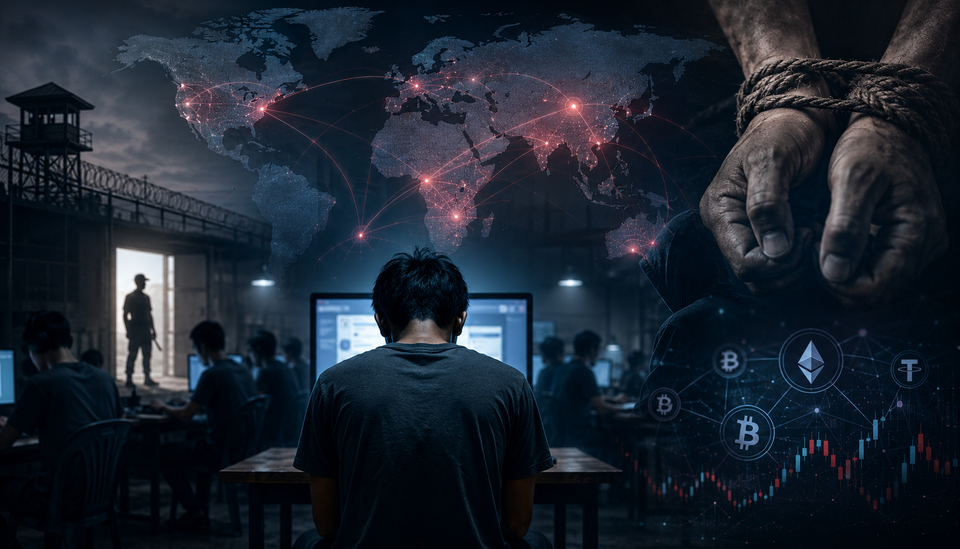
Every July 30th, the world marks the Day Against Trafficking in Persons. For most of the observance's history, that meant stories about forced labor, domestic servitude, and sexual exploitation. This year's theme, "Trapped Behind the Scam," reflects a shift no one anticipated a decade ago: one of the fastest-growing forms of human trafficking on Earth right now runs through a keyboard, not a brothel or a sweatshop.
The scale of what's driving that shift has moved well past a regional problem into something closer to a parallel criminal economy with global reach.
The business model, briefly
The mechanics are by now well documented, but bear repeating because they're what make this trafficking rather than merely fraud. A person answers what looks like a legitimate job posting: customer service, data entry, tech support, sometimes even "crypto trading analyst." They travel, often across a border, on the promise of decent pay. On arrival, their passport is confiscated. They're moved into a guarded compound, hotel, or office building. And then they're told the real job: run romance scams, pig-butchering crypto schemes, or investment fraud against strangers online, under threat of violence, debt bondage, or worse if they refuse or underperform.
INTERPOL's most recent crime trend update, released in mid-2025, put numbers to this. As of March 2025, victims trafficked into scam operations came from at least 66 countries, with no continent left untouched. Seventy-four percent of those victims ended up in Southeast Asia, the original hub built around Myanmar, Cambodia, and Laos, where UNODC estimates the compounds collectively employ or hold as many as 300,000 people. But the update's more urgent finding is about where the model is spreading: the Middle East, Central America, and especially West Africa, which INTERPOL now flags as a potential emerging regional hub in its own right. UNODC's 2026 assessment, released around this year's Trafficking Day, adds Eastern and Southeastern Europe, South Asia, and Latin America and the Caribbean to that expanding map. This is no longer a Mekong-region story. It is a story about a criminal business model that has proven so profitable it is franchising itself onto every continent.
Why this belongs in a cyber diplomacy conversation
It would be a mistake to file this under "human trafficking" and consider it someone else's policy lane. The scam centre economy sits directly at the intersection of organized crime, cybercrime, and forced labor, and it's evolving using the same technology stack that shows up in every other cyber policy conversation this year. INTERPOL's analysis flags a growing use of AI inside the centres themselves: generative tools produce convincing fake job ads to lure the next round of victims, and deepfake technology fabricates the photos and video used in romance scams and sextortion. The victims are trafficked people; the tooling is frontier AI applied to social engineering at industrial scale. UNODC's own framing for 2026 explicitly describes technology, virtual assets, and specialized criminal services as now-integrated components of the wider organized-crime economy that scam compounds sit inside.
There's also a hard convergence point with financial crime that anyone working cybersecurity, fraud, or crypto policy should recognize immediately: the money extracted from victims overwhelmingly moves through cryptocurrency rails, laundered through the same infrastructure of exchanges, mixers, and shell entities that shows up in ransomware and sanctions-evasion cases. A 2024 INTERPOL operation seized USD 257 million tied to online scam networks in a single coordinated action. That is not a trafficking statistic. That is a financial crime statistic sitting on top of a trafficking crime.
The uncomfortable middle ground
One thing INTERPOL's own language is careful about, and that policy conversations often flatten, is that not everyone inside a scam centre is a trafficking victim. Some are willing participants in the fraud, recruited knowingly into criminal work. INTERPOL's data suggests roughly 90 percent of the facilitators running these operations are themselves from Asia, with 11 percent from South America or Africa, and the large majority are men in their twenties and thirties. That distinction matters enormously for how law enforcement, courts, and NGOs should respond: a trafficking victim forced into fraud under threat of violence needs protection and non-prosecution, not a fraud conviction. A joint statement issued by UN agencies for this year's observance was explicit about that principle, framing the needed response as "protection, not punishment" for those coerced into the schemes. Getting that distinction wrong at scale, treating every person pulled out of a raided compound as a criminal rather than screening for trafficking indicators, risks re-victimizing the very people this day exists to protect.
What "strengthening international cooperation" actually needs to mean
Dismantling the networks, protecting victims, and strengthening international cooperation remain the right priorities, and none of them are new; INTERPOL has been issuing warnings on this since 2023. What has changed is the geography, and geography is where cooperation gets hard. A trafficking-fraud network that recruits in Kenya, holds victims in a compound in the UAE or a West African free-trade zone, and launders proceeds through exchanges registered in yet another jurisdiction requires exactly the kind of cross-border evidence-sharing and mutual legal assistance that international policing has always found slow to execute at the speed criminal networks now operate. The 2024 raid that freed roughly 3,200 potential trafficking victims and identified 17,800 irregular migrants in a single coordinated operation shows this can be done. The question this Trafficking Day poses is whether that kind of operation can happen often enough, and fast enough, to outpace a criminal model that is actively franchising itself into new regions faster than most governments are building the capacity to respond.
That's the real test of this year's theme. "Trapped Behind the Scam" is not just a slogan for one day of awareness. It's a description of a criminal architecture that has fully absorbed cyber tools, crypto rails, and AI-generated deception into what used to be understood as an old-world crime. Treating it as a trafficking issue, a cybercrime issue, and a financial crime issue simultaneously — rather than picking one lane — is the only framing that matches what INTERPOL and UNODC are both now describing.
Sources: INTERPOL, "INTERPOL releases new information on globalization of scam centres" (June 2025); UNODC, "Forced to scam: Inside one of the fastest-growing forms of human trafficking" (July 2026); UN Women, Joint Statement on World Day Against Trafficking in Persons 2026; European Commission, "UNODC and the EU warn of rising human trafficking for criminal activities in scam centres" (July 2026).
Member discussion