
Türkiye's Cyber Crackdown: Enforcement Theatre or Systemic Reform?
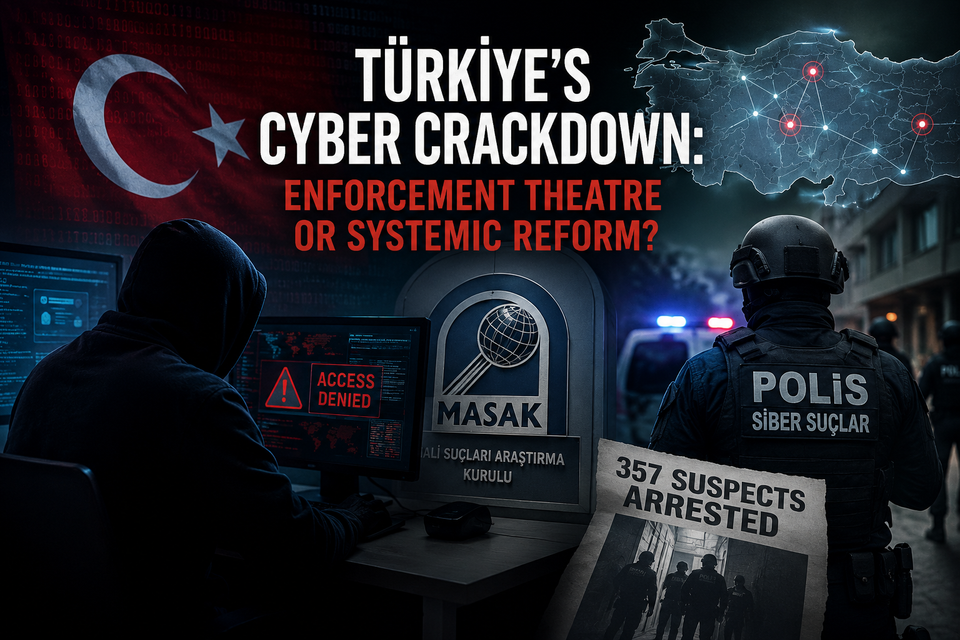
Analyzing the 357-Suspect Raids Through the Lens of FATF Compliance, MASAK Authority, and the Architecture of Digital Financial Crime
Analysis | June 2026
The Operation in Figures
In five days spanning early June 2026, Turkish authorities swept across 18 provinces, detaining 357 suspects and arresting 194 in coordinated raids targeting illegal betting networks, online investment fraud, account-rental schemes, phishing operations, and child sexual abuse material. The operation was a joint effort between the General Directorate of Security's Cybercrime Department, the Financial Crimes Investigation Board (MASAK), and public prosecutors — the institutional triangle that has become Turkey's principal instrument against the convergence of digital crime and financial misconduct.
The numbers are significant, but they must be read within a larger pattern. This was not an isolated event. In May 2026, Turkish authorities arrested 135 suspects across 33 provinces in a parallel illegal betting sweep. In April, the National Intelligence Organization (MIT) led a nine-province operation against a group that had deployed malware to compromise government employee credentials. In 2025 alone, more than 1,200 fraudulent websites linked to cyber fraud were shut down. What has emerged in Türkiye is not periodic enforcement but a sustained, institutionalized campaign — one with deep roots in the country's recent experience with the global financial compliance architecture.
The FATF Shadow: From Grey List to Enforcement Pressure
To understand why Türkiye's cybercrime enforcement posture has intensified so dramatically, it is necessary to look back two years. In October 2021, FATF placed Türkiye on its grey list — the "Jurisdictions under Increased Monitoring" — citing systemic deficiencies in its AML/CFT regime. These included insufficient oversight of high-risk sectors such as banking and real estate, inadequate resources at the financial intelligence unit (FIU), weak supervision of unregistered money transfer services, insufficient handling of terrorist financing investigations, and concerns over sanctions evasion. The FATF had, in earlier reporting, specifically flagged sectors like banking and construction as vulnerable to illicit financing of UN-designated groups.
Removal came in June 2024, when FATF's Singapore plenary concluded that Türkiye had made "significant progress in improving its AML/CFT regime." The action plan Türkiye fulfilled required, among other things: dedicating greater FIU resources to high-risk sector supervision; applying dissuasive sanctions for AML/CFT breaches, particularly involving unregistered money transfer services; enhancing the use of financial intelligence in money laundering investigations; and undertaking more complex ML prosecutions linked to actual risk profiles.
That political and institutional commitment did not end with delisting. FATF's evolving posture — on full display at the February 2026 plenary in Mexico City — signals an increasingly outcomes-based framework: countries that have exited the grey list are expected to demonstrate sustained enforcement, not just reformed legislation. For Türkiye, the surge in coordinated cybercrime operations across 2025 and 2026 is partly an operational continuation of that FATF-driven reform agenda. MASAK is not simply chasing criminals — it is demonstrating to international monitors that Türkiye's financial intelligence architecture has teeth.
MASAK: Expanding Mandate, Expanding Power
MASAK has been the institutional engine of this transformation. In 2025, its activity report recorded 502 analysis filescompleted on illegal betting activities alone, with 545 intelligence reports and information notes disseminated to relevant institutions. Transactions worth 5.1 billion lira ($131 million) linked to alleged illegal betting organizers were suspended as part of anti-money laundering measures.
The scale of the underlying criminal economy these measures are targeting is staggering. Investigations into a single major illegal betting and money-laundering network — which made headlines in May 2026 when a prominent Turkish television commentator was detained — identified approximately ₺200 billion ($4.37 billion) in suspicious transactions and laundering activity. That network ran money through electronic payment institutions, bank accounts, virtual POS systems, foreign exchange bureaus, gold dealers, shell companies, and cryptocurrency systems, and had built proprietary software and panel systems to provide financial backbone for multiple illegal betting sites spanning 21 provinces and extending to the Turkish Republic of Northern Cyprus and Montenegro.
MASAK's powers are also expanding legislatively. Under Türkiye's 11th Judicial Reform Package — pending parliamentary approval — MASAK would gain authority to directly impose restrictions on mobile and internet banking operations suspected of facilitating financial crimes. This would mark a shift from MASAK as an investigative and intelligence-sharing body toward a quasi-regulatory authority with real-time intervention capabilities in the payments system. The strategic logic is sound: if the criminal infrastructure increasingly runs on digital payment rails, the financial intelligence unit must be positioned to disrupt those rails quickly.
Separately, investigators in an Istanbul operation uncovered 47.5 billion lira in suspicious transactions carried out between 2022 and 2024 using 312 point-of-sale (POS) devices in six provinces, with transactions following highly organized patterns inconsistent with legitimate business — generally executed late at night. That investigation led to the detention of employees of Denizbank, Şekerbank, and a fintech firm, illustrating a chronic vulnerability: insider complicity within financial institutions as a vector for laundering criminal proceeds.
The Crime Architecture: What the Raids Reveal
The taxonomy of offenses uncovered in the June 2026 raids maps neatly onto what Europol identified in its EU Serious and Organized Crime Threat Assessment 2025: online platforms, digital payment systems, and cryptocurrencies are increasingly the infrastructure of choice for organized crime networks operating across borders. The crimes are not merely opportunistic digital fraud — they constitute a sophisticated, layered financial ecosystem:
Illegal Betting Networks function as a parallel financial system. Operators collect funds through payment processors, distribute winnings, and move profits through a chain of intermediary accounts — sometimes cryptocurrency, sometimes virtual POS terminals, sometimes courier networks (as the ₺200 billion case illustrated, with suitcase-carrying couriers using pre-selected banknotes as passwords). The Paymix-3 operation in May 2026 traced financial flows through Fincrypto UAB, a Malta-registered cryptocurrency payment provider allegedly processing approximately $3 billion in monthly transactions as the financial backbone of illegal Turkish betting organizations — exemplifying how criminal infrastructure reaches into EU-regulated entities.
Account-Rental Schemes — in which individuals rent out their bank or mobile accounts to criminal networks — are particularly corrosive because they embed financial crime within the legitimate banking system and make traditional AML transaction monitoring much harder. A rented account held by an ordinary citizen presents very differently to a compliance algorithm than an account registered to a shell company.
Phishing and Mobile Banking Compromise represent the retail layer of the criminal economy — lower-yield per incident but operating at massive scale. The combination of SIM-swap fraud, social engineering, and compromised banking applications creates a constant low-level financial hemorrhage across the consumer banking population.
Online Investment Fraud — fraudulent forex, cryptocurrency investment offers, digital pyramid schemes — exploits both the complexity of digital asset markets and the lack of investor literacy. Europol data confirms these schemes are now a principal driver of consumer financial losses across European and Eurasian markets.
The presence of child sexual abuse material (CSAM) among the detained suspects is a sobering reminder that cybercriminal infrastructure frequently overlaps across offense types. Networks built for financial fraud — with access to anonymous communications, cryptocurrency payment rails, and compromised accounts — are the same networks that facilitate the distribution of CSAM. Enforcement operations that target financial cybercrime therefore often intersect with child protection mandates.
The Budapest Convention and International Dimension
Türkiye is a signatory to the Council of Europe Convention on Cybercrime (Budapest Convention), which provides a framework for mutual legal assistance, evidence sharing, and extradition in cross-border digital offenses. This matters operationally: the May 2026 Paymix-3 operation resulted not only in domestic arrests but in Red Notices issued through Interpol for 15 suspects believed to be operating abroad, and the Malta connection to Fincrypto UAB triggered cross-jurisdictional proceedings.
Under Turkish criminal law, jurisdiction extends to any offense committed within Turkish territory, any act targeting Turkish information systems regardless of the perpetrator's location, and acts by Turkish nationals abroad that constitute crimes under both jurisdictions. For foreign financial institutions with Turkish correspondent relationships, this legal reach has compliance implications: Turkish authorities can and do pursue proceeds that flow through international banking channels.
What Enforcement Concentration Tells Us About Structural Weakness
A surge in enforcement activity across multiple concurrent operations is a signal worth interrogating. It can indicate one of three things: a genuine increase in criminal activity, an increase in enforcement capacity and political will, or — most often — both simultaneously. In Türkiye's case, the evidence points strongly to the latter.
The criminal ecosystem feeding these operations has been building for years. The shift toward digital payments in Turkey, accelerated by fintech growth and mobile banking adoption, created new attack surfaces faster than regulatory and enforcement frameworks could adapt. MASAK, long underfunded relative to the sophistication of the threats it monitored, is now receiving greater political priority. The Cybercrime Department's operational tempo has visibly increased. And crucially, the coordination between MASAK, the cybercrime police, gendarmerie cyber units, MIT, and public prosecutors has deepened — creating multi-vector joint operations rather than single-agency sweeps.
But scale of enforcement does not necessarily equate to structural remediation. Several systemic vulnerabilities persist:
The informal digital economy — cryptocurrency exchanges, unregistered payment intermediaries, virtual POS networks — remains difficult to fully supervise. MASAK's expanded powers, if passed, would help at the banking layer, but crypto remains a significant blind spot.
Financial literacy gaps leave ordinary citizens vulnerable to account-rental recruitment, phishing, and investment scams. Criminal networks prey precisely on people who do not understand the legal and financial consequences of renting out their bank accounts or clicking a fraudulent link.
Insider threat within financial institutions — evidenced by the bank employee arrests in the POS scheme investigation — requires enhanced internal controls, whistleblower protections, and AML training that goes beyond checkbox compliance.
Assessment: Enforcement as a Necessary but Insufficient Condition
The June 2026 raids represent the visible surface of a far more complex transformation in Türkiye's relationship with financial cybercrime. Behind the arrest tallies lies a meaningful institutional evolution: MASAK has become a serious financial intelligence authority; inter-agency coordination has deepened; and the FATF-driven reform agenda has, at least in part, translated from legislative text into operational practice.
Yet enforcement-led strategies face an inherent limitation: they address symptoms more readily than causes. Illegal betting generates its demand from consumer appetite and restricted legal alternatives. Online fraud exploits persistent digital literacy deficits. Account-rental schemes reflect economic precarity — people renting their accounts are often doing so because the immediate cash is more visible to them than the legal risk.
For Türkiye, the post-grey-list challenge is to demonstrate to the global financial community not just that its law enforcement machine is busy, but that its financial system is structurally less hospitable to organized criminal activity. That requires regulatory depth — not just raiding capacity.
The 357 suspects detained across 18 provinces are a data point. The architecture that recruited, funded, and operationally sustained them is the actual problem.
Sources: Turkish Interior Ministry Statement, June 2026; MASAK 2025 Activity Report; Europol SOCTA 2025; Daily Sabah; Türkiye Today; Turkish Minute; OCCRP; Global Investigations Review; FATF Plenary Outcomes (2021–2024); Council of Europe Budapest Convention.
Member discussion