
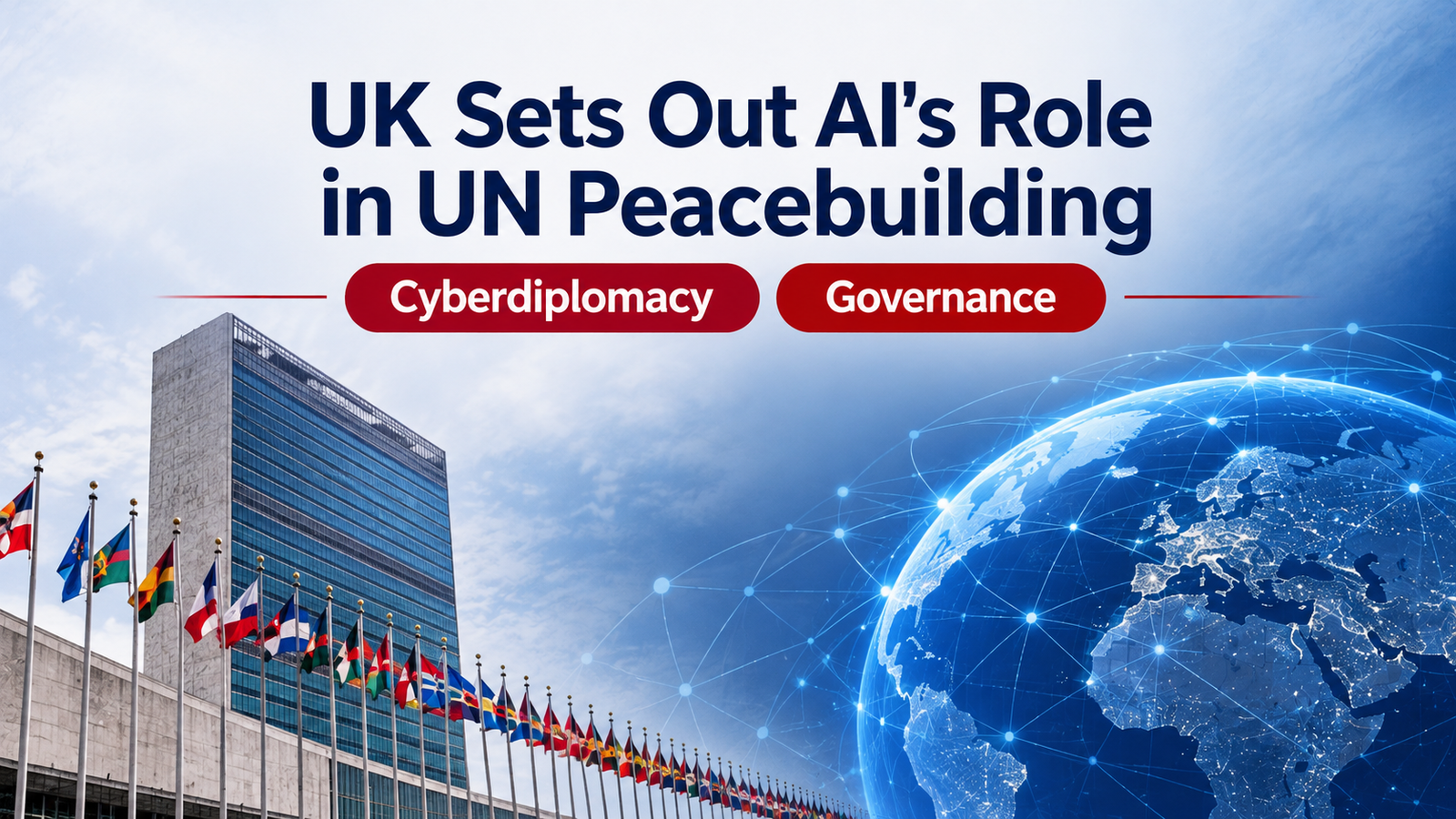
UK Sets Out AI's Role in UN Peacebuilding
The UK has outlined potential uses of AI in UN peacebuilding, from conflict early warning to mission planning, while emphasising that human judgment and accountability must remain central to its deployment.
- Filed
- Desk
- Cyberdiplomacy
- Read
- 3 min read
Artificial intelligence is increasingly becoming part of discussions about international security. But its place in resolving conflicts raises a different question from its role in warfare: can technology help prevent violence and support peace operations without displacing the people responsible for making those decisions?
That question featured in the United Kingdom's statement to the United Nations Security Council on 24 November 2026, delivered by Ambassador Sarah MacIntosh during a debate on conflict resolution amid rapid technological change.
The UK's position was not that AI could resolve conflicts. Rather, it argued that advanced technologies could strengthen efforts to prevent conflict, support mediation and improve the work of peace operations, provided their use remained under human judgment.
The distinction matters because the proposed applications extend beyond conventional security monitoring.
For conflict prevention, the UK pointed to data analysis as a means of identifying patterns of escalation and strengthening early-warning capabilities. It also highlighted the potential of AI to identify misinformation, disinformation and manipulation across social media, helping practitioners understand changing public sentiment.
In mediation, the emphasis shifted towards understanding conflict dynamics and engaging communities affected by violence. The UK confirmed that its funding would support policymakers and practitioners in testing and sharing findings from Accord 31 on Digital Peacemaking, which is due in February. The work will examine how data and AI can be responsibly integrated into peacemaking.
The implications for peace operations are more operational.
The UK identified three areas where its research sees potential: situational awareness and early warning, engagement with local communities, and mission planning and logistics.
AI-enabled analysis of satellite and drone imagery could help monitor areas too extensive for personnel to cover directly. The technology could also help identify patterns in force movements, population movements, transport activity and the establishment of new bases or camps. Around UN bases, identifying unusual movements could support the protection of peacekeepers.
Community engagement presents a different challenge. Peace operations depend not only on the consent of host countries but also on the support of local populations. The UK argued that analysis of public opinion, sentiment and social media narratives could help missions understand how communities perceive their presence. AI could also extend engagement in local languages.
In mission planning, predictive tools could help anticipate supply requirements, identify waste and flag potential fraud. AI could also draw on daily field reporting and lessons from previous missions to support more informed decisions.
Yet the statement did not present these possibilities as a straightforward technological upgrade. It acknowledged unresolved questions around ownership and management of sensitive data, model drift, partnerships and ethical concerns.
The issue becomes particularly consequential when the discussion moves from supporting peace operations to the use of autonomous weapons.
The UK reiterated that parties to armed conflict must comply with international law and international humanitarian law, emphasising that human judgment and appropriate control must remain throughout the design and use of lethal autonomous weapons systems. Its position was explicit: human responsibility cannot be delegated to machines.
That position comes alongside a recent development in Geneva. At the Seventh Review Conference of the Convention on Certain Conventional Weapons, states agreed on a mandate to develop an instrument addressing lethal autonomous weapons systems over 2027–2028. The agreement establishes a process for further work; it is not a completed treaty or a settled set of binding rules.
The UK welcomed that development and also identified itself as a founding member of the informal Expert Group on Technology and Peace and Security, established by Latvia and Greece.
Why it matters
AI is entering international peace and security discussions through more than its military applications. Early-warning analysis, digital mediation, community engagement and operational planning are becoming part of the conversation about how international missions function.
But the same technologies that help interpret information can also introduce questions about whose data is being analysed, how reliable the resulting assessments are and who remains accountable when decisions rely on algorithmic outputs.
The UK's statement places that tension at the centre of its approach: technology can support the work of peacebuilding, but it cannot replace the political judgment and human responsibility on which that work depends.
Source:
This brief was prepared with AI assistance from the sources above and reviewed by our editors.
Sources
Keep reading

Peninsula Energy Shuts Down Lance Uranium Operations After Cyber Breach
A cyber incident affecting plant and wellfield control systems has forced Peninsula Energy to suspend operations at its Lance uranium project in Wyoming. Recovery is underway, with production and restart timelines still uncertain.
CIA-Used OSINT System Breached, Raising Questions Over Intelligence Data Security
A breach involving an unclassified OSINT system used by the CIA and ODNI has brought renewed attention to the security of intelligence infrastructure built around publicly available information.

JAXA Web Server Breach Exposes 2,000 Accounts
A command-injection vulnerability in JAXA's web server exposed account details belonging to 2,000 users. Investigators also discovered a backdoor and attempted access to network infrastructure, raising concerns beyond the stolen credentials.