
When Secrecy Backfires: How Nuclear Policy Learned (and How Cyber is Forgetting) the Lesson of Open Innovation
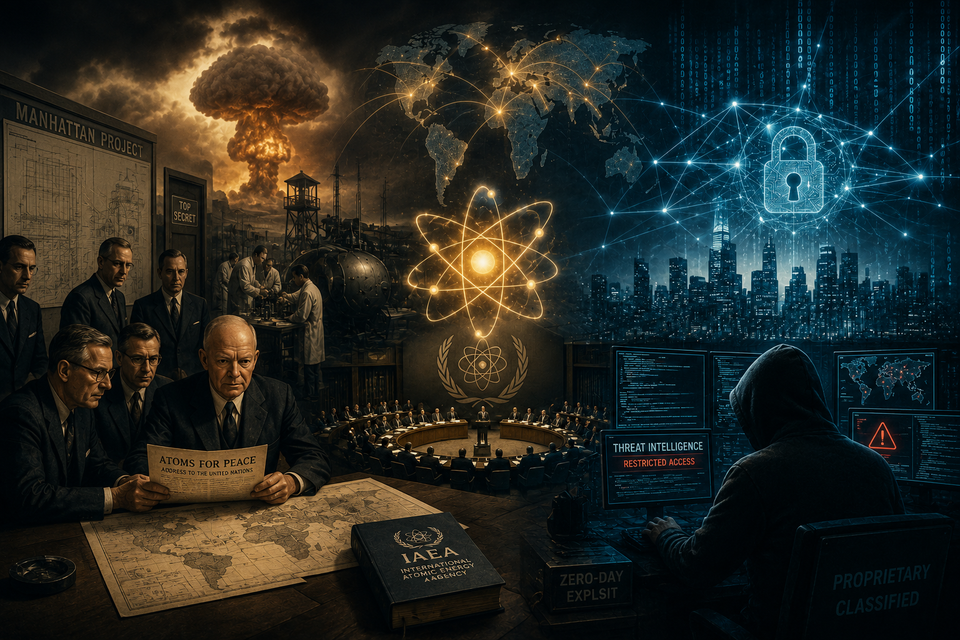
Part 1 of 5: From Manhattan Project to Atoms for Peace
The story of nuclear regulation offers an unlikely but instructive parallel to today's cybersecurity crisis. It begins, as so many stories of technological dominance do, with a decision to hoard.
The Manhattan Project: Innovation through Secrecy
In 1938, nuclear fission was discovered. By 1941, President Roosevelt had signed Executive Order 8807, launching what would become the Manhattan Project—a massive, secret undertaking to build an atomic weapon before Nazi Germany could. The decision to pursue nuclear development in absolute secrecy made sense at the time. The technology was revolutionary, the stakes existential, and the enemy implacable.
For several years, this strategy of closed innovation worked. The United States maintained a monopoly on atomic weapons technology. The combination of massive investment ($2 billion, in 1940s dollars), coordination between the government and private industry, and ruthless compartmentalization of information created an insurmountable lead. By 1945, when the first bombs fell on Japan, the US stood alone as a nuclear power.
The sense of triumph was short-lived.
The Inevitability of Leakage
What the Manhattan Project's leadership underestimated was a simple truth: secrecy, no matter how carefully guarded, is always temporary. Soviet atomic spies had penetrated the program during the war itself. The British and Canadians, who had collaborated on the project, possessed crucial knowledge. Scientists move between countries. Techniques can be independently rediscovered. Defectors talk.
By 1952, the Soviet Union detonated its first atomic bomb. The "impossible" had happened. The US monopoly had lasted less than a decade.
The strategic response to this failure would reshape not just nuclear policy, but the very concept of how nations could compete in high-technology domains. Rather than double down on secrecy—which had demonstrably failed—the US decided to embrace something far more radical: controlled openness.
Eisenhower's Gambit: The Atoms for Peace Program
In 1953, President Eisenhower announced the "Atoms for Peace" program to the United Nations. The speech was a masterpiece of strategic reframing. Instead of treating nuclear technology as a secret to be hoarded by the US, Eisenhower proposed treating it as a resource to be managed globally—under American leadership.
The program's logic was elegant: if the US could no longer maintain a monopoly through secrecy, it would instead maintain dominance through managed openness. The US would share nuclear technology, materials, and expertise with allied nations—but only through carefully controlled channels. Nations receiving this knowledge would have to sign agreements committing to peaceful use only. In return, they would accept international inspection and oversight.
This was the birth of "cyber sovereignty" applied to nuclear technology: the US would remain the acknowledged center of technical expertise and policy-setting, while appearing to share power internationally.
From Closed to Open: What Changed and Why
The Atoms for Peace program led directly to the creation of the International Atomic Energy Agency (IAEA) in 1957. It also led to the privatization of the US nuclear industry in 1954—a reversal of the Manhattan Project model where government had directly controlled all development.
Why privatize? Because the US realized that commercial competitiveness was a more sustainable form of control than military secrecy. Private companies racing to build nuclear reactors and export them to allies would create economic incentives aligned with US foreign policy. A reactor sold to Japan or West Germany would bind those nations to US technical standards, fuel supply chains, and safeguard agreements. Profit motive and geopolitical control would work in harmony.
The calculation proved correct. By the 1960s, American companies dominated the global nuclear market. France emerged as a competitor, but even French nuclear ambitions eventually led to bilateral agreements with the US. The open-innovation approach, managed through institutional frameworks like the IAEA and enforced through bilateral treaties, proved far more effective at maintaining US dominance than the closed-innovation model of the Manhattan Project.
What This Actually Meant
It's important to be precise about what "open innovation" meant in this context. It did not mean free access to technology or knowledge. It meant:
- Controlled dissemination of technology through government-approved bilateral agreements
- Export licenses that bound recipient nations to non-proliferation commitments
- Inspection regimes that created transparency in civilian nuclear facilities (while military programs remained secret)
- Standardization of safety practices that, coincidentally, kept the US firmly in the position of standard-setter
- Commercial competition that enriched private American firms while maintaining US policy control through export restrictions and licensing agreements
In other words, it was open enough to prevent rivals from independently developing the technology, but controlled enough to ensure American leadership. It was a strategy of appearing generous while remaining dominant.
Why This Matters for Cyber Today
Here's where the parallel becomes uncomfortable.
The cybersecurity industry today shows signs of mimicking the Manhattan Project model: treating advanced capabilities as trade secrets to be protected, withholding threat intelligence from competitors and even allies, restricting knowledge-sharing across borders, and assuming that proprietary advantage is a sustainable strategy.
But the nuclear experience suggests this is a dead-end. Competitors will reverse-engineer capabilities. State actors will steal intellectual property. Knowledge will spread. The only question is how long you maintain the illusion of monopoly before reality forces an adjustment.
The difference is timing. The US had roughly a decade of nuclear monopoly before the Soviet breakthrough forced a rethink. In cyber, that window is shorter—perhaps already closed. China's advanced cyber capabilities, Russia's demonstrated willingness to conduct large-scale offensive operations, and the proliferation of tools and techniques mean that no single actor can maintain dominance through secrecy alone.
Yet the cybersecurity industry remains largely organized around the Manhattan Project model: proprietary threat intelligence, restricted researcher access, companies hoarding zero-day exploits, governments compartmentalizing capabilities and refusing to share defensive knowledge with allies, let alone with the broader ecosystem of smaller companies and countries that desperately need it.
The Irony
The deepest irony is that the Atoms for Peace program achieved what it set out to do—maintain US dominance through managed openness and institutional control. American companies remain the leading exporters of nuclear technology. The IAEA, despite its flaws, ensures that nuclear safeguards follow American-influenced standards. Bilateral agreements tie nations into frameworks that serve US interests.
But nuclear regulation worked partly because nuclear technology is capital-intensive and geographically concentrable. You cannot build a reactor in a garage. You need uranium mines, enrichment facilities, specialized manufacturing plants. Control of these resources meant control of proliferation.
Cyber is different. A sophisticated cyber capability can be developed with computers and talent. It can hide in plain sight. It can be deployed globally at the speed of the internet. The kind of resource control that worked for nuclear will never work for cyber.
This means that cyber cannot rely on the same regulatory model as nuclear—and that's what the second article in this series will explore. But before we get there, the first lesson is clear: the pretense of innovation through secrecy is a historical dead-end. The only question is how long policymakers will cling to it before necessity forces a shift.
The nuclear precedent suggests: not very long. And by then, the damage may already be done.
Member discussion