
When the Cloud Becomes a Battlefield
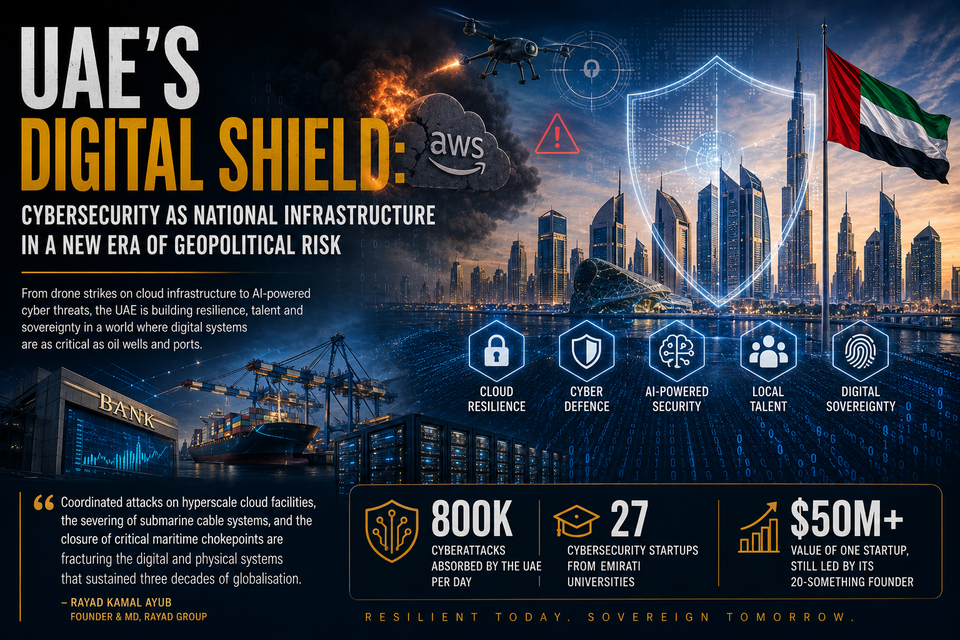
The attack on AWS infrastructure was not just a geopolitical incident. For the UAE, it was a clarifying moment — proof that digital systems are now as critical to national security as oil wells and ports.
800K - Cyberattacks absorbed by the UAE per day
27 - Cybersecurity startups from Emirati universities
$50M+ - Value of one startup, still led by its 20-something founder
In March 2026, drone strikes struck Amazon Web Services facilities in the Middle East during the escalation of the US-Israel-Iran conflict. Financial platforms degraded. Logistics slowed. GPS interference rippled through delivery networks. Some organisations quietly reverted to manual processes — years of automation unwound in hours.
Nobody called it a cyberattack. But the consequence was identical: critical digital systems, suddenly unreliable, in the middle of a working day.
For the UAE, a nation whose banking systems, free-zone ports, airlines and government services run almost entirely on cloud-based environments, the episode was not a warning. It was a confirmation of something policymakers had been quietly acknowledging for years: cybersecurity is no longer an IT department concern. It is foundational infrastructure — as consequential as an oil terminal or a shipping lane.
"Coordinated attacks on hyperscale cloud facilities, the severing of submarine cable systems, and the closure of critical maritime chokepoints are fracturing the digital and physical systems that sustained three decades of globalisation." RAYAD KAMAL AYUB, FOUNDER & MD, RAYAD GROUP
The redefinition of infrastructure
For most of the twentieth century, infrastructure meant steel and concrete: roads, power grids, pipelines, harbours. Governments built it, protected it and occasionally went to war over it. The definition has been quietly expanding ever since the first undersea fibre-optic cables were laid in the 1980s — but the expansion has accelerated dramatically in the past five years.
Data centres now process transactions that move more value per second than any single highway or rail line ever could. Payment networks operate in real time across dozens of jurisdictions simultaneously. Cloud environments run the logic behind port scheduling, flight operations, customs clearance and central bank settlements. These are not conveniences layered on top of an economy. They are the economy's nervous system.
Morgan Stanley analysts recently described infrastructure instability as an entirely new operational risk category for globally integrated financial markets. The framing matters: it signals that the financial community is no longer treating connectivity disruption as a low-probability tail risk, but as a recurring operating condition that businesses must plan around.
Pressure on the banking system
The March disruptions made this concrete. Abu Dhabi Commercial Bank confirmed interruptions to its mobile banking application and contact centre services. First Abu Dhabi Bank and Al Fardan Exchange reported temporary platform outages. Services were restored quickly — testament to existing resilience investments — but the incidents exposed a structural vulnerability: UAE financial activity is now so deeply digital that even brief instability in regional cloud infrastructure creates visible friction for customers.
Industry analysts note that financial institutions have since begun rerouting transactions and prioritising settlement traffic during periods of degraded connectivity. That kind of real-time operational adaptation — manually managing traffic flows that would normally run automatically — is not cheap. It requires preparation, trained teams and redundant systems. Increasingly, it requires a standing assumption that disruption will come.
The AI dimension
Alongside the physical threat to infrastructure runs a parallel escalation in the sophistication of digital attacks themselves. UAE officials have confirmed the country absorbs up to 800,000 cyberattacks per day. Many of these now involve AI-generated tooling: phishing campaigns that adapt in real time to evade detection, malware variants synthesised at machine speed, fraud schemes personalised at scale.
THREAT VECTOR
AI-generated phishing adapted in real time to bypass email filters
THREAT VECTOR
Shadow AI: unsanctioned employee tools creating unmonitored data flows
THREAT VECTOR
Cloud infrastructure attacks via physical disruption to hyperscale facilities
THREAT VECTOR
GPS spoofing and supply chain disruption affecting real-time logistics
Organisations are responding by integrating AI into their own security operations — automating threat detection, compressing alert response windows, building systems capable of processing event volumes no human team could monitor manually. But cybersecurity leaders are cautious about the risks of over-automation.
A related concern is what practitioners are calling "shadow AI" — productivity tools adopted independently by employees without organisational oversight. These applications can create unmonitored data pathways and governance gaps that persist undetected for months, quietly expanding an organisation's attack surface.
Local capability, not imported security
Perhaps the most significant shift taking place in the UAE is not reactive but strategic. At ISNR 2026 in Abu Dhabi, Dr Mohamed Al Kuwaiti, Chairman of the UAE Cybersecurity Council, announced that 27 cybersecurity companies had already emerged from Emirati university graduation projects — including one valued at over $50 million while still led by a founder in their early twenties.
The figure is symbolic as much as commercial. It represents a deliberate policy choice: to build domestic cybersecurity capability rather than perpetually import it. That logic parallels a similar ambition in defence technology. EDGE Group CEO Hamad Al Marar described Emirati engineers who designed the navigation system now used in locally produced drones, weapons and aircraft. "Written by Emirati hands," he said.
That phrase — written by Emirati hands — captures the strategic direction more clearly than any policy document. Technological sovereignty is not achieved by buying the best foreign products. It is achieved by developing the people who can design, build and maintain them domestically.
"Cybersecurity is no longer operating at the edge of economic planning — it is becoming embedded within the continuity of the economy itself." - INDUSTRY ANALYSIS, 2026
What comes next
The global context is unlikely to stabilise. Geopolitical fragmentation continues to stress the shared infrastructure — cloud platforms, submarine cables, satellite navigation systems — that the world's economies built in an era that assumed international cooperation. As that assumption erodes, the organisations and nations that have invested in redundancy, local capability and active resilience planning will be at a structural advantage over those that treated connectivity as a utility and continuity as a given.
For the UAE, that means cybersecurity investment is increasingly inseparable from economic strategy. The systems keeping its digital economy running are not immune to conflict, climate or cascading failure. But they are, increasingly, being treated with the seriousness they deserve — not as an IT line item, but as the infrastructure of everything that comes next.
Member discussion