
Who Guards the Memory? The Cyber Questions Behind an SCO Manuscript Network
- Filed
- Desk
- General
- Read
- 4 min read
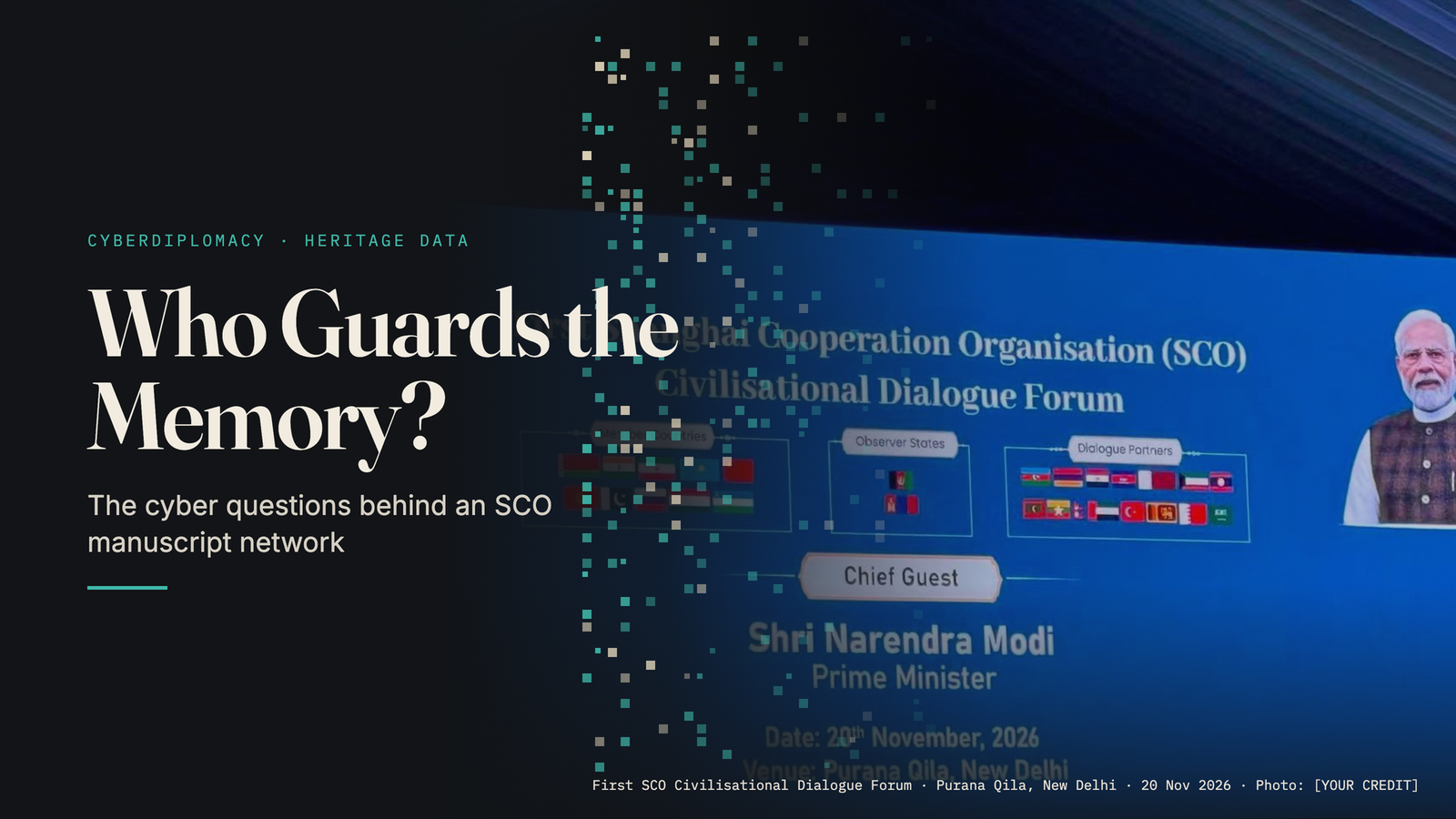
A proposal to digitise the region's shared written heritage is welcome. Before anyone builds it, the countries involved need to agree on who holds the data, who can change it, and who protects it.
At the first SCO Civilisational Dialogue Forum, held at New Delhi's Purana Qila, India and Iran met on the sidelines to discuss cultural cooperation. The most concrete idea to come out of the forum was Iran's proposal for an "SCO Joint Network for Written Heritage and Civilisational Memory." It would bring member states together to preserve and digitise manuscripts and historical documents, train restorers, and support joint research, publications and exhibitions.
India's Culture Secretary said several ideas were discussed but no project has been finalised. That makes this the right moment to raise a point that was missing from the conversation. Nobody mentioned cybersecurity. Yet once these manuscripts are digitised and shared across borders, the network becomes a piece of digital infrastructure, and it will need protecting like any other.
Digitisation turns heritage into data
The case for the network is strong. India and Iran share centuries of written heritage in Persian, Arabic and other languages, spread across libraries, shrines and private collections. Iran's Noor International Microfilm Centre has already digitised more than 150,000 Persian and Arabic manuscripts and has worked with Indian institutions, including on projects in Telangana and Hyderabad. Scaling that work across the SCO could save fragile documents and open them to scholars everywhere.
But once a manuscript becomes a file, the risks change. A physical manuscript can be lost to fire, damp or theft. A digital collection can be lost to ransomware, altered without anyone noticing, cut off by a sanctions decision, or quietly controlled by whichever country runs the servers. Cultural institutions have learned this the hard way. The 2023 ransomware attack on the British Library took much of its digital services offline for months. Heritage bodies tend to have small IT budgets and few security staff, which makes them easy targets.
Five questions to settle before the first scan
1. Where will the data live, and under whose laws? The SCO brings together countries with very different legal systems, data protection laws and relationships with each other. India now has its own data protection framework. Other members have laws that give the state broad access to stored data. A shared archive hosted in one member state falls under that state's laws. Members should agree on hosting and jurisdiction openly at the start, not leave it to whoever offers servers first.
2. Who owns the digital copy? Owning a manuscript and owning its digital image are not the same thing. If an Indian library's manuscript is scanned with another country's equipment and stored on its servers, who decides how the image is licensed, shared or commercialised? The network needs a clear charter that keeps custodial rights with the institution that holds the original.
3. How will the records be kept authentic? Heritage carries political weight. Texts about borders, religion, dynasties and identity can be contested. A shared archive must make it possible to prove that a digital copy has not been altered, and to keep a full record of who changed metadata, translations or catalogue entries. Cryptographic checks on files and tamper-evident audit logs are standard tools for this and should be designed in from the start.
4. What happens when politics or sanctions get in the way? Iran works under extensive international sanctions, and parts of the region have been affected by conflict this year. Sanctions can limit access to cloud services, software licences and security updates. A network that depends on a single host or provider can be cut off overnight. The answer is distributed custody: each participating country keeps a full, verified copy of its own material, and the network connects them rather than centralising everything in one place.
5. Who responds when something goes wrong? If the archive is breached or held to ransom, who leads the response, and how do national cyber agencies coordinate? Heritage institutions should not be left to handle incidents alone. The network should name a point of contact in each country's national CERT and agree on a shared incident response plan before going live.
A better way to build it
None of this argues against the network. It argues for building it properly. A few principles would go a long way:
- Agree on governance before technology. Set out data ownership, hosting, access rights and dispute resolution in a charter before procuring any systems.
- Distribute, don't centralise. Use a federated model where each country hosts its own collections and shares them through common, open standards, such as the International Image Interoperability Framework (IIIF) widely used by libraries and museums.
- Build integrity in from day one. Every file should carry verifiable checksums, and every change should leave an audit trail.
- Keep offline copies. Ransomware-resistant offline backups, stored in each country, are the simplest protection against the worst outcome.
- Make security part of the training. The proposal already includes training in manuscript restoration. It should also include training in basic digital security for archivists and librarians.
- Involve national cyber agencies early. Bring CERTs into the design, not just the response.
Why this matters for cyberdiplomacy
This proposal is a useful reminder that cyber issues now appear in places where diplomats don't expect them. A forum about civilisation and culture produced an idea that is, at its core, a cross-border data-sharing project among countries with very different approaches to data, sovereignty and security.
India is well placed to shape it. It has experience building large-scale digital public infrastructure, a national manuscripts mission, and a growing body of data protection law. If India helps set the rules for this network, covering ownership, federated hosting, integrity and incident response, it can make the project a model for trusted digital cooperation within the SCO rather than a new vulnerability.
The manuscripts have survived centuries of war, empire and neglect. The goal now should be to make sure their digital copies survive too, under rules that every participating country can trust.
Based on reporting of the India-Iran bilateral meeting on the sidelines of the SCO Civilisational Dialogue Forum, New Delhi, November 2026. Iran's Embassy in India announced the proposed SCO Joint Network for Written Heritage and Civilisational Memory.