
Africa's Intelligence Shield: How AI Is Rewriting the Continent's Defence Playbook
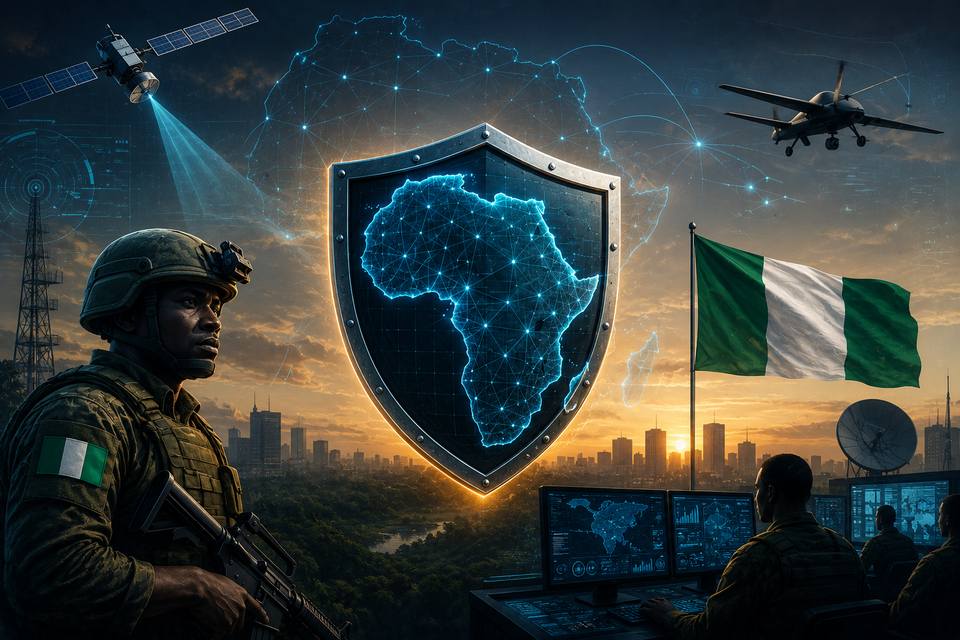
Nigeria's $190 million deal with UK firm MARSS Group is not just a procurement decision. It is a signal — that Africa's security future will be built on artificial intelligence, and that the race to build it has already begun.
A Continent at a Security Crossroads
Africa is fighting a multi-front war. On one side: armed insurgencies, cross-border terrorism, and organised crime networks that have destabilised swathes of West Africa, the Sahel, and the Horn of Africa. On the other: an accelerating wave of cyber threats exploiting rapidly expanding digital infrastructure, mobile financial systems, and government networks that were never designed for the modern threat environment.
Cyberattacks account for 68% of successful breaches across the African continent, with criminal networks increasingly targeting law enforcement databases and terrorist organisations exploiting weak digital defences. At the same time, physical security threats from groups like Boko Haram, ISWAP, and Al-Shabaab continue to test the limits of conventional military response.
The answer emerging across the continent is not more troops or more hardware. It is intelligence — artificial, networked, and real-time.
Nigeria's Landmark Bet: The Intelligence Shield
In March 2026, Africa's most populous nation made the most significant defence technology investment in the continent's recent history. The Nigerian Ministry of Defence signed a $190 million Memorandum of Understanding with UK-based defence technology firm MARSS Group on March 19, 2026, to establish a national AI-powered security network — one of the largest defence technology investments in Africa.
The deal, finalised in London during an official state visit and backed by the UK Government and UK Export Finance, initiates a multi-year programme with a singular ambition: to give Nigeria its first fully integrated national defence architecture.
The programme targets asymmetric threats from terrorism and organised insurgency facing Nigeria and the wider West African region, and marks one of the first national-scale adoptions of AI-enabled C4I on the African continent.
In May 2026, Minister of Defence General Christopher Gwabin Musa led a senior government delegation to MARSS's R&D and technology innovation lab — receiving live demonstrations of the core systems and marking a tangible step from agreement to implementation.
What Is NiDAR and Why Does It Matter?
At the heart of the programme is MARSS's NiDAR platform — a Command, Control, Communications, Computers, and Intelligence (C4I) system built around AI-driven situational awareness.
NiDAR provides 360-degree situational awareness across air, surface, sub-surface, and land domains, autonomously detecting, tracking, classifying, and recommending responses to asymmetric threats. It is currently operational across more than 60 sites globally, protecting military and critical infrastructure installations.
For Nigeria, the deployment will be nothing short of a national nervous system for defence. The programme scope includes a fleet of expeditionary platforms equipped with a mix of sensors and effectors, meshed by the NiDAR C4I system, alongside a new national command centre featuring a Centre of Excellence to train Nigerian operators and maintain operational readiness at all levels.
The Multi-Domain Hybrid Intelligence Shield — as the integrated system is known — brings together two of NiDAR's latest capability upgrades: NiDAR Nation Shield, which enables those in expeditionary vehicles, piloting UAVs, or operating in regional and national hubs to work from the same single operational picture, allowing faster and more accurate decision-making across tactical, operational, and strategic levels simultaneously.
Critically, the programme is designed with longevity in mind. By building a local training and maintenance ecosystem, the programme aims to avoid the equipment graveyard effect often seen in large-scale defence procurements, where assets fail due to a lack of local technical support. This is not aid. It is capacity building with accountability built in.
The Threat Landscape Driving the Shift
To understand why Nigeria — and Africa more broadly — is investing in AI-powered defence now, you have to understand what it is up against.
In the physical domain, the threat is acute and evolving. West Africa has witnessed the collapse of multiple governments to military coups in recent years, with jihadist insurgencies filling the resulting governance vacuums across Mali, Burkina Faso, and Niger. Nigeria's northeast remains a battleground against ISWAP and remnants of Boko Haram. The Lake Chad Basin is a theatre of asymmetric warfare that conventional military doctrine has repeatedly failed to contain.
In the digital domain, the threat is just as serious and growing faster. With cyberattacks in the region occurring at a rate roughly 60% higher than the global average, reactive defences are insufficient. Africa's rapid digital transformation — cloud adoption across Sub-Saharan Africa has reached 61% — has dramatically expanded the attack surface for adversaries.
In Africa's mobile-first economy, AI-generated deception has become the fastest-growing threat — with SIM-swap fraud already costing South Africa over R5 billion annually, and the rise of cloned voice approvals and synthetic interactions threatening to bypass traditional mobile authentication systems. Meanwhile, ransomware has evolved into targeted data-extortion operations against critical infrastructure — power grids, financial institutions, and government systems.
The convergence of physical and cyber threats is not theoretical. Terrorist organisations are actively exploiting weak digital defences to coordinate operations, transfer funds, recruit online, and gather intelligence. Defending the physical frontier without securing the digital one is an incomplete strategy.
Africa's Broader AI Defence Awakening
Nigeria is not moving alone. Across the continent, a recognition is building that the security challenges of the 21st century demand 21st-century tools.
South Africa — which has the third-highest incidence of cyberattacks in the world — faces a deepening crisis where citizens are being scammed and defrauded by sophisticated cybercriminal gangs, businesses are being held to ransom, and the country's own defence organisations regularly fall victim to attacks. Analysts there have called for a dedicated, politically insulated national cybersecurity organisation as a matter of national survival.
At the Regional Consultative Seminar on Harnessing Artificial Intelligence and Cybersecurity for Security, Cooperation, and Resilience held in Nairobi in June 2025, regional leaders warned that by 2035, AI could contribute $180 billion to Africa's regional GDP while creating 2.5 million jobs — but only if the continent acts decisively to build secure foundations.
The Africa Center for Strategic Studies launched an AI for Africa's Defense Forces Toolkit in February 2026, and a growing series of inter-governmental workshops on AI strategy in the security domain reflects the rising urgency at the policy level. The question is shifting from whether to adopt AI in defence to how fast and on whose terms.
The Sovereignty Question
The Nigeria-MARSS deal raises a question that will become increasingly central to African defence policy: when a continent buys its intelligence infrastructure from abroad, who ultimately controls the intelligence?
The programme's inclusion of local partners MPS Mikopowers Ltd and APS Aegis Ltd is significant — as is the deliberate investment in a Centre of Excellence to build indigenous Nigerian operator capability. The UK Government's backing through UK Export Finance situates this firmly within a Western strategic partnership framework, distinct from the parallel competition for African security relationships being waged by Russia (through Wagner/Africa Corps deployments) and China (through dual-use infrastructure investments).
African nations are acutely aware that defence partnerships carry geopolitical strings. The Sahel's experience — where French military partnerships were first welcomed, then rejected, and replaced with Russian mercenary forces — is a cautionary tale about the politics of security dependency. The Nigeria-MARSS model, with its emphasis on local capacity building, training infrastructure, and sovereign operational control, appears designed to address that concern directly.
But the deeper sovereignty question is about data. An AI-powered C4I system that aggregates intelligence on border movements, threat actors, communications, and critical infrastructure is an extraordinarily valuable dataset. Who owns that data, who can access it, and what governance frameworks govern its use are questions that no $190 million MoU can fully answer — and that African governments are only beginning to build the regulatory capacity to ask.
What Comes Next
Nigeria's Intelligence Shield programme is a milestone, but it is a beginning, not a conclusion. The real test will come in implementation — whether the technology performs in the complex, resource-constrained operational environment of northern Nigeria; whether local technical capacity is actually built and retained; and whether the system can adapt as the threat landscape continues to evolve.
With 80% of African nations still lacking basic cybersecurity infrastructure, and cybercrime costing the continent $4 billion annually, the gap between the ambition of programmes like NiDAR and the baseline security reality across the continent remains vast.
But ambition has to start somewhere. Nigeria, Africa's largest economy and most populous nation, has chosen to start with a national AI nervous system for defence. Other nations will be watching closely.
The intelligence shield is being built. The continent that gets this right — that builds AI-enabled security architecture without surrendering sovereignty, that bridges the cyber skills gap without creating permanent dependency on foreign expertise, and that uses technology to protect citizens rather than surveil them — will define the template for African security in the decades ahead.
The window to shape that template is now.
Tags: Nigeria · Africa Defence · AI · Cybersecurity · MARSS Group · NiDAR · C4I · Intelligence Shield · West Africa · National Security · UK Defence · MoRTH · Asymmetric Threats · Military Africa
Member discussion