
When Silicon Stops Having a Conscience
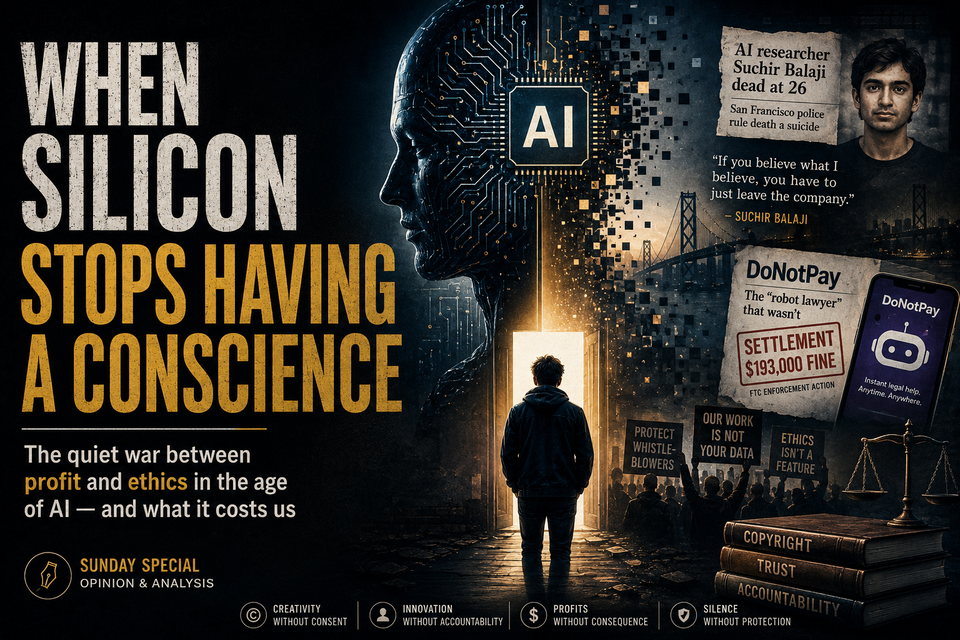
The quiet war between profit and ethics in the age of AI — and what it costs us
Sunday Special | Opinion & Analysis
There is a particular kind of silence that follows when someone speaks the truth in a room full of people who profit from the lie.
Suchir Balaji knew that silence well. In October 2024, the 26-year-old AI researcher — who had spent four years at OpenAI helping gather and organise the very internet data used to train ChatGPT — walked out of one of the most powerful companies in the world and went public with a simple, devastating claim: that OpenAI had built its empire on a foundation of mass copyright infringement. "If you believe what I believe," he told the reporter who interviewed him for the New York Times, "you have to just leave the company."
One month later, he was dead.
The Weight of Speaking Up
The San Francisco police ruled Balaji's death a suicide. The medical examiner confirmed it. His parents, wracked with grief and disbelief, have disputed the finding and filed lawsuits seeking answers. Whether or not one accepts the official conclusion, the story of Suchir Balaji represents something that goes beyond any single death or any single company.
It is a story about what it costs to have a conscience in the tech industry today.
Balaji was not a disgruntled employee with an axe to grind. He was, by all accounts, intellectually brilliant and morally serious — a young man who began coding at eleven, built his own computer at thirteen, and joined OpenAI straight out of Berkeley because he genuinely believed in the mission. He left because that belief broke against the reality of what he saw. His essay, "When does generative AI qualify for fair use?", methodically argued that AI chatbots like ChatGPT fail the legal test for fair use under US copyright law — that the entire generative AI boom may rest on the systematic, unlicensed consumption of human creative work.
He wasn't the first to say this. He was the first insider with four years of intimate knowledge of the machinery to say it on the record, in the Times, with his face attached.
OpenAI, meanwhile, remains the hottest startup in the world, currently seeking up to $100 billion in new investment. The AI Whistleblower Protection Act, introduced bipartisanly in May 2025, has been stuck in committee for nearly a year — a bill that could have codified protections for exactly the kind of insider knowledge Balaji possessed, still gathering dust while the industry it was meant to govern charges ahead.
The DoNotPay Parable: Fraud as a Feature
If Balaji's story is a tragedy, the saga of DoNotPay is something closer to a dark comedy — one that tells us everything about how the tech industry relates to ethics when no one is watching.
Founded in 2016 by Joshua Browder, a Stanford dropout and Thiel Fellow, DoNotPay branded itself "the world's first robot lawyer." Its promise was seductive: AI-powered legal help for the common person, cutting expensive human lawyers out of the equation. Browder declared he wanted to "remove the word 'lawyer' from the dictionary" and "replace the $200-billion-dollar legal industry with artificial intelligence."
The pitch worked. It attracted media adoration and serious investors. But when the FTC finally looked under the hood in 2024, what they found was astonishing in its brazenness. DoNotPay had never tested whether its AI performed at the level of a human lawyer. It had never hired a single attorney to review the legal documents it was generating for users. It had been creating NDAs, custody agreements, prenuptial agreements, and court filings for hundreds of thousands of customers — all without any legal oversight whatsoever.
The company even cited a glowing endorsement that appeared to be from the Los Angeles Times. It was actually from the LA Times High School Insider — a student-run content platform.
The FTC fined DoNotPay $193,000 — a sum so small relative to its valuations and funding that it barely qualifies as a slap on the wrist. The company admitted no wrongdoing. It is still operating. New investors are still circling.
This is the world we are in.
The Philosophy of Consequence-Free Innovation
The ancient Greeks had a concept called hubris — not merely arrogance, but the specific arrogance of believing oneself exempt from the natural laws that govern all others. It was considered the most dangerous of human failings, precisely because it preceded catastrophe with such a convincing sense of immunity.
Silicon Valley has institutionalised hubris. "Move fast and break things" was never just a product philosophy — it was a moral stance. It declared, explicitly, that the friction caused by caution, ethics, and accountability was an acceptable price for speed. What it left out was who pays that price.
Ordinary people paying DoNotPay for legal help they desperately needed, trusting an AI that had never been vetted by a single actual lawyer — they paid. Copyright holders whose life's work was consumed without consent to train models that now compete with them commercially — they paid. Whistleblowers like Suchir Balaji, who dared to name what was happening — they paid most dearly of all.
Meanwhile, the Promethean figures at the top of this industry tend to pay very little. OpenAI's Sam Altman raises billions. DoNotPay's Browder raises more rounds. The industry keeps expanding, and the accountability gap between harm caused and consequence suffered grows wider with each funding cycle.
The philosopher Hannah Arendt wrote about the "banality of evil" — the observation that great harms are most often not committed by monsters, but by ordinary people operating within systems that normalise harm through bureaucratic process and institutional indifference. She was writing about totalitarian regimes, but the insight applies wherever large-scale harm is generated without anyone in particular being held responsible.
No one at OpenAI decided to harm writers and journalists. No one at DoNotPay intended to defraud vulnerable people seeking legal help. These were the aggregate outcomes of thousands of individual decisions made within institutional cultures that rewarded speed, scale, and financial growth — and treated ethics as a PR problem to be managed rather than a foundation to be built upon.
The Structural Problem: Ethics Has No Lobby
Here is the uncomfortable truth at the centre of this moment: in the current architecture of the tech industry, ethics has no institutional power.
It has plenty of institutional presence. Every major AI company has an ethics team, a safety committee, a responsible AI framework. These exist, in the main, to provide reassurance to regulators and investors — not to function as genuine brakes on decisions that generate revenue. The moment ethical concerns conflict with a product timeline or a fundraising round, ethics loses.
Suchir Balaji understood this. He left a company paying him handsomely because he concluded that the only honest response to what he saw was departure and disclosure. Whistleblower protections in the AI industry remain, as of today, almost nonexistent as a matter of law. The bill that could have helped sits in committee. The industry self-regulates. The self-regulation is voluntary. The voluntary commitments are rarely binding. The cycle continues.
DoNotPay is a microcosm of the same dynamic. The company's entire premise — that you can replace human professional judgment with AI and still claim equivalence — was ethically untenable from the beginning. But it was also fundable, scalable, and profitable for long enough that investors had no incentive to ask hard questions. The FTC's eventual enforcement was meaningful but belated. And the fine was, effectively, a cost of doing business.
Where Are We Headed?
There is a version of this future that looks like consolidation of a new feudalism — a small number of AI companies with access to the world's data, the world's compute, and the world's regulatory tolerance, able to absorb fines, weather scandals, and outlast any individual critic. A world where the Suchir Balajis are remembered in footnotes while the companies they criticised become utilities as essential and unaccountable as electricity grids.
There is another version — harder to see from inside the current moment, but historically more plausible. Every era of technological disruption that caused sufficient harm eventually produced the regulatory and cultural response that bounded it. The Industrial Revolution produced labour law. The financial industry's excesses produced the SEC. The tobacco industry's predations took decades but eventually produced consequences.
AI's reckoning is coming. The question is how much harm accumulates before it does.
What we owe to Suchir Balaji — and to every person misled by a robot lawyer, every artist whose work was ingested without consent, every employee pressured into silence — is to refuse the comfortable narrative that this is simply innovation moving faster than regulation. That framing flatters the powerful and obscures the choices that real, named, accountable people made.
Ethics is not a constraint on progress. It is the condition for progress that deserves to last. Every civilisation that forgot this distinction eventually learned it the hard way.
We are not exempt.
This Sunday Special draws on reporting from The Nation, Fortune, the San Francisco Standard, the FTC's enforcement record, and public documents related to the cases of Suchir Balaji and DoNotPay.
Member discussion