
AI and the Future of Counter-Terrorism: What Just Wrapped at UN Headquarters Signals for the Fight Ahead
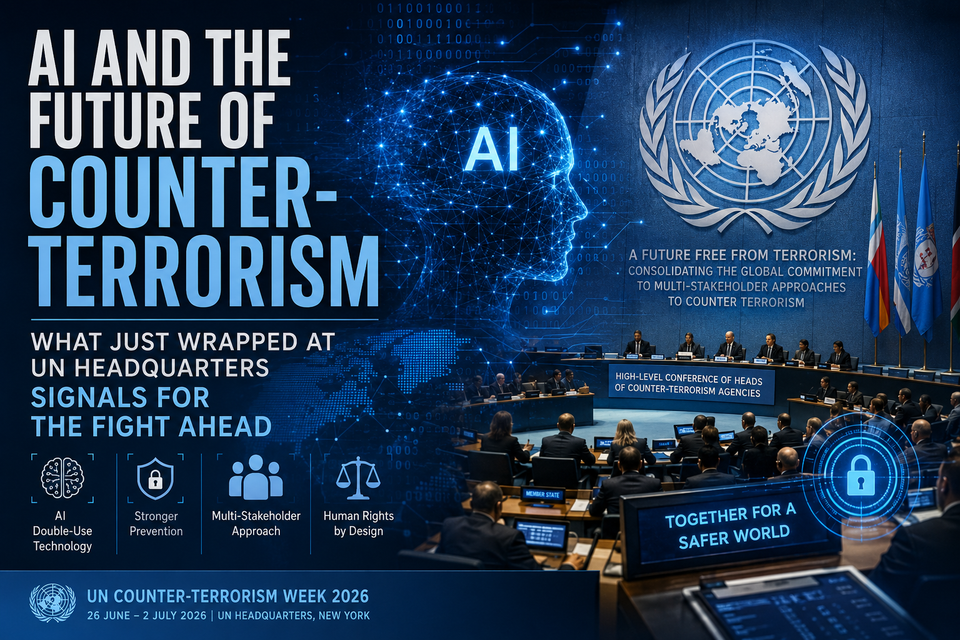
A high-level session on artificial intelligence closed out this year's UN Counter-Terrorism Week — part of a broader reckoning with how AI is reshaping both the terrorist threat and the institutions built to counter it
The United Nations wrapped its Fourth Counter-Terrorism Week on 2 July, and artificial intelligence was one of the defining threads running through it. Held at UN Headquarters in New York from 26 June to 2 July under the theme "A Future Free from Terrorism: Consolidating the Global Commitment to Multi-Stakeholder Approaches to Counter Terrorism," the week combined a High-Level Conference of Heads of Counter-Terrorism Agencies (29–30 June) with roughly 40 side events convened by member states, UN entities, regional organizations, and civil society groups — and a session on AI and the future of counter-terrorism institutions and operations fit squarely within a week that gave the technology its own dedicated thematic track for the first time.
That track — "Strategic Capacity-Building Responses: Countering the Misuse of AI and New and Emerging Technologies" — was one of four thematic sessions at the High-Level Conference, alongside sessions on conflict-affected contexts, networked multilateralism, and the global threat landscape. Its inclusion reflects how central the technology has become to UN counter-terrorism planning, a shift that's been building for several years but has accelerated sharply over the past twelve months.
Why AI Has Moved to the Center of the Conversation
UN officials have been increasingly direct about the stakes. Acting Under-Secretary-General for Counter-Terrorism Alexandre Zouev told the opening of the High-Level Conference that terrorist groups including Al-Qaeda, ISIL/Da'esh, and their affiliates remain adaptive and resilient, and are growing more sophisticated in part through their use of artificial intelligence and cyber capabilities — leveraging instability, governance gaps, and socioeconomic inequality alongside emerging technology to expand their reach and mobilize resources. Secretary-General António Guterres struck a similar note in his own remarks during the week, warning that AI, digital platforms, and unmanned weapons have supercharged terrorist groups' ability to recruit, finance, and plan attacks — while also stressing that the same technologies, used responsibly, can help detect threats earlier, disrupt illicit financing, and map the pathways that lead people toward radicalization.
That dual-use framing — AI as both an accelerant of terrorist capability and a tool for countering it — has been the throughline of UN thinking on this issue since UNOCT and the UN Interregional Crime and Justice Research Institute (UNICRI) began jointly researching the question in 2020. It's shown up repeatedly in the UN's own institutional output: the 2021 report "Algorithms and Terrorism: The Malicious Use of Artificial Intelligence for Terrorist Purposes," a 2025 UNODC symposium examining AI-driven radicalization and disinformation, and a February 2026 Special Dialogue with the Republic of Korea that launched a new Practice Guide on AI and preventing violent extremism.
The Institutional Readiness Gap
What distinguishes this year's discussions from earlier ones is a sharper focus on operational and institutional readiness — not just what AI can theoretically do, but whether counter-terrorism agencies and prevention practitioners are actually equipped to use it responsibly, or to defend against its misuse. A 2025 UNOCT global survey of PCVE (preventing and countering violent extremism) practitioners and policymakers across 45 countries found that fewer than a quarter currently use AI in their work, with significant gaps in AI literacy, governance frameworks, and institutional capacity. That gap between the pace of technological change and the pace of institutional adaptation has become a recurring concern across UN counter-terrorism programming this year, including in an earlier CT Week side event on terrorist use of drones, where officials noted that regulatory fragmentation and uneven national capacity are letting the availability of new technology outstrip states' ability to actually prevent or respond to its misuse.
Speakers at UN-hosted panels earlier this year have described the resulting threat landscape as "multipolar and sophisticated" — a reference to how AI, encrypted communications, and digital assets are lowering the barriers for a widening range of actors, from established terrorist organizations to loosely networked extremist movements with no clear leadership structure, to exploit the same tools nearly simultaneously.
Human Rights as a Design Constraint, Not an Afterthought
A consistent feature of UN discussions on AI and counter-terrorism — one that has shown up in nearly every related session this year — is the insistence that human rights safeguards be built into AI deployment from the outset rather than added after the fact. Officials from the Office of the High Commissioner for Human Rights and the Counter-Terrorism Committee Executive Directorate have repeatedly flagged the risks of algorithmic bias, over-surveillance, and erosion of public trust that come with deploying AI-enabled monitoring or predictive tools in counter-terrorism contexts, particularly where oversight and accountability mechanisms haven't kept pace with the technology's rollout. That tension — between AI's potential to reduce the need for more invasive surveillance and its potential to entrench exactly that kind of overreach if poorly governed — has become one of the UN's central talking points on the issue, and one it has been notably unable to fully resolve through non-binding guidance alone.
What Comes Next
The Counter-Terrorism Week closed with the UN General Assembly's ninth review of the Global Counter-Terrorism Strategy on 1–2 July, marking the twentieth anniversary of the strategy's original adoption. Whatever specific commitments emerged from this year's AI-focused sessions will now feed into that broader strategic review process — the mechanism through which member states periodically recalibrate the UN's counter-terrorism priorities. Given the trajectory of the last several years of UN programming on this issue, the likely near-term output is more of what's already underway: practical guidance documents, capacity-building support for under-resourced member states, and continued advocacy for human rights-compliant AI governance — an approach built for consensus-building among 193 member states with very different levels of technical capacity, but one that will keep facing pressure from a threat landscape that, by the UN's own admission, is evolving considerably faster than multilateral institutions are able to.
This article draws on official UN Office of Counter-Terrorism documentation, UN News, and coverage of the Fourth UN Counter-Terrorism Week (26 June–2 July 2026) and related 2026 programming. Specific proceedings, speakers, and remarks from the individually named session were not independently verifiable through public reporting at the time of writing; this piece situates it within the confirmed themes, structure, and prior programming of CT Week 2026 and UNOCT's broader AI and counter-terrorism work.
Member discussion