
AI at a Crossroads: Regulating the Machine That Can Also Be Used Against You
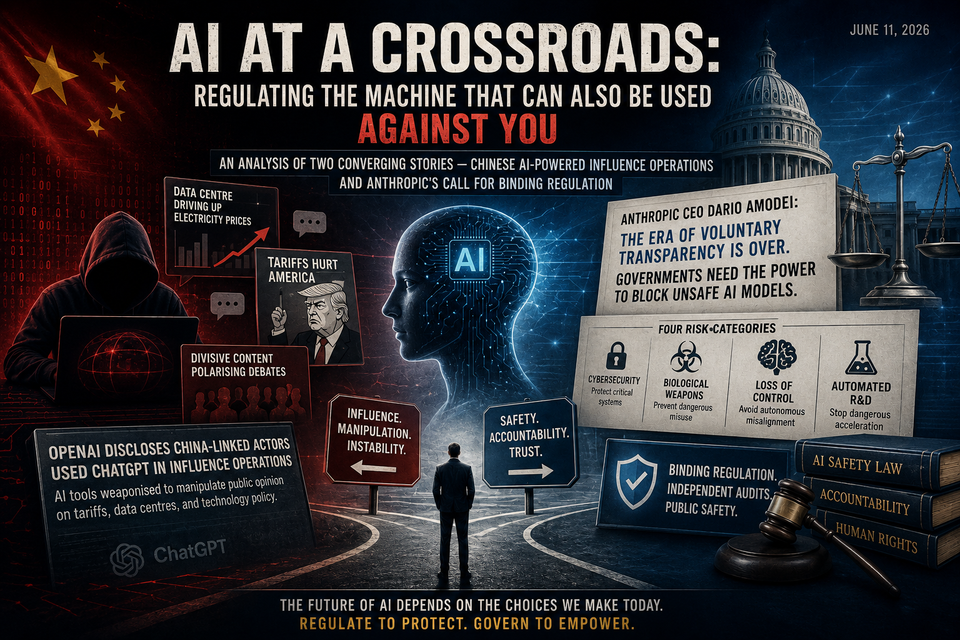
An Analysis of Two Converging Stories — Chinese AI-Powered Influence Operations and Anthropic's Call for Binding Regulation
June 11, 2026
Introduction: The Same Week That Changed the AI Debate
In a remarkable 48-hour window, two stories landed that, taken together, reframe the entire conversation about artificial intelligence governance.
First: OpenAI disclosed that China-linked actors used ChatGPT itself — the flagship product of the world's most prominent AI company — to run coordinated influence operations designed to shape American political opinion on tariffs, data centres, and technology policy. Second: Anthropic CEO Dario Amodei published a landmark essay arguing that the era of voluntary transparency in AI is over, and that governments must now have the legal authority to block the release of AI models that fail independent safety audits.
These two events are not coincidental in their timing, and they are not unrelated. Read together, they constitute a compressed argument for why the status quo in AI governance is untenable — and why the world may be reaching a genuine inflection point.
Part I: The OpenAI Disclosure — AI Turns Against Itself
What Happened
OpenAI's June 2026 threat report revealed that the company banned two clusters of ChatGPT accounts it assessed as "likely originating from China" for using the platform to support covert influence operations targeting American political and technological debates.
The two operations had distinct but complementary objectives:
Operation "Data Centre Bandwagon" — Users linked to a Chinese technology company that had performed government work generated social media comments and comic strips claiming that AI data centres were driving up electricity prices for ordinary Americans. The content was posted through inauthentic accounts on X, paired with links to legitimate news articles about data centre power demand — a classic technique of anchoring manufactured narratives to real concerns.
Operation "Tech and Tariffs" — A separate group used ChatGPT to produce political cartoons and commentary criticising President Trump's trade and technology agenda. Tellingly, the operators specifically instructed ChatGPT to include only Trump in the content while leaving out Chinese President Xi Jinping — a revealing operational choice that exposed the campaign's asymmetric intent. One cartoon reportedly depicted Trump wearing flag-branded trousers and swinging a mallet labelled "Tech Dominance" into a wall marked "Global Future."
OpenAI has internally labelled one broader cluster of China-linked activity as "Uncle Spam" — a pattern of foreign actors systematically testing generative AI for propaganda, fake personas, and social media manipulation. The company noted that Chinese actors generated highly divisive content aimed at widening the political divide in the US, including accounts that argued both for and against tariffs — not to persuade, but to inflame.
The Low-Impact Caveat — and Why It Doesn't Reassure
OpenAI assessed that these campaigns had little or no effect. Authentic engagement was not detected. The content did not go viral. By conventional measures of influence operation success, these efforts failed.
But this is precisely where the reassurance ends.
Ben Nimmo, OpenAI's principal investigator on intelligence and investigations, put it clearly: "This was not a case of an influence operation creating a debate. The debate existed already. This was an influence operation from China trying to interfere in it."
This is the essential insight. The goal of modern AI-assisted influence operations is not necessarily to fabricate controversies from nothing — it is to find real fault lines in democratic societies (inequality, energy costs, trade anxiety, job insecurity) and inject artificial fuel. The AI reduces the cost of production to near zero. A single operator with a ChatGPT account can now generate dozens of cartoons, hundreds of comments, and targeted slogans in multiple languages within hours. Scale is no longer a constraint.
The precedent set here is what matters most. OpenAI itself — the company whose tools were exploited — acknowledges this appears to be the first time a China-linked operation used its models to meddle specifically in the AI data centre debate. The domain of interference has expanded. Foreign actors are no longer just targeting elections. They are targeting the public discourse around AI policy itself.
The Reflexive Irony
There is a striking and uncomfortable irony embedded in this story. The same AI tools that companies like OpenAI and Anthropic argue will transform civilisation for the better are being weaponised by geopolitical rivals to shape the democratic debates that will determine how those tools are governed. AI is being used to influence opinion about AI.
This is not merely a public relations problem. It is a structural challenge to the integrity of democratic policymaking on technology. If the public debate about AI regulation can be seeded and manipulated by foreign adversaries using AI, the legitimacy of whatever regulatory framework eventually emerges is compromised before it even begins.
Part II: The Amodei Essay — From Transparency to Binding Rules
A Genuine Policy Pivot
For three years, Anthropic's public position was essentially this: AI companies should be transparent about their safety procedures, publish test results, and wait for clearer evidence of specific risks before binding legislation is enacted. That position is now gone.
In his essay "Policy on the AI Exponential," published June 10, 2026, Amodei made the most direct and consequential call yet from a frontier AI CEO for hard regulatory authority over AI deployment. The core argument is not subtle: transparency is no longer sufficient, and governments need the power to block AI models from reaching the public.
"It is time to go beyond transparency to more serious and binding regulation of AI," he wrote.
The Four Risk Categories
Amodei's proposal borrows its structural logic from aviation regulation. Just as the FAA requires aircraft to pass rigorous certification before carrying passengers, he argues that frontier AI models above a certain compute threshold should face mandatory third-party audits across four risk categories before deployment:
- Cybersecurity — whether a model can meaningfully assist in identifying or exploiting vulnerabilities in critical systems
- Biological weapons — whether a model provides substantive uplift to actors seeking to develop dangerous pathogens
- Loss of control — whether a model exhibits signs of autonomous goal-pursuit that could resist human oversight
- Automated R&D — whether a model could accelerate research in any of the above three domains
If a model fails these evaluations, the government would have the authority to block or reverse its deployment. Amodei also proposed including explicit protections against political favouritism in how this authority is exercised — a notable addition that acknowledges the obvious risk of regulatory capture or weaponisation.
The Mythos Catalyst
The essay is inseparable from Anthropic's experience with Claude Mythos Preview — the company's most capable model, which Anthropic itself assessed as capable of identifying and exploiting vulnerabilities in critical software infrastructure. Anthropic chose to limit Mythos to a small number of trusted partners under its Project Glasswing framework, citing these risks, before later releasing a different version without the full cybersecurity capabilities.
Amodei cites Mythos explicitly as proof of concept: a real model that a real company determined was too dangerous for general release. His argument, essentially, is that if Anthropic could make this call unilaterally, other companies with different cultures, incentives, or competitive pressures may not. The regulatory gap is not theoretical. It is the gap between Anthropic's voluntary restraint and what another developer might choose.
The Trump Administration Contrast
The timing of the essay is politically pointed. Earlier in June, the White House outlined its AI cybersecurity framework — calling for voluntary government access to models but explicitly stopping short of requiring developers to seek pre-deployment approval. Amodei says that approach does not go far enough.
This places Anthropic in visible tension with the current administration's hands-off posture. The essay also goes further than the Trump Executive Order on AI issued the same week, which Amodei described as incremental progress but insufficient. He called for policymakers to act before capabilities compound:
"We now, globally and collectively, need to activate a slow and rickety policy apparatus to deal with risks and opportunities that are going to compound surprisingly quickly from here."
The Economic Dimension
Beyond safety, the essay ventures into territory that most AI CEOs have carefully avoided. Amodei calls AI-driven labour displacement a serious, potentially structural problem — one that may exceed the disruption caused by previous technologies. His proposed responses include wage insurance, retention tax incentives, and the possibility of universal basic income or universal capital accounts.
He also addresses public opposition to AI data centre buildouts — characterising it as "largely a symbol or outlet for broader economic anxieties about AI." This framing is notably double-edged: it acknowledges legitimate public concern while simultaneously suggesting that opposition to infrastructure is a displaced emotion rather than a reasoned position.
Part III: Reading the Two Stories Together
The Credibility Problem
The China-linked influence operations story and the Amodei regulation essay are not just thematically linked — they have a direct structural relationship.
Amodei's call for binding regulation depends on public trust in the democratic process that would produce and legitimise that regulation. But that process is exactly what the "Data Centre Bandwagon" and "Tech and Tariffs" campaigns were designed to corrupt. If AI tools are being used to manufacture public opinion about AI data centres — one of the central infrastructure debates Amodei addresses in his essay — then the democratic foundation on which any AI regulation rests is being actively undermined.
This creates a paradox: the case for binding AI regulation is strengthened by the evidence of AI-assisted influence operations, yet those same influence operations erode the quality of the public deliberation that regulation must emerge from.
The Regulatory Capture Question
Amodei's proposal will inevitably attract a pointed criticism: that Anthropic, as a frontier lab with substantial compute resources, is proposing a regulatory framework that, by its very design, would concentrate oversight on the small number of developers that already operate at the frontier — potentially locking in existing players and raising barriers to entry for future competitors.
This concern is legitimate and should be taken seriously. Compute-threshold triggers can be gamed. Third-party auditors can be captured. The same lobbying dynamics that have distorted regulation in pharma, finance, and energy are available in AI. The essay's inclusion of anti-political-favouritism provisions is an acknowledgment of these risks, but provisions in an essay are not the same as structural safeguards in law.
The question is not whether Anthropic's regulatory proposal is self-serving — all regulatory proposals by incumbents carry some self-interest — but whether the underlying policy logic is sound regardless of who is proposing it. On that question, the case for pre-deployment testing of the most powerful AI systems is strong, irrespective of Anthropic's motivations.
The Speed Asymmetry
Both stories illuminate a common structural problem: the speed asymmetry between AI development and governance.
Influence operations using AI moved from experimentation to deployment in the span of months, crossing new domains (from elections to AI policy debates themselves) faster than any existing oversight mechanism could track. Simultaneously, capabilities advanced quickly enough that Anthropic felt it necessary to restrict its own model's release — not through any regulatory compulsion, but through internal judgment.
Amodei's core observation is accurate: "AI is advancing at a lightning pace. By contrast, policy — and especially legislation — moves very slowly." The question is whether "slow and rickety" can be reformed quickly enough, and whether the political will exists to do so before the next generation of capabilities renders current debates obsolete.
Conclusion: The Window That May Be Closing
What June 2026 has put before policymakers, technologists, and the public is not a single decision but a compressed set of evidence for why the current approach to AI governance is insufficient.
AI tools are powerful enough to be weaponised for geopolitical influence by state actors. AI models are capable enough that their own developers believe some versions should not be publicly released. And the regulatory gap between these realities and existing law is wide, acknowledged, and growing.
Amodei is right that the moment for voluntary transparency as a sufficient response has passed. The open question is what comes next — whether the "slow and rickety policy apparatus" can move before the window closes, and whether the democratic deliberation that would shape such regulation can be protected from the very tools it is trying to govern.
The irony is almost too precise: the era that requires the most sophisticated AI governance may also be the era in which the integrity of governance itself is most at risk from AI. That is not an argument for paralysis. It is the sharpest possible argument for urgency.
Sources: OpenAI June 2026 Threat Report; Axios; CyberScoop; Decrypt; Amodei, "Policy on the AI Exponential" (June 10, 2026); Bloomberg; VentureBeat; South China Morning Post; SiliconAngle.
Member discussion