
Cyber Recruitment Scams: Is the Labour Ministry Responsible — And What Does the Law Say?
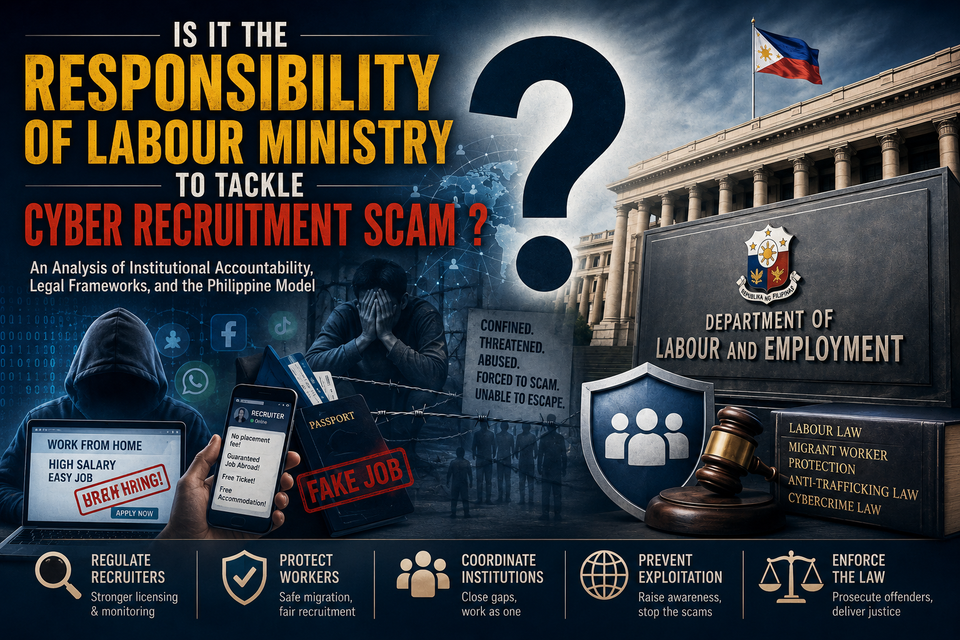
An Analysis of Institutional Accountability, Legal Frameworks, and the Philippine Model
Introduction: The Click That Changes Everything
It begins with a job advertisement — polished, persuasive, and utterly convincing. A well-paying role abroad. Free accommodation. A reputable company name. For millions of job seekers across the developing world, that single click can be the difference between prosperity and catastrophe.
Cyber recruitment scams have become one of the most brutal intersections of digital crime and labour exploitation in the 21st century. Behind many large-scale online fraud operations are not professional criminals, but ordinary people — migrant workers, students, fresh graduates — who responded to what appeared to be legitimate employment opportunities. The global cybercrime economy does not run on code alone. It runs on people.
The scale is staggering. The UN Human Rights Office, in a landmark February 2026 report, documented hundreds of thousands of people trafficked from dozens of countries into cyber scam centres across Southeast Asia and beyond — victims subjected to torture, sexual abuse, forced labour, and passport confiscation. In the first four months of 2025 alone, over 3,500 Bangladeshis were denied entry and deported as victims of digital recruitment scams. The ILO estimates that approximately 28 million people globally are in some form of forced labour, a significant portion of whom entered exploitation through fraudulent recruitment.
The central question this article addresses: Is the Labour Ministry the appropriate institution to lead the fight against cyber recruitment fraud, what legal tools exist to support this, and which country offers the most instructive model?
What Is Cyber Recruitment Fraud?
Cyber recruitment scams operate through a deceptively simple pipeline. Recruitment almost always begins with a promise — a well-crafted job advertisement, a professional-looking recruiter account, a lucrative salary, and the assurance of free travel and accommodation. Everything appears legitimate. Platforms exploited include Facebook groups, sponsored TikTok videos, WhatsApp groups, cloned corporate websites, and professional job boards.
Once a victim responds, scammers deploy escalating tactics: requests for processing fees, confiscation of documents upon arrival, transportation to remote or controlled locations, and ultimately, forced participation in criminal operations such as romance scams, crypto fraud, or cyberattacks — all under threat of violence. Survivors interviewed by UN Human Rights reported instances of being sold between scam compounds, subjected to "water prisons" for failing to meet scam quotas, and forced to witness the beating of fellow captives.
This is not simply cybercrime. It is labour trafficking facilitated by digital technology.
The Case FOR Labour Ministry Responsibility
1. The Recruitment Gateway Is a Labour Matter
Cyber recruitment scams are, at their origin, a corruption of the labour recruitment process. The fraudulent contract, the fake job order, the unlicensed broker — these are instruments that fall squarely within the regulatory remit of labour and employment ministries. The ILO's Declaration of Philadelphia, incorporated into its Constitution in 1946, establishes the foundational principle that "labour is not a commodity." This moral and legal foundation justifies strong state intervention in how workers are recruited — and by whom.
The ILO's Forced Labour Protocol (P029), which supplements Convention No. 29, explicitly requires states to strengthen labour inspection services, protect migrant and other workers from abusive and fraudulent practices during the recruitment process, and support due diligence by both the public and private sectors to prevent and respond to forced labour risks.
2. Licensing and Regulation of Recruiters
Only a Labour Ministry (or equivalent body) has the structural authority to license, monitor, audit, and revoke the credentials of recruitment agencies. In contexts where cyber scams rely on unlicensed brokers or licensed agencies that violate standards, the Labour Ministry is the first and most direct line of accountability. Kenya's Ministry of Labour and Social Protection, for example, uncovered an illegal recruitment scheme targeting Kenyan workers for jobs in Oman in January 2026, revealing the use of forged ministry stamps and unlicensed brokers — and immediately launched an investigation, demonstrating the ministry's role as the institutional gatekeeper against fraud.
3. Labour Migration Policy Is Labour Ministry Business
The regulation of overseas employment — pre-departure checks, bilateral labour agreements, worker protection standards, and standardised contracts — is fundamentally a labour policy function. Without ministry oversight, there is no systemic mechanism to ensure that workers departing for foreign employment are doing so through legitimate, verified channels.
The Case for SHARED Responsibility: The Coordination Gap
While the Labour Ministry plays a central role, cyber recruitment fraud is a cross-cutting challenge that exposes the limits of siloed governance.
In Bangladesh, a country deeply affected by the crisis, the Bureau of Manpower, Employment and Training (BMET) handles training, the Ministry of Expatriates' Welfare sets policy, the police tackle cybercrime, and the Bangladesh Bank regulates financial services — but these agencies do not always work together seamlessly. This fragmentation is dangerous. Scammers exploit exactly these institutional gaps.
The crime involves multiple dimensions:
- Digital infrastructure — Social media platforms, fake websites, messaging apps → Ministry of Communications / Cybercrime Units
- Financial flows — Fraudulent fees, money laundering → Financial regulators
- Border control — Interception of at-risk travellers → Immigration authorities
- Criminal prosecution — Trafficking charges → Law enforcement and judiciary
- Victim support — Repatriation, psychosocial care → Social welfare agencies
This is why international frameworks increasingly call for a lead agency model — where one ministry (typically Labour) anchors the response and coordinates across all relevant bodies, rather than a fragmented system where everyone has partial jurisdiction and no one has full accountability.
What the Law Says
International Law
ILO Convention No. 181 (Private Employment Agencies, 1997) requires member states to regulate private employment agencies, prohibit charging fees to workers, protect workers from abusive practices, and ensure adequate complaint mechanisms. This is the foundational international instrument for regulating recruiters.
ILO Protocol P029 (2014) builds on the Forced Labour Convention to explicitly address fraudulent recruitment as a precursor to forced labour. It mandates national policies, action plans, and labour inspection mechanisms to specifically protect migrant workers during the recruitment process.
UN Palermo Protocol (2000) — the Protocol to Prevent, Suppress and Punish Trafficking in Persons — criminalises the recruitment, transportation, or receipt of persons by means of deception or fraud for exploitation, including labour exploitation.
ILO General Principles and Operational Guidelines for Fair Recruitment (2016) establish that workers should never pay for recruitment, that all terms should be transparent and disclosed before departure, and that governments bear responsibility for enforcing these norms.
National Law: The Gap Between Text and Practice
In most countries, the legal architecture exists on paper but fails in enforcement:
- Cybercrime laws address digital fraud but often do not cover the specific act of fraudulent job advertising
- Labour laws regulate domestic employment but are weakly extended to overseas and digital recruitment
- Anti-trafficking laws catch the extreme end of the spectrum but rarely address the pre-departure fraud phase where intervention would be most effective
Pakistan is currently running the FJA PAK project (2025–2026), funded by the Norwegian Directorate for Immigration, specifically to address the gap between cyber fraud and illegal migration by strengthening institutional capacity, inter-agency cooperation, and public awareness — an acknowledgment that existing laws are insufficient without coordination infrastructure.
The critical legal gap: most countries have no legislation that specifically criminalises fraudulent online job advertising as a standalone offence. Victims must pursue their cases under general fraud, cybercrime, or trafficking statutes — a patchwork that is both costly and slow.
A Country That Gets It Right: The Philippines
Among all nations that send large numbers of overseas workers, the Philippines stands out as the most structurally advanced model for protecting citizens against fraudulent recruitment — including its cyber dimensions.
The Legal Architecture
The Philippines has built a layered legal framework specifically for this challenge:
- Republic Act No. 8042 (Migrant Workers and Overseas Filipinos Act, as amended by RA 10022) defines illegal recruitment comprehensively — including by non-licensees and by licensed recruiters who violate standards such as charging excessive fees or misrepresenting job conditions.
- Republic Act No. 10364 (Expanded Anti-Trafficking in Persons Act of 2012) explicitly links illegal recruitment to human trafficking, treating fraudulent recruitment for exploitative purposes as a trafficking offence.
- Republic Act No. 11641 (Department of Migrant Workers Act, 2021) established the Department of Migrant Workers (DMW) — a standalone ministry dedicated exclusively to overseas Filipino workers (OFWs), absorbing the functions of the Philippine Overseas Employment Administration (POEA).
The DMW Model: A Dedicated Labour Migration Authority
The DMW represents the gold standard of institutional design for this problem. It functions as a one-stop regulatory and protection body with the authority to:
- License and regulate all private recruitment agencies — no agency can legally recruit Filipino workers for overseas employment without DMW accreditation
- Verify all job orders before deployment — foreign employers cannot hire OFWs directly except under specific exemptions; all roles must be verified
- File administrative charges against violating agencies — the DMW filed 4,521 administrative charges against licensed recruitment agencies for disallowed practices in a single reporting period, cancelling 14 agencies' licenses
- Maintain bilateral labour agreements with destination countries, ensuring receiving nations uphold OFW rights before deployment is approved
- Provide legal assistance, shelter, and repatriation for victims of illegal recruitment and trafficking
The government mandates that all departing OFWs be monitored through labour assistance centres at international airports, and workers without proper documentation are not cleared for departure.
Digital Anti-Fraud Infrastructure
The DMW has extended its mandate into the digital space:
- A mobile app allows workers to scan QR codes or search for licensed agencies in real-time before engaging with any recruiter
- An e-Report system enables anonymous online submissions of illegal recruitment complaints
- A DOLE 8888 Citizens' Complaint Hotline is available for urgent reports
- Any recruiter directing a worker to bypass the DMW/POEA process is explicitly illegal under the Labour Code
Why It Works
The Philippines model succeeds for three reasons:
- Institutional clarity — one dedicated ministry has consolidated, unambiguous authority over overseas labour. There is no jurisdictional confusion.
- Pre-departure intervention — the system catches fraud before victims board planes, not after they are trapped abroad
- Legislative linkage — recruitment fraud and trafficking are legally connected, allowing prosecutors to pursue heavier charges and deter bad actors
What Other Countries Must Do
The Philippine model is not without flaws — enforcement can be slow, corruption within agencies occurs, and the sheer volume of OFWs creates administrative backlogs. But its structural design offers a clear blueprint.
Countries with high rates of labour out-migration should consider:
1. Assign a Lead Agency — whether a standalone DMW-style ministry or a dedicated division within the Labour Ministry, one body must have primary jurisdiction over overseas employment with cross-agency coordination powers.
2. Legislate Fraudulent Recruitment as a Standalone Offence — general cybercrime and fraud laws are insufficient. Advertising fake overseas jobs should be explicitly criminalised with proportionate penalties.
3. Build a National Recruiter Registry — all legitimate recruitment agencies should be on a publicly verifiable, searchable digital database. Workers must be empowered to check before they commit.
4. Pre-Departure Digital Screening — integrate AI-powered job offer verification (as Bangladesh has begun with ScamCheck) into the formal emigration process, making verification a mandatory step before any overseas employment certificate is issued.
5. Bilateral Labour Agreements — no state should permit deployment to countries that do not have enforceable worker protection frameworks in place.
Conclusion: Responsibility Without Excuses
Is it the Labour Ministry's responsibility to tackle cyber recruitment scams? Yes — and it cannot be delegated away.
The fraud begins in the labour recruitment space. It exploits the aspiration for decent work. It corrupts the very gateway through which workers enter the global labour market. No other ministry has the regulatory authority, the mandate, or the institutional proximity to the problem that the Labour Ministry possesses.
But responsibility without coordination is theatre. The Labour Ministry must anchor a whole-of-government response — working in real time with cybercrime units, immigration authorities, financial regulators, and victim support agencies. The law already provides the scaffolding: ILO conventions, anti-trafficking protocols, national labour codes. What is missing, in most countries, is the political will to build the institution that makes the law real.
The Philippines has shown that it can be done. A young person in rural Bangladesh, Indonesia, India, or Kenya deserves the same protection before they click on that advertisement — not after they find themselves trapped in a compound thousands of miles from home.
Sources: UN Human Rights Office (February 2026); Global Voices / Bangladesh Migration Analysis (November 2025); Kenya Ministry of Labour and Social Protection (January 2026); Philippine DMW/POEA framework; ILO Conventions 181, P029; ICMPD/FJA PAK Project; US Department of Homeland Security Forced Labour Data (2025).
Member discussion