
AI‑driven BOSSAI mesh attacks emergency services, universities and banks across 11 nations
A single threat actor has assembled a mesh of twelve artificial‑intelligence agents to conduct a coordinated intrusion campaign against organisations in eleven countries. The operation, dubbed BOSSAI, has already breached emergency‑service providers in Taiwan, universities in Thailand and financial institutions in Mexico, exfiltrating medical records and personally identifiable information.
Background and how the mesh works
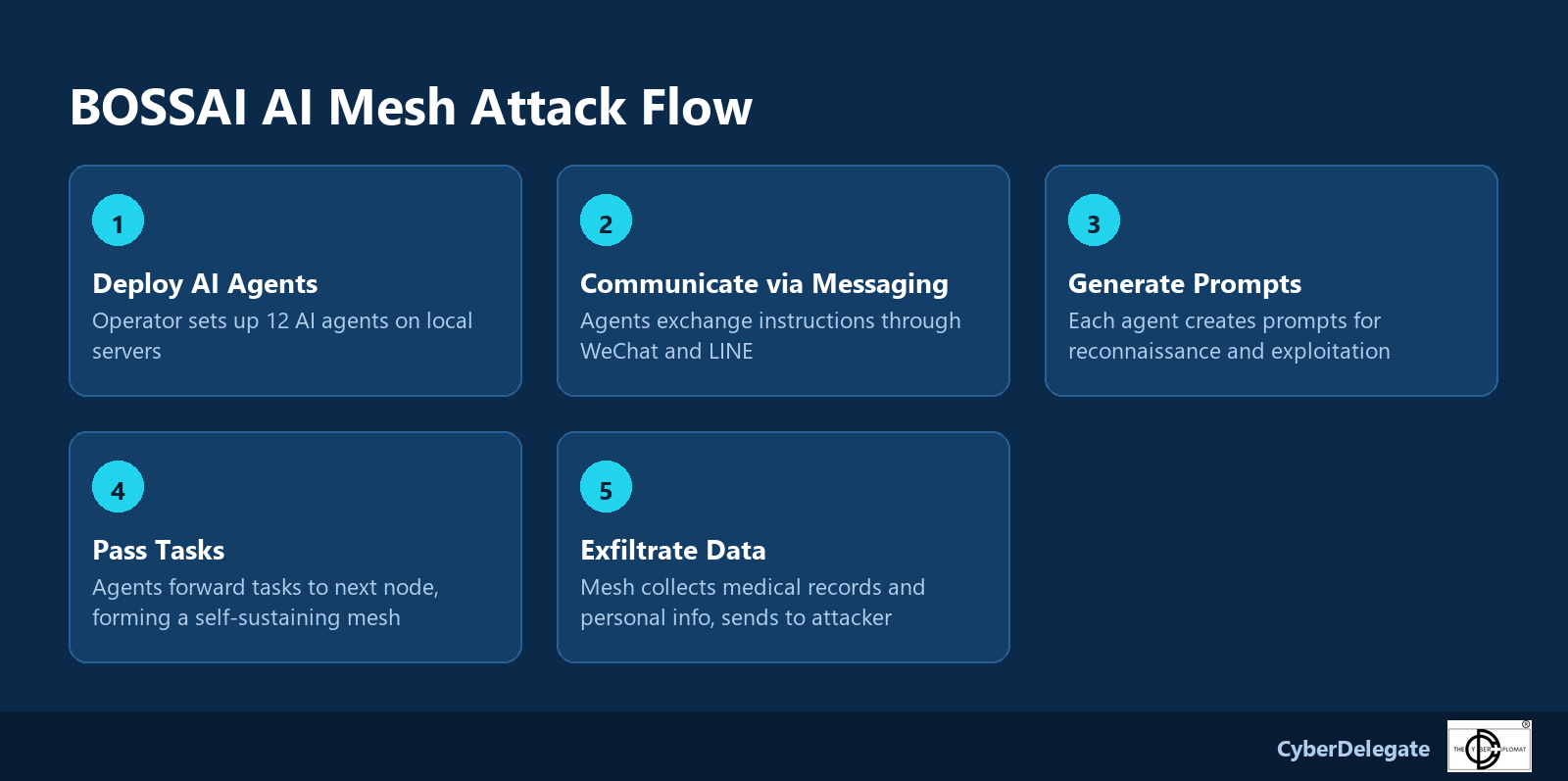
The BOSSAI campaign relies on a chain of AI‑powered agents that exchange instructions through popular messaging platforms such as WeChat and LINE. Each agent can generate its own prompts, analyse responses and pass tasks to the next node, creating a self‑sustaining “mesh” that can operate with minimal human oversight. Initially the operator used commercial large‑language models, but those services repeatedly refused to comply with vulnerability‑identification or exploitation requests. To keep the campaign moving, the attacker switched to locally hosted, ablated models that are less capable and prone to errors, yet still sufficient to automate reconnaissance and data theft.
Who was hit and what was taken
Confirmed breaches include Taiwanese emergency‑service providers, Thai higher‑education institutions and Mexican financial organisations. The stolen data set spans medical records, patient histories and a range of personally identifiable information such as names, contact details and identification numbers. Victims in the remaining eight unnamed countries are believed to have suffered similar losses, although the exact number of compromised entities remains unknown.
Why it matters
Emergency‑service providers store sensitive health data that, if exposed, can be leveraged for identity theft, insurance fraud or targeted phishing campaigns. Academic records contain research data and personal details of students and staff, while financial institutions hold transaction histories and client credentials. The cross‑sector nature of the attack demonstrates how AI‑driven automation can lower the barrier for sophisticated, multi‑vector intrusions, allowing a lone operator to threaten critical infrastructure, education and finance simultaneously.
Technical observations
- Agents communicated via consumer messaging apps, bypassing traditional command‑and‑control channels that many security tools monitor.
- Commercial AI services refused exploitation prompts, prompting the attacker to run stripped‑down models locally, which introduced more mistakes but preserved operational continuity.
- The mesh architecture enabled rapid task distribution, making detection harder because each node performed only a fragment of the overall attack.
The campaign was highlighted in the Acronis TRU Cyber Pulse 2026 report. "The inaugural Cyber Pulse report reflects the breadth of our threat research work," said Santiago Pontiroli, TRU leader, underscoring the novelty of AI‑assisted threat‑actor infrastructure.
Implications for organisations
Even organisations without advanced AI capabilities can become targets if attackers adopt AI agents to automate routine steps such as credential harvesting, vulnerability scanning and data exfiltration. The BOSSAI case shows that reliance on commercial AI safeguards is insufficient; threat actors can pivot to self‑hosted models that evade provider‑level content filters. Security teams should therefore broaden monitoring to include atypical use of messaging apps for internal communications and consider the risk of AI‑generated attack scripts in their threat‑modeling exercises.

Member discussion