America's Cyber Fortress Gets a Rebuild: What Trump's NSPM-12 Actually Changes
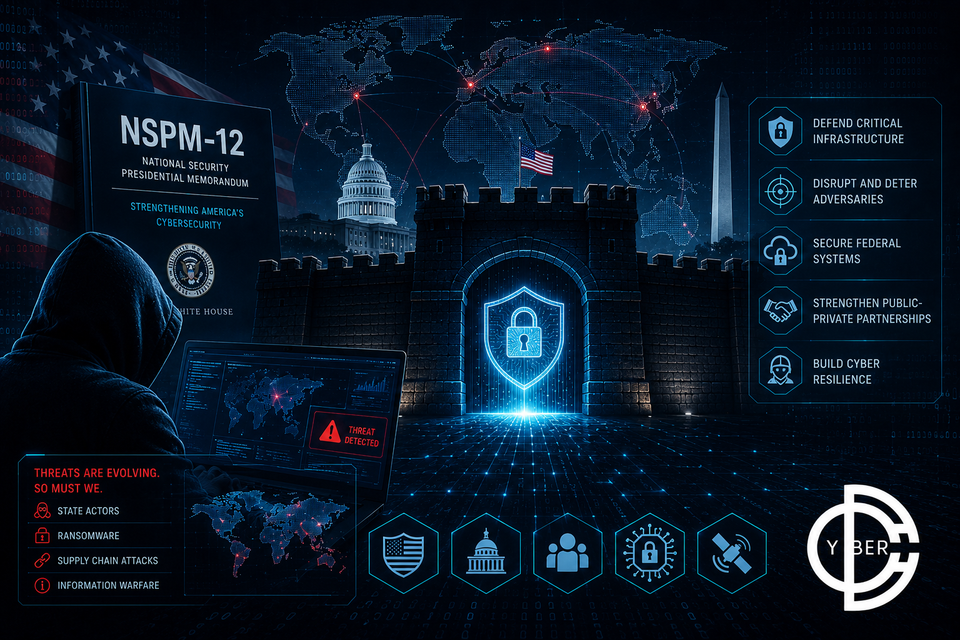
The first major overhaul of US government cyber governance in over 35 years arrives as Chinese and Russian actors are already inside the walls
June 16, 2026
When President Donald Trump signed National Security Presidential Memorandum 12 on June 12, 2026, he quietly dismantled two foundational pillars of how the United States has governed its most sensitive computer systems — one of them dating back to the final year of the Cold War. The document that governed cybersecurity for America's classified military and intelligence networks since 1990 was a product of a world with no commercial internet, no cloud computing, no AI, and no Chinese state-sponsored hackers spending years pre-positioned inside US critical infrastructure waiting for orders.
The threat environment has changed somewhat since then.
NSPM-12 replaces National Security Directive 42 — signed by President George H.W. Bush in July 1990 — and National Security Memorandum 8, which the Biden administration issued in January 2022. In their place, it establishes a new governance architecture for what the government terms National Security Systems: the classified computer networks, military command infrastructure, and intelligence systems that underpin America's ability to fight wars, conduct espionage, and safeguard its most sensitive secrets.
The memorandum is not a new set of technical controls. It is a reorganisation of who is in charge, who is accountable, and what standard every system must meet. But in a world where the previous framework was drafted before the world wide web existed, that reorganisation is long overdue.
The Architecture of the Old System — and Why It Failed
To understand what NSPM-12 does, you first need to understand what it is fixing.
National Security Directive 42, signed in 1990, established the basic framework under which agencies owning or operating classified government systems managed their cybersecurity responsibilities. Over the following three and a half decades, the threat landscape transformed beyond recognition — but the foundational governance framework largely did not. The Committee on National Security Systems (CNSS), the interagency body meant to coordinate cybersecurity standards across defence, intelligence, and civilian agencies operating classified systems, had not undergone significant structural updates in more than 35 years.
The result was predictable: a patchwork of agency-specific standards, unclear lines of authority when incidents crossed organisational boundaries, and civilian agencies operating national security systems with cybersecurity protections that lagged behind those of the Department of Defense and the Intelligence Community. The assumption embedded in the 1990 framework — that national security systems were discrete, air-gapped, and physically isolated from the broader digital environment — has not been operationally accurate for decades.
Salt Typhoon, the Chinese state-sponsored group that penetrated major US telecommunications networks in 2024 and is believed to have accessed the communications of senior government officials, operated in exactly the gaps this framework left open. A former senior FBI official described the breadth of the campaign in terms that still reverberate: "I can't imagine any American was spared." NSA Director General Timothy Haugh, testifying to Congress, characterised Volt Typhoon's positioning inside US energy, water, communications, and transportation infrastructure as representing "pre-positioning for disruption or destruction" rather than conventional espionage. These were not the adversaries the 1990 framework was designed to confront.
What NSPM-12 Actually Does
Reestablishing the CNSS — With Teeth
The central institutional change in NSPM-12 is the reconstitution of the Committee on National Security Systems as an authoritative, enforcement-capable body rather than a coordination forum. Under the new framework, the CNSS is empowered to establish binding baseline cybersecurity requirements for all National Security Systems and to issue security directives to agency heads — not requests, not guidelines, but binding directives with accountability mechanisms attached.
The CNSS will be chaired by a member of the National Security Council staff and draw its membership from the Department of War (the administration's redesignation of the Department of Defense), the Intelligence Community, the Office of Management and Budget, and the NSA. This composition is significant: it embeds OMB — the White House's budget enforcement arm — directly into cybersecurity governance, giving the framework financial and administrative teeth alongside its security mandate.
NSS must now meet or exceed cybersecurity standards issued by the National Institute of Standards and Technology, unless the CNSS provides otherwise through a complementary standard. This is a meaningful floor: it establishes parity with commercial best practice as a minimum, not an aspiration.
The NSA Gets Formal Authority
NSPM-12 formally designates the Director of the NSA as the National Manager for National Security Systems — a title that now comes with explicit authority to issue emergency directives, serve as the government's cryptologic authority, and assess government-wide cybersecurity posture across all agencies operating NSS.
This is a significant expansion of the NSA's formal mandate. The agency has long been the technical nerve centre of US signals intelligence and information assurance, but its authority to compel action across civilian agencies has historically been ambiguous. Under NSPM-12, that ambiguity is resolved in the NSA's favour. The National Manager may also enter into agreements for the procurement of technical security material and other equipment, extending the NSA's reach into the supply chain of secure communications hardware across federal agencies.
The CNSS will leverage the combined authorities and resources of the Federal Chief Information Officer, the Chief Information Officers of the Department of War and the Intelligence Community, and the Director of the NSA to ensure — in the memorandum's language — that there are "no gaps or weak links" in NSS defences.
Levelling the Playing Field Across Civilian Agencies
One of the quieter but more consequential elements of NSPM-12 is its explicit commitment to ensuring that National Security Systems operated by civilian agencies receive cybersecurity protections comparable to those used by the Department of War and the Intelligence Community.
This matters because it was precisely the civilian agency gap that adversaries have exploited most effectively. State Department, Treasury, Energy, and Homeland Security systems all qualify as National Security Systems in various configurations, yet have historically operated under lighter cybersecurity regimes than their military and intelligence counterparts. The SolarWinds compromise in 2020, which penetrated Treasury and Commerce among others, exploited exactly this disparity. NSPM-12 is, in part, a structural response to that lesson — arriving six years after the breach that made it necessary.
The Policy Coordination Committee and the 30-120 Day Clock
NSPM-12 creates a Policy Coordination Committee that will work with the CNSS to assess the cybersecurity posture of National Security Systems and identify areas requiring attention. Crucially, the memorandum sets hard deadlines: 30-, 60-, 90-, and 120-day timelines for revising CNSS Directive 900, issuing a policy roadmap, harmonising existing directives, and updating incident reporting standards.
Within 90 days, the CNSS is also required to issue a report on the provisioning of cloud capabilities at the Secret, Top Secret Collateral, TS/SCI, and Top Secret Controlled and Special Access Program levels — addressing a critical gap in how classified cloud services are governed. This deliverable is drafted in coordination with the roadmap on advanced computing resources tasked in NSPM-11, which addressed artificial intelligence in the national security enterprise just one week earlier, on June 5.
The Threat Context: Why Now
The timing of NSPM-12 is not coincidental. The US government's own assessments describe the current threat environment for National Security Systems in terms more alarming than at any prior point in the internet era.
China's pre-positioning operations — conducted by Volt Typhoon and Salt Typhoon — represent what CISA described in a February 2026 supplementary advisory as "pre-conflict positioning," with new indicators of compromise identified in water and communications sectors. Volt Typhoon has maintained persistent access inside US critical infrastructure for at least five years, according to a joint advisory from the FBI, CISA, and NSA. CISA's characterisation of the group's intent — "pre-positioning for disruption or destruction" rather than intelligence collection — means these actors are not primarily interested in reading US secrets. They are building the capacity to turn off the lights.
Russia's Sandworm has demonstrated, in Ukraine, the operational playbook for that scenario: deploying wiper malware to destroy data across energy and logistics systems simultaneously, co-ordinated with kinetic military operations. European systems have been targeted with increasing aggression since 2024. US National Security Systems, which underpin military command and control, are the obvious endpoint for a similar capability turned westward.
The internal governance failures exposed by Salt Typhoon and prior incidents — disparate standards across agencies, unclear incident reporting chains, no single authoritative body empowered to compel action — are the very vulnerabilities that NSPM-12 is designed to close.
The Broader Cyber Strategy It Fits Into
NSPM-12 does not stand alone. It is the latest component of what the administration has framed as a comprehensive national cyber posture, built across the past 12 months:
June 2025: A National Security Presidential Memorandum on AI in the National Security Enterprise (NSPM-11), establishing a framework for deploying AI systems within military and intelligence operations securely and responsibly. NSPM-12 explicitly coordinates its cloud security requirements with that roadmap.
March 2026: An executive order targeting cybercrime, fraud, and predatory schemes against American families and businesses — the civilian-facing counterpart to NSPM-12's military and intelligence focus.
March 2026: The release of the administration's national Cyber Strategy for America, outlining priorities to ensure the US "remains unrivalled in cyberspace."
June 12, 2026: NSPM-12, addressing National Security Systems — the classified, military, and intelligence infrastructure that the prior documents left to separate governance frameworks.
Together, these represent the most systematic reconfiguration of US cyber governance since the Obama administration's early executive orders on critical infrastructure protection in the early 2010s. Whether the implementation matches the ambition will depend on the 30-, 60-, 90-, and 120-day deliverables the memorandum mandates — and on whether the agencies responsible for the systems it covers treat the new binding authority as a genuine constraint or, as has historically been common, a flexible guideline.
What NSPM-12 Does Not Do
The memorandum is a governance document, not a technical fix. It does not patch the unpatched Cisco and Fortinet edge devices that Volt Typhoon used as entry points. It does not eject adversaries already pre-positioned inside NSS infrastructure. It does not address the workforce shortage in cleared cybersecurity professionals needed to implement whatever standards the CNSS issues. And it does not resolve the fundamental tension between the intelligence community's preference for classified, compartmented security standards and the commercial technology industry's need for transparent, testable ones.
The information-sharing provisions — calling for improved coordination with public-private partners and international counterparts — acknowledge the reality that critical infrastructure is overwhelmingly privately owned, and that National Security Systems increasingly depend on commercial cloud, hardware, and software ecosystems. But acknowledgement is not a mechanism. The practical architecture of that sharing, and its legal underpinnings, will be developed in the subsequent directives and roadmaps the memorandum commissions.
The Bottom Line
Signing a memorandum that rescues a 1990 governance framework from obsolescence is, in one sense, the minimum responsible action for an administration inheriting a threat environment characterised by nation-state actors already inside US infrastructure. In another sense, it is the beginning of an enormous administrative, technical, and resource challenge: building a unified, accountable, binding cybersecurity framework across the most complex, sensitive, and politically fragmented technology estate in the world.
The adversaries NSPM-12 is designed to counter — China's pre-positioned Typhoon groups, Russia's Sandworm, and the ecosystem of criminal actors who exploit the gaps they leave behind — did not pause their operations while the Committee on National Security Systems waited 35 years for an update. The question now is whether the machinery created by NSPM-12 can move faster than they do.
History suggests that is harder than it sounds.
Sources: White House NSPM-12 Full Text, White House Fact Sheet, HSToday, Verdict News, SamSearch, Akin Gump Executive Order Tracker, CISA Advisories, Congressional Testimony
Member discussion