
The World Cup Has Become Big Tech's Biggest AI Showcase
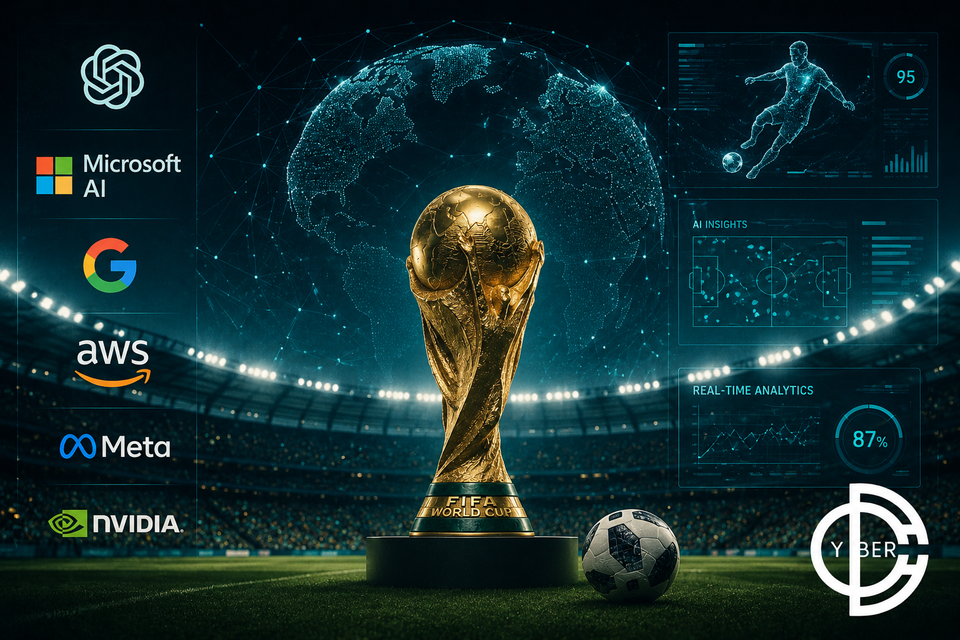
How Lenovo, Google, Salesforce, and a cast of tech giants are using the 2026 FIFA World Cup to prove their AI credentials to the world
June 16, 2026
Football has always been about more than sport. It sells beer, shapes political careers, moves fashion, and binds nations. In 2026, it is doing something new: serving as the most watched live demonstration of artificial intelligence the tech industry has ever staged.
The FIFA World Cup 2026 — spanning 16 cities across three countries, 48 teams, and 104 matches from June 11 to July 19 — has been called the most complex tournament in the competition's history. FIFA estimates more than five million fans will attend matches in person, with billions more watching remotely. For the world's largest technology companies, that global audience is not just a market. It is an exam.
"Most of the world is watching, and it creates an unbelievable expectation that you really have to make sure this works," says Art Hu, Lenovo's chief information officer.
Lenovo's Starring Role
When Lenovo announced its partnership as FIFA's Official Technology Partner in October 2024, it raised eyebrows. The company has long been associated with personal computers and enterprise devices rather than AI infrastructure. The World Cup is a calculated attempt to change that perception — in front of the largest audience in human history.
Lenovo's centrepiece offering is Football AI Pro, a generative AI platform built on FIFA's own Football Language Model that analyses hundreds of millions of data points from historical matches and real-time gameplay. Coaches, trainers, and support staff can query it via text, video, graphs, and 3D visualisations, asking, for instance, about the success rate of a corner kick delivered by Argentina's Lionel Messi or what defensive shape Portugal uses when protecting a one-goal lead in the 75th minute.
Crucially, FIFA and Lenovo made Football AI Pro available to all 48 competing nations equally — a deliberate decision to level a playing field that has historically tilted toward wealthier federations with larger sports science budgets. What teams do with that data remains entirely their choice. Some may follow it closely; others may treat it as a backdrop to instinctive coaching.
Lenovo's role extends beyond the tactical and into the operational. The company is deploying servers at the International Broadcast Center in Dallas, Texas, powering near real-time AI-driven IPTV distribution — what executives describe as potentially the largest single day of data transmission in history on the day of the final. Lenovo is also supporting the tournament's RefCams, which equip referees with first-person cameras whose footage is processed by AI in near real time, as well as providing the hardware infrastructure that underpins Hawk-Eye Innovations' VAR video review system.
Google's Subtle but Pervasive Play
Where Lenovo is making a loud statement, Google's approach is quieter and, in some ways, more revealing about where consumer AI is actually headed.
Google has struck team partnerships with eight squads heading into the tournament, including the United States, Argentina, Brazil, and France. Marvin Chow, Google's vice president of consumer and AI marketing, describes the technology as "intentionally subtle" from a design standpoint — a departure from the AI maximalism of many tech showcases. World Cup players, Chow noted, are using Google AI to prepare for matches, learn about new cities, find restaurants, and plan their days off. "They're people too," he said.
For fans, Google's AI-powered search can now display interactive graphics that explain the difference between a 4-4-2 and a 4-3-3 formation — a step up from the news articles and static summaries that pre-AI search returned. Google Maps and Waze are loaded with stadium imagery, live scoring updates, traffic data, and road closure alerts that activate whenever a car is stopped.
The more ambitious frontier — AI agents that can autonomously hunt for and book tournament tickets on a fan's behalf — is still in early pilot stages. Chow was candid that these capabilities will be more mature in time for the FIFA Women's World Cup in Brazil in 2027. "It's really in the early days, I would say, for this World Cup," he acknowledged. The agentic era of consumer AI, it turns out, will be a process rather than a moment.
Salesforce, Verizon, and the Infrastructure Behind the Scenes
The visible AI — the tactical dashboards and the search improvements — rests on a less glamorous but equally critical foundation. Salesforce's Slack is being used to coordinate workforce management across all host cities, giving FIFA operational staff and stadium teams a unified communication and task management layer. Verizon is providing network connectivity at stadiums across North America, ensuring that the data flowing through every AI system at every venue has the bandwidth to do so reliably.
These partnerships are less headline-grabbing than Football AI Pro, but they illustrate something important: the World Cup is not one AI deployment, but dozens, layered on top of each other and dependent on each other working simultaneously at scale.
Keeping 5 Million Fans Safe — and Understood
One of the more unexpected AI stories of the tournament belongs to RapidSOS, a platform that connects data from more than 723 million devices, apps, and sensors to 911 and other first responder systems. RapidSOS is working directly with FIFA and local stadiums in major cities including Atlanta and Kansas City to address a challenge that doesn't appear on the match schedule: the linguistic chaos of an international crowd in a genuine emergency.
When thousands of fans from dozens of countries converge on a stadium and something goes wrong, people instinctively revert to their native language. "When things get real and the shit hits the fan, people go to their native tongue to express themselves," says Zach LaValley, RapidSOS's chief technology officer. Under the existing system, a first responder fielding a 911 call from a non-English speaker could spend up to three minutes just identifying the language before finding a translator. That delay, in a medical emergency or crowd incident, is significant.
RapidSOS's AI-driven translation plugs directly into stadium 911 calls, removing that identification and routing delay. The platform also shares stadium layout data, access ramp locations, and emergency contact structures with federal, state, and local agencies in advance, so that when something happens, the information infrastructure is already in place.
AI on the Referee's Whistle — and the Bookmaker's Screen
The integrity of the game itself is also subject to AI scrutiny. Sportradar, which provides data services to sports betting companies and works directly with major leagues including FIFA, uses machine learning to detect anomalous betting patterns that may indicate match-fixing attempts. Any suspicious signal goes through a second AI-enabled identification phase before a human analyst is alerted.
The stakes are significant. Sportradar expects up to $50 billion in total betting turnover during the World Cup — making it the largest single betting event in the world. "We play a big role in providing integrity services for different sports, including FIFA," says Behshad Behzadi, Sportradar's chief product, technology, and AI officer.
The Bigger Picture: AI Proving Ground
The commercial motivation behind all of this is not hard to read. With AI investment running at record levels and a growing number of executives questioning whether returns are materialising fast enough, the World Cup offers something priceless: a real-world demonstration at maximum scale, under maximum scrutiny, with a deadline that cannot move.
A survey released alongside the tournament found that 59% of IT leaders rank AI as their top IT investment, up 12% from 2025. Four in ten companies plan to significantly increase spending on AI tools in the near term. But 46% of organisations report that AI projects are exposing problems with data quality and governance — a reminder that deployment at the scale the World Cup demands is far harder than the press releases suggest.
That tension — between AI's promise and its operational reality — will be on display every time a referee consults a semi-automated offside call, every time a coach asks Football AI Pro whether to push forward or sit back, and every time a foreign fan dials 911 and hears a voice that understands them.
The ball is already rolling. The biggest question now is whether all the technology underneath it can keep up.
Sources: Fortune CIO Intelligence, Lenovo StoryHub, FIFA, AI Magazine, InformationWeek
Member discussion