
America's Drone Defense Test Run: Why the 2026 World Cup Is a Preview of a Bigger Problem
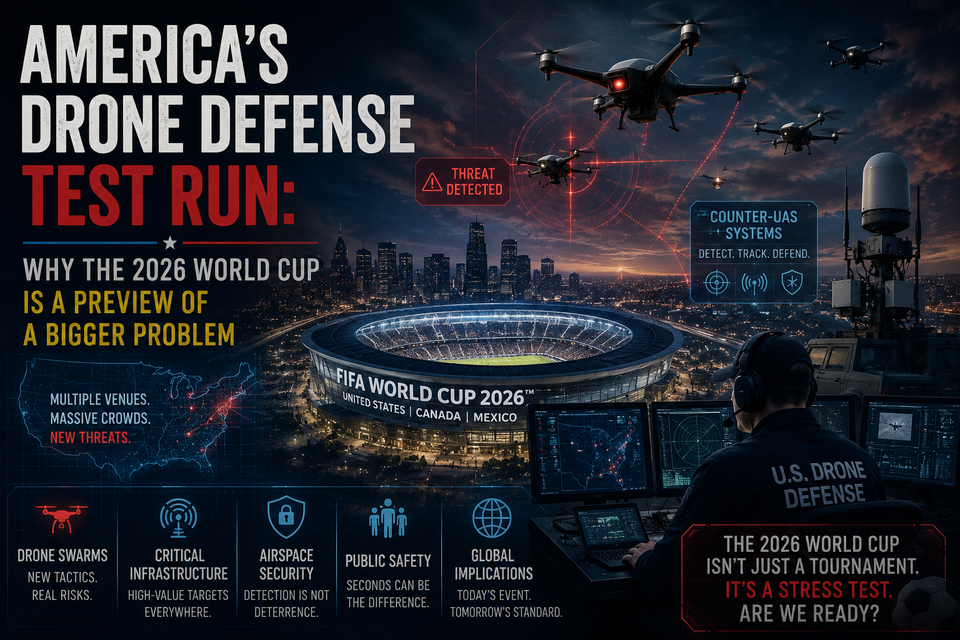
When retired Air Force General Glen VanHerck, the former commander of US Northern Command and NORAD, writes that "the threat of unmanned aircraft systems is no longer theoretical," he's speaking from direct experience. In a Washington Times op-ed published this month, VanHerck pointed to a 2025 "60 Minutes" investigation that exposed how unprepared American defenses were for drone incursions over sensitive sites like Langley Air Force Base in Virginia, where he says he personally watched existing radar and counter-drone systems struggle to detect threats that, by then, were already real. That episode helped push Congress to act, and the policy response is now colliding with a very public test case: the 2026 FIFA World Cup, which this summer brings millions of visitors into eleven US host cities, plus venues in Canada and Mexico, all of which now sit squarely inside the country's biggest live experiment in counter-drone defense.
From Wake-Up Call to Legislation
In December 2025, Congress passed the Safer Skies Act as part of that year's National Defense Authorization Act, expanding counter-UAS authority and, critically, empowering state and local law enforcement to detect, track, and in some cases mitigate credible drone threats rather than leaving that responsibility bottled up at the federal level. VanHerck describes that shift as replacing "jurisdictional paralysis" with the ability to actually act, a meaningful change given how often previous drone incidents, including high-profile sightings over the Northeast in recent years, exposed confusion over which agency even had authority to respond. The Department of Homeland Security followed with money to match the mandate: $115 million specifically earmarked for counter-drone technology ahead of the World Cup and the country's 250th-anniversary celebrations, on top of a separate $500 million grant program split across two fiscal years to help states and host jurisdictions buy detection and mitigation equipment.
What the Technology Stack Actually Looks Like
The portable RF detection devices now on the market, designed to scan wide frequency bands and flag drone control links, video feeds, and remote-ID broadcasts before an operator gets visual contact, represent the front end of a layered defense model that officials now describe as the only realistic approach. That layered concept, combining radar, electro-optical and infrared sensors, and AI-assisted signal identification, is meant to give responders early warning and, ideally, the location of the person flying the drone rather than just the drone itself, since the operator is often the more useful target for law enforcement to track down. Companies like D-Fend Solutions and Sentrycs have built businesses around the next layer in that chain: takeover and safe-landing capabilities that let officials seize control of a hostile drone's radio link rather than shoot it down, a non-kinetic approach that matters enormously in a stadium full of tens of thousands of people, where intercepting a drone kinetically risks falling debris becoming its own hazard. Sentrycs alone has reported securing contracts covering roughly 70% of the US states hosting World Cup matches this year, alongside deployments in the co-host nations.
The Problem Money Alone Doesn't Solve
VanHerck's central argument, echoed by other security officials, is that policy and funding are necessary but not sufficient. Detection technology has to scale to an event spread across eleven cities simultaneously, and it has to do so without false positives overwhelming the operators trying to distinguish a hobbyist's drone from an actual threat. There's also a cost-asymmetry problem baked into traditional kinetic defenses that officials have been blunt about: using a missile costing in the high hundreds of thousands or millions of dollars to bring down a drone that costs a few hundred dollars to build isn't a sustainable model when adversaries can simply launch more drones than defenders can afford to shoot down, which is part of why the industry and Pentagon planners have both pushed toward cheaper detection-and-takeover systems instead of pure kinetic interception. The threat picture has also broadened geographically. VanHerck has separately noted that drug cartels operating in Mexico have already weaponized drones, a development that adds a cross-border dimension to World Cup security given that Mexican cities are hosting matches as well, and that officials say could eventually translate into domestic threats even though no weaponized drone attack has yet occurred inside the US homeland.
A Test Run for Something Bigger Than Soccer
The stakes extend well past the tournament itself. The same federal task force coordinating World Cup security, along with the funding structure behind it, is explicitly designed to carry forward into the 2026 America 250th-anniversary events and, eventually, a future US Olympics bid, treating this summer less as a one-off security operation than as a proving ground for a counter-drone architecture the country will need repeatedly in the coming years. JIATF-401, the joint interagency task force VanHerck has expressed cautious optimism about, represents an attempt to build exactly that kind of standing capability rather than reassembling an ad hoc response every time a major event or new incursion forces the issue. Whether that architecture holds up under the actual pressure of a month-long, multi-city global tournament, with millions of fans, hundreds of legitimate hobbyist drones in the air at any given time, and an unknown number of bad actors mixed in, will say a great deal about whether the US has actually closed the gap VanHerck and others identified at Langley, or whether the World Cup becomes the next data point in the same warning.
Member discussion