
The Peace-Sign Selfie Panic: What's Real About Fingerprint Theft from Photos, and What Isn't
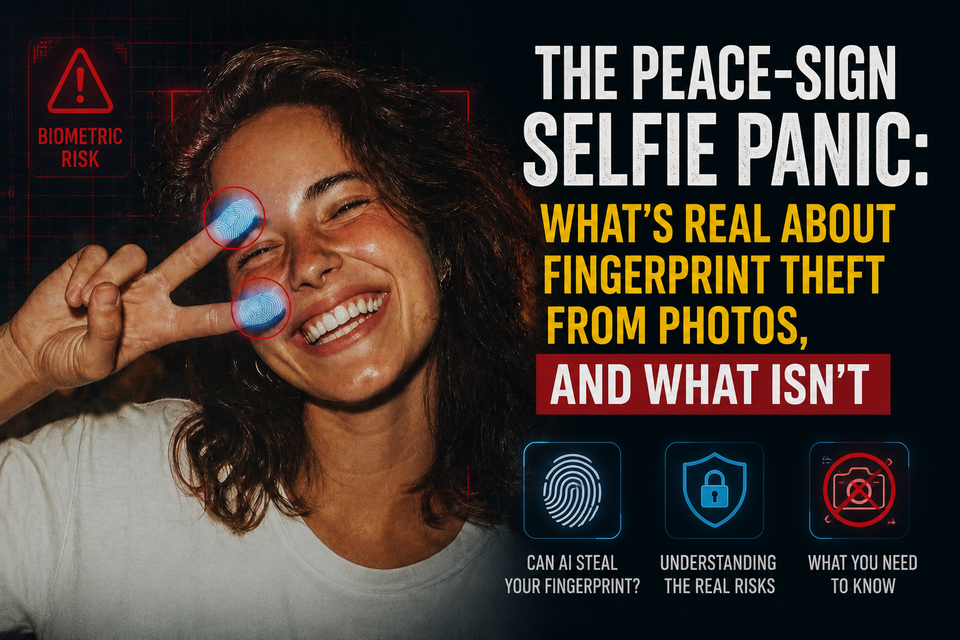
A LinkedIn post warning that "AI could steal fingerprints from high-resolution selfies" has been making rounds this week, illustrated with a photo of a woman making the classic two-finger peace sign, her fingertips highlighted to show exactly where an attacker might lift a print. The warning isn't fabricated — it reflects a real, well-documented area of biometric security research — but the practical risk for most people posting selfies is considerably smaller than viral posts like this suggest. The interesting story is less "your selfies are dangerous" and more "biometric data behaves very differently from a password, and that difference matters."
A Decade-Old Finding, Freshly Viral
The core claim traces back to 2014, when German security researcher Jan Krissler — known by the handle "Starbug" — recreated the fingerprint of then-German Defense Minister Ursula von der Leyen using only a handful of high-resolution press photographs of her hands. He went on to show that high-quality images could also defeat iris scanners and basic facial recognition. A few years later, Japan's National Institute of Informatics demonstrated that fingerprints could be reconstructed from photos taken from as far as three meters away, specifically flagging gestures like the peace sign and the Vulcan salute as risky poses. In 2021, researchers at the crypto exchange Kraken built a workable fingerprint mold from a photographed print using little more than Photoshop, a printer, and glue.
This particular wave of attention started after an April broadcast on a Chinese workplace reality show, where a financial commentator used a celebrity's selfie to demonstrate how photo-editing and AI tools could pull fingerprint ridge detail out of a peace-sign pose, provided the fingers faced the camera directly from within about 1.5 meters. The segment went viral on Chinese social media, then spread internationally, eventually prompting concrete, if localized, action: on June 1, the Wagoner County Sheriff's Office in Oklahoma issued a public advisory dubbing it the "selfie fingerprint" scam and urging residents to avoid posting close-up photos that clearly show their fingertips, while noting it had no confirmed local cases. The advisory itself is a useful marker of how a niche piece of biometric-security research has worked its way from a TV segment into mainstream law-enforcement messaging within about six weeks.
What It Actually Takes
Security researchers who study this are careful to note the conditions required: the finger needs to be close to the camera, in sharp focus, well-lit, and at a favorable angle, and the resulting image generally needs to be quite high resolution before usable ridge detail survives JPEG compression and the heavy filtering most phone cameras and social apps apply automatically. Casual selfies, especially ones run through beautification filters, often smooth over exactly the fine detail an attacker would need.
Even when a print is successfully extracted, turning it into something useful generally still requires physical proximity to whatever it's meant to unlock. As Carnegie Mellon professor Vyas Sekar told CBS News, an attacker would also need access to the actual scanner tied to the fingerprint, whether that's a specific phone, laptop, or secure-facility entry pad, which narrows the realistic attacker pool to someone deliberately targeting a specific, usually high-value, individual rather than scraping prints at random from public photos. New York University security researcher Justin Cappos made a similar point, noting that criminals have not shown signs of weaponizing this technique at scale, largely because phishing and conventional credential theft remain far cheaper and more reliable ways to compromise an account.
Modern fingerprint sensors also aren't purely image-matching systems. Most incorporate liveness detection, capacitive or ultrasonic sensing of a real finger's conductivity and subsurface structure, which is specifically designed to reject flat photographic reproductions and even fairly sophisticated molds. That's a meaningful difference from a 2014-era iPhone sensor, though it's not an absolute guarantee, since determined researchers have continued to find ways around anti-spoofing measures over the past decade.
Where the Real Exposure Lies
The risk is not evenly distributed. Public figures, executives, and anyone whose hands appear repeatedly in high-resolution press or event photography present a larger attack surface simply because more usable images of them exist, which is exactly the population Krissler targeted in his original research. There's also a category of biometric systems with weaker safeguards than a flagship smartphone: India's Aadhaar-linked AEPS payment system, for instance, has seen real fraud cases where cloned fingerprints, sometimes derived from photos or silicone molds, were used to authorize unauthorized withdrawals, since point-of-sale biometric devices in the field don't always implement the same liveness checks found in premium consumer hardware.
The deeper concern security professionals raise isn't really about any single selfie. It's that biometric data is permanent in a way passwords aren't. If a password leaks, it gets changed. A fingerprint, iris pattern, or voiceprint can't be reissued, and as image-enhancement and upscaling tools improve, the gap between "theoretically extractable" and "practically extractable" tends to narrow rather than widen over time. That argument doesn't require any single viral claim to be fully accurate to be worth taking seriously.
A Reasonable Response, Not a Panic Response
None of this calls for abandoning selfies or treating every photo as a security incident. It does support a few low-cost habits: avoiding finger-forward poses in very high-resolution images intended for wide public distribution, being more cautious with biometric authentication on devices or systems that rely on cheaper sensors without strong liveness detection, and treating fingerprint and face unlock as one layer of security rather than the only one, with a strong passcode or password as backup. For most people, the everyday risks of phishing, credential stuffing, and SIM-swap attacks remain far more likely sources of account compromise than someone reconstructing a fingerprint from a peace-sign photo. But for high-profile individuals, and for the biometric payment infrastructure spreading across markets like India, the underlying vulnerability the viral post points to is a documented one, not a myth.
Member discussion