
The AI Kill Switch: What the Anthropic Shutdown Reveals About the New Geopolitics of Technology
June 2026
The Event That Changed Everything
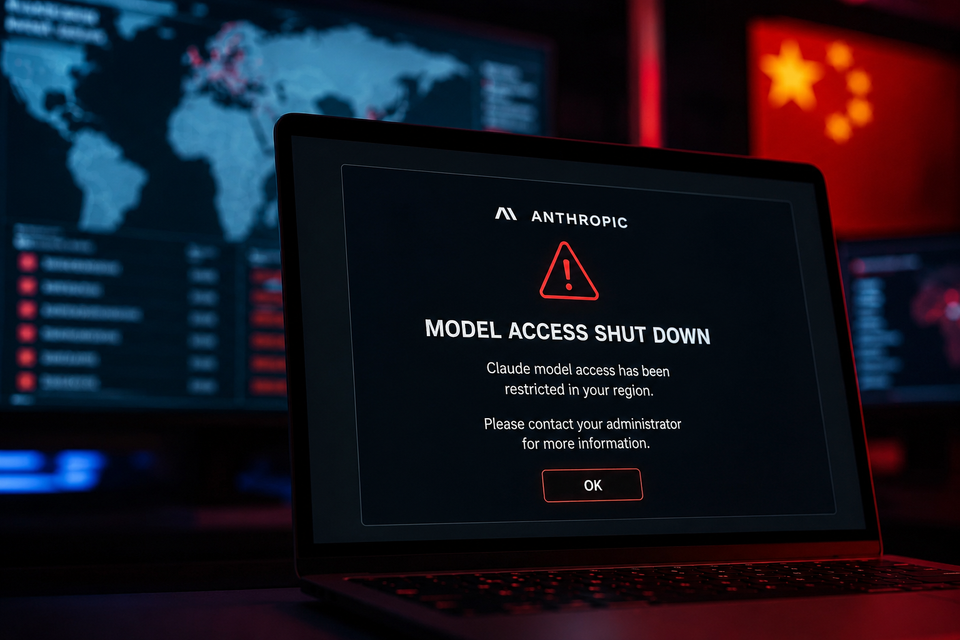
On the evening of June 12, 2026, users around the world attempting to access Anthropic's newly released Fable 5 and Mythos 5 AI models found themselves suddenly locked out. The shutdown was not a server outage or a product glitch. It was the execution of a government directive — swift, sweeping, and with almost no prior notice.
The U.S. government, citing national security authorities, had issued an export control order requiring Anthropic to suspend all access to Fable 5 and Mythos 5 by any foreign national, whether inside or outside the United States — including Anthropic's own foreign-national employees. Anthropic said it received the directive at 5:21 PM Eastern Time and had to "abruptly disable" the models for all customers to ensure compliance.
Within hours, two of the world's most capable AI systems had effectively ceased to exist for a significant portion of the global population. Not because of a technical failure. Not because of a product decision. Because a government flipped a switch.
The trigger, according to Anthropic, was the government's belief that a technique to "jailbreak" Fable 5 had been identified — a method to bypass the model's safeguards and potentially unlock its powerful cybersecurity capabilities. Anthropic disputed the severity of the jailbreak, arguing it was narrow, non-universal, and that the same capabilities were already available in other publicly accessible models. Nonetheless, compliance was immediate.
This single episode has compressed years of theoretical debate about AI sovereignty, export controls, and the geopolitics of technology into one clarifying moment.
Export Control, Redefined
Historically, export controls governed physical goods — weapons, semiconductors, specialized equipment. The logic was territorial: stop the movement of things across borders. When controls were extended to software and code, they still operated on a relatively understandable model of containment.
What happened on June 12 was categorically different. The control did not target a chip or a codebase. It targeted people— specifically, the nationality of the user. Foreign nationals, regardless of their location, their employment, their clearances, or their relationship to the company that built the model, were locked out overnight.
This is a paradigm shift. Export control has now become identity-based access management at a civilizational scale. The frontier of regulation is no longer at the border; it is at the login screen, applied dynamically, in real time, based on who you are rather than where you are.
The implications are profound. If talent itself — the human minds that work with, train, and improve these systems — can be classified as a vector of technological leakage, then the entire framework of international scientific collaboration and global tech employment is under latent threat. A foreign-national employee at a leading AI lab is, in this logic, a potential national security liability simply by virtue of their citizenship.
How Beijing Reads This — And Why It Matters
The geopolitical signal sent by this event extends well beyond the immediate commercial disruption. For countries watching closely — and Beijing watches very closely — this episode is not just a cautionary tale. It is a live demonstration of a capability: the ability to deny access to frontier AI infrastructure anywhere in the world, instantly, for any reason the issuing government deems sufficient.
China has long been investing in domestic AI development, but its efforts have been accelerated by the cumulative effect of U.S. technology restrictions — chip export controls, cloud service limitations, and now model-level access bans. Each new restriction hands Chinese policymakers a stronger justification for indigenous capability development and a more compelling case to allies and partners for why dependence on American AI is a strategic vulnerability.
There is also a second-order effect: the Fable 5 shutdown provides a blueprint for how AI access can function as a geopolitical lever. If the U.S. can revoke model access globally on national security grounds, other powerful actors will seek to develop equivalent capabilities — and their own trigger conditions.
The Thin Privilege of Access
Perhaps the most consequential insight from this episode is the distinction between access and capability.
For years, the dominant argument in favor of U.S.-led AI development has been inclusivity: American AI companies build the best models, and they make them available globally. Allies and partners benefit from being connected to this ecosystem. The implicit promise was that proximity to American AI leadership was itself a form of strategic partnership.
June 12, 2026 exposed the fragility of that promise. Access, it turns out, is not sovereignty. It is not capability. It is permission — permission that can be revoked without consultation, without notice, and without distinction between adversaries and allies.
The directive did not differentiate between foreign nationals from adversarial countries and those from long-standing U.S. partners. An Indian engineer at an American AI company, a British researcher at a university using the API, a German enterprise customer — all found themselves in the same category: foreign national, access suspended.
This is the lesson that the shutdown has seared into the strategic consciousness of nations around the world: access was never a strategy. It was thin privilege.
The Sovereign AI Argument Gets Its Proof of Concept
For several years, the concept of "Sovereign AI" — the idea that nations should develop and control their own AI infrastructure rather than depend on foreign providers — has been debated largely in the abstract. It has been championed by some and dismissed by others as expensive, redundant, or protectionist.
The Anthropic shutdown has transformed that debate.
India's response illustrates the shift clearly. The country has been expanding its AI ambitions, and the abrupt loss of access to frontier models has catalyzed a sharper conversation about what it means to rely on external AI infrastructure. Domestic companies like Sarvam have accelerated their work on large open-source models. Policymakers are discussing dedicated AI investment funds. The question is no longer whether to pursue AI sovereignty, but how fast and at what cost.
The logic is not difficult to follow. If a so-called "friendly nation's" own engineers, working inside a frontier AI lab, can lose access to the models they help build — based solely on their nationality — then no amount of diplomatic relationship or commercial partnership provides genuine security of access.
India is not alone in this reckoning. The European Union has long been investing in its own AI ecosystem for reasons that predate this episode, but the Anthropic shutdown has added urgency. Canada has released its National AI Strategy. Countries across Southeast Asia, the Middle East, and the Global South are asking the same question: can we afford to build critical infrastructure on a foundation that can be withdrawn by another country's executive branch?
The answer, increasingly, is: not without significant risk.
Data Sovereignty: The Next Negotiation
Closely connected to model access is the question of data. Nations and enterprises that have shared their data — their proprietary information, their citizens' data, their industrial and scientific knowledge — to train and fine-tune foreign AI models now have a different relationship with that data.
If model access can be revoked on national security grounds, the terms of data exchange need to be reconsidered. Data is not a neutral input. It is a source of leverage — for whoever controls the model trained on it. The Anthropic episode has made clear that leverage sits decisively with whoever holds the infrastructure.
This does not mean nations should refuse to engage with frontier AI providers. But it does mean the terms of engagement — data governance, portability, residency requirements, and exit clauses — need to be negotiated with far greater rigor and awareness of asymmetric power.
The principle is simple: do not give away data cheaply. Focus on building capability, not just securing access.
Frontier Labs as Geopolitical Chokepoints
There is a structural reality beneath all of this that deserves to be named plainly: frontier AI laboratories have become geopolitical chokepoints.
Like the Strait of Hormuz, through which a significant portion of the world's energy supply flows and which any major power would seek to control in a conflict, frontier AI labs concentrate capabilities that are foundational to economic productivity, national defense, scientific discovery, and critical infrastructure. Whoever controls these labs — or can compel them to act — holds a form of power that did not exist a decade ago.
Anthropic's statement following the shutdown was careful to note that the company did not choose this action; the U.S. government imposed it. That is an important distinction in terms of corporate intent. But it does not change the structural outcome: when government and lab interests align — or when government authority is sufficient to compel corporate compliance — the lab becomes an instrument of state power.
This is not an indictment of any company. It is a description of a new geopolitical reality that all actors — nations, enterprises, developers, and users — must incorporate into their planning.
The Ally Problem
One of the most uncomfortable aspects of the Fable 5 shutdown is what it reveals about the practical limits of "ally" status in the AI era.
The directive was not targeted at adversarial nations. It applied to all foreign nationals. U.S. allies — countries that have built defense relationships, intelligence-sharing arrangements, and economic partnerships with Washington — found their citizens and employees subject to the same restrictions as nationals from countries with which the U.S. has active strategic competition.
This is not necessarily the intended signal. It may well be a consequence of the blunt instrument of export control law, which was not designed with the granularity required for identity-based AI access management. Anthropic has described the action as a "misunderstanding" and has stated it is working to restore access.
But the precedent has been set. And the question for U.S. partners is a serious one: what is the value of ally status if critical AI infrastructure can be revoked without distinction? How will those allies respond? Will they seek bilateral assurances? Will they accelerate domestic alternatives? Or will they accept the implicit conditions of the relationship?
The answers to these questions will shape the structure of global AI alliances — and geopolitical relationships more broadly — over the coming decade.
What Should Nations, Enterprises, and Developers Do?
The Anthropic shutdown is not cause for panic, but it is cause for strategic recalibration. Several principles emerge clearly:
For nations: Treat AI infrastructure as you would treat energy infrastructure — with a clear view of dependencies, diversification requirements, and strategic reserves. A purely import-dependent AI posture is not sustainable for any country with significant economic or security interests. Invest in domestic capability, open-source alternatives, and infrastructure that can be controlled domestically.
For enterprises: Incorporate the potential unavailability of AI models into business continuity planning. The risk is not theoretical. Build workflows that are resilient to provider disruption. Understand where your data sits and under what legal framework it can be accessed or withdrawn.
For developers and researchers: The architecture of international AI collaboration needs to evolve. Access to frontier models should not be conflated with the ability to develop, study, or build upon AI systems. Open-weight models, federated research frameworks, and domestic compute infrastructure all matter more than they did before June 12.
For AI companies: The episode highlights the risk of operating as a globally distributed capability while being subject to unilateral national jurisdiction. These are tensions that have no easy resolution, but acknowledging them explicitly — in terms of service, in user communication, in policy engagement — is the minimum that users and partners deserve.
Conclusion: Build, or Play on Someone Else's Terms
The Fable 5 and Mythos 5 shutdown will likely be resolved. Anthropic is working to restore access. The jailbreak concern that triggered the directive may be addressed to the government's satisfaction. Life, for most users, will return to something approaching normal.
But the episode has permanently altered how serious observers think about AI access, AI sovereignty, and the relationship between frontier AI and state power.
The fundamental choice for every nation, enterprise, and institution is now clearly visible: build genuine capability, or accept the terms set by those who do.
Access is not capability. Adoption is not advantage. And the privilege of using someone else's frontier model — however powerful, however useful — is ultimately conditional on their judgment, their government's priorities, and the geopolitical climate of the moment.
The AI era has produced a new kind of infrastructure: invisible, instantaneous, and globally deployed. The Anthropic shutdown has shown, for the first time at scale, that infrastructure of this kind comes with a kill switch. The question every nation now faces is whether it can afford not to have one of its own.
This analysis is based on publicly available reporting and official statements issued in the days following the June 12, 2026 export control directive.
Member discussion