
Where Do We Draw the Line? The Geopolitics of Tech Investing in India
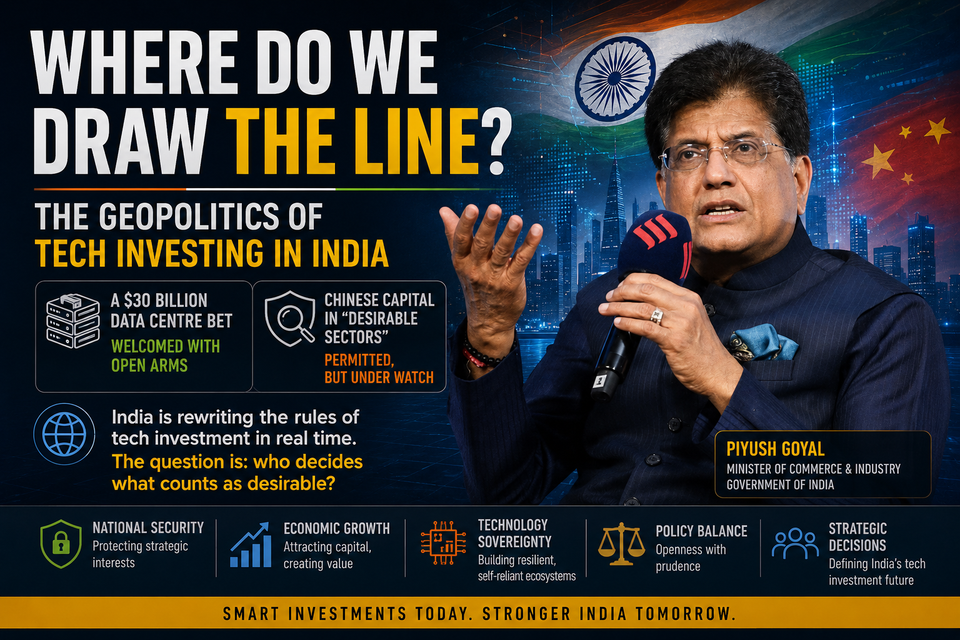
Two headlines. One week. A $30 billion data centre bet welcomed with open arms. Chinese capital in "desirable sectors" — permitted, but under watch. India is rewriting the rules of tech investment in real time. The question is: who decides what counts as desirable?
The Week That Framed the Debate
Two stories broke within days of each other, and together they reveal everything about where India stands on the geopolitics of technology investment.
The first: Robin Khuda, a Bangladesh-born Australian billionaire and founder of data centre giant AirTrunk, announced a staggering $30 billion investment to build over 5 gigawatts of digital infrastructure capacity across India by 2030. Prime Minister Narendra Modi personally received Khuda in New Delhi, posting on X that the investment would strengthen India's position as a global hub for cloud computing and artificial intelligence. AirTrunk — backed by Blackstone and the Canada Pension Plan Investment Board — entered India in April 2026 through the acquisition of Lumina CloudInfra, securing an initial 600MW development pipeline across Mumbai, Chennai, and Hyderabad. The reception was warm, the photo opportunity prominent, the ambition celebrated.
The second: Commerce Minister Piyush Goyal, speaking at the Financial Express Best Banks Awards, signalled that India remains open to Chinese investment — but strictly in "desirable sectors," and with investment screening firmly in place to guard against opportunistic acquisitions. He also confirmed that RCEP — the China-led Regional Comprehensive Economic Partnership — remains firmly off the table, and that India's merchandise trade deficit with China, which stood at $112.4 billion in 2025–26, would be addressed through domestic manufacturing capacity and action against dumping and predatory pricing.
Two signals. One direction of travel. But the gap between them raises a question that India — and most of the world — has yet to fully answer: in the geopolitics of tech investing, where exactly do you draw the line?
The Framework India Is Building
India's approach to foreign tech investment is not arbitrary. It is a layered, evolving framework built around a central principle: capital is welcome when it builds India up; it is screened when it could compromise India's strategic autonomy or economic sovereignty.
Since April 2020, FDI applications from countries sharing land borders with India — including China — have required mandatory government approval across all sectors. This rule was introduced in the wake of the Galwan Valley clash, when the strategic risks of economic interdependence with a hostile neighbour became impossible to ignore.
In March 2026, India eased fast-track approval norms for investments of up to 49% FDI from land-border countries in priority sectors such as capital goods, electronic components, and polysilicon — a carefully calibrated loosening, not an opening of floodgates. The message was clear: we want technology and manufacturing inputs. We are not selling strategic control. KNN India
The AirTrunk investment, by contrast, sailed through without friction. Why? Because it ticks every box India has defined as desirable: it is Western-aligned capital, it builds sovereign digital infrastructure, it generates local employment, it integrates India into the global AI economy, and it does not hand any foreign government a lever over critical systems.
The Two Dimensions of "Desirable"
When India — or any country — says it welcomes investment in "desirable sectors," there are really two dimensions at play: economic desirability and strategic desirability. They are related but not identical.
Economic desirability asks: does this investment create jobs, build manufacturing capability, transfer technology, grow exports, and reduce import dependency? AirTrunk's $30 billion bet scores highly on all counts. The project is expected to generate employment, boost domestic supply chains, and accelerate innovation-led growth — the kind of multiplier effect India's infrastructure-hungry economy needs.
Strategic desirability asks a harder question: who controls the infrastructure being built, and what can they do with that control? Data centres are not neutral. They are the physical backbone of AI, cloud, financial systems, healthcare, and national security. A data centre built by a Blackstone-backed Australian firm, backed by Canadian pension capital, operating under Indian regulatory oversight, is a fundamentally different proposition from a data centre that could — even theoretically — be subject to influence from a rival state.
This is why the country of origin of capital matters as much as its size. It is not about xenophobia. It is about who has legal and political jurisdiction over the entity deploying the capital.
The China Question Is Not Going Away
China has never been a major source of FDI in India — a mere $2.5 billion, or 0.3% of total equity inflow, came from Chinese investments between April 2000 and December 2025, making China the 23rd-largest investor in the country. The numbers are modest. The anxiety is not.
The concern is not primarily about direct Chinese FDI in Indian factories. It is about three more subtle risks:
Dependency through trade. A $112 billion annual trade deficit with China means India's electronics, pharmaceuticals, and solar supply chains are deeply reliant on Chinese inputs. That is leverage, even without a single yuan of FDI.
Indirect investment. Global venture capital and private equity funds with Chinese connections were affected by India's 2020 restrictions — because the concern was never just about direct ownership. It was about who ultimately benefits from, and potentially influences, the companies being backed.
Critical sector exposure. Telecom, semiconductors, power grids, data infrastructure — these are not sectors where the downside of a geopolitically compromised investor can be absorbed. The cost of getting it wrong is asymmetric.
India's current position — yes to Chinese capital in electronics components, no to Chinese capital in data infrastructure or strategic assets — reflects a reading of this risk map. It is pragmatic rather than ideological. But it requires constant recalibration as technology evolves and as geopolitical conditions shift.
The Global Pattern India Is Navigating
India is not alone in wrestling with this. The United States has CFIUS — the Committee on Foreign Investment in the United States — which reviews foreign acquisitions for national security implications. The European Union has built out its own foreign investment screening framework. Australia has the Foreign Investment Review Board. The UK has its National Security and Investment Act.
What all of these frameworks share is a recognition that the era of politically neutral capital is over — if it ever truly existed. Technology investment is strategic investment. The country building your data centres, your semiconductor fabs, your telecoms networks, and your AI infrastructure has a degree of influence over your future that no trade agreement can fully offset.
India's screening framework is younger and more informal than its Western counterparts, but it is moving in the same direction: sector-by-sector calibration, with an implicit hierarchy of trust based on geopolitical alignment.
The Risks of Getting the Line Wrong
Drawing the line too loosely creates obvious risks — strategic dependency, security vulnerabilities, and the kind of asymmetric leverage that turns an economic partner into a geopolitical pressure point.
But drawing the line too tightly carries its own costs, and they are underappreciated.
Excessive restriction raises the cost of capital, slows technology transfer, and can entrench domestic monopolies behind the shield of national security. It can also signal to genuinely aligned investors that the regulatory environment is too unpredictable to commit to — a risk that is very real for a country competing with Southeast Asian manufacturing hubs for the same global supply chain diversification dollars.
AirTrunk joins a growing list of companies investing in India's digital infrastructure — Amazon, Google, Microsoft, OpenAI, and Uber have announced major investments in cloud and AI infrastructure, while Indian companies Reliance, Adani Group, and TCS have laid out ambitious plans to expand data centre capacity. That momentum is not guaranteed. It is the product of a regulatory environment that Western and allied capital currently trusts. That trust can erode.
The line, in other words, has to be credible in both directions.
So Where Is the Line?
The honest answer is that no country has fully drawn it yet, because the technology landscape keeps moving. Today's question is about data centres and semiconductors. Tomorrow it will be about quantum computing, autonomous systems, satellite networks, and AI model infrastructure.
What the India story suggests is that the emerging consensus — imperfect and contested as it is — looks something like this:
Capital aligned with democratic, rule-of-law jurisdictions gets a broadly open door, with sectoral scrutiny for the most sensitive infrastructure. Capital from geopolitically adversarial states gets a narrow door: permitted in non-strategic manufacturing and component supply, restricted from critical digital and physical infrastructure.
That is not a clean principle. It requires constant judgment calls. It will produce inconsistencies and grey zones. It will be exploited by domestic vested interests seeking protection under the banner of national security. It will be tested every time a large enough investment arrives with a complicated enough ownership structure.
But the alternative — treating all capital as equivalent and all investors as politically neutral — is a fiction that the last decade of geopolitical experience has thoroughly dismantled.
The line exists. The debate is about where to draw it, how transparently, and who gets to decide.
India, right now, is drawing it in real time.
Tags: India · FDI · Geopolitics · China Investment · AirTrunk · Robin Khuda · Piyush Goyal · Data Centres · AI Infrastructure · Technology Policy · Digital India · RCEP · Investment Screening
Member discussion