
Beyond the Meme: What the US-China Tech Thaw Actually Means for Cyber Sovereignty
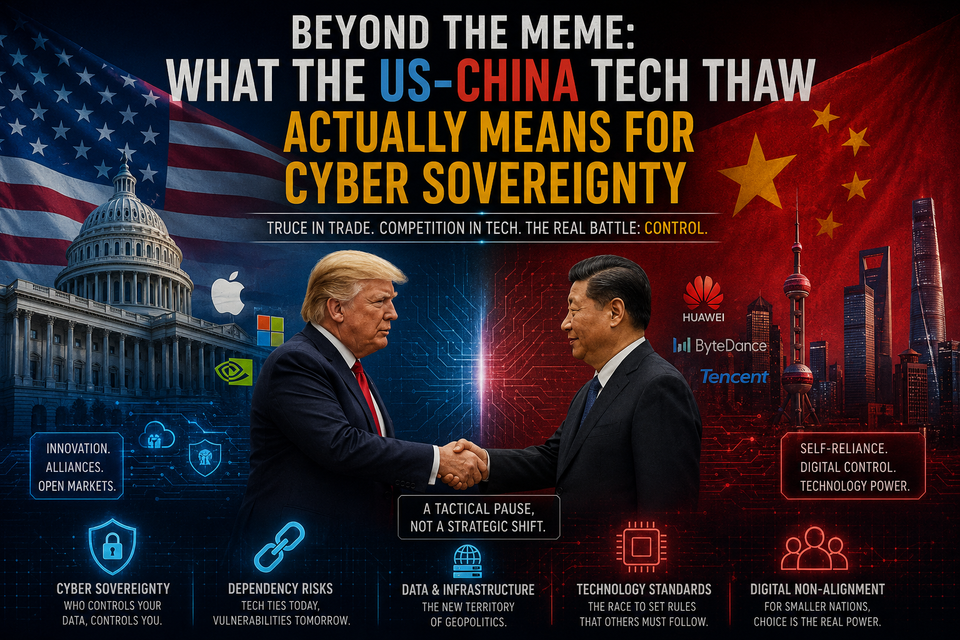
In May 2026, President Trump made a state visit to Beijing, and more than a dozen prominent American business leaders, including Tesla and SpaceX's Elon Musk, Apple's Tim Cook, Nvidia's Jensen Huang, and the heads of Goldman Sachs, BlackRock, and Citi, traveled with him. Xi told the assembled executives that China's door would "open wider" to American business. The meme's framing is pointed and partisan, but the underlying trend it's reacting to, deepening commercial entanglement between the US and Chinese technology sectors even as strategic rivalry between the two countries intensifies, is genuine, and it raises real questions about technological and cyber sovereignty that are worth examining on their own terms.
The Visit Wasn't Really About Optics
The CEOs who accompanied Trump weren't there for a photo opportunity. Many run companies with direct financial stakes in Chinese market access: Tesla's Shanghai factory reported sales up nearly 27% year-over-year in the first four months of 2026, and firms like Goldman Sachs, BlackRock, and Citi have long sought broader access to China's financial markets. Xinhua reported Xi telling the delegation that American companies are deeply involved in China's economic opening and that both countries have benefited from the relationship, a framing that signals Beijing's interest in keeping US capital and technology flowing into China even as geopolitical tension between the two governments remains high on other fronts, including Taiwan, tariffs, and military posture in the Pacific.
The Chip Decision Underneath the Trip
The more consequential cybersecurity story sits underneath the visit rather than in it. In January 2026, the Trump administration formally reversed years of export-control policy by shifting Nvidia's H200 AI chips, along with AMD's comparable MI325X chips, from a "presumption of denial" standard to case-by-case export review for Chinese buyers, while imposing a 25% tariff on the advanced hardware. That decision reverses a policy line that began under the Biden administration in 2022, built on the premise that restricting China's access to frontier AI compute would preserve a US lead in artificial intelligence.
The administration's rationale, as reported, is that the restrictions had become counterproductive: blocking exports gave Chinese chipmakers like Huawei room and incentive to build out a domestic alternative, and US firms argued they were ceding a lucrative market without meaningfully slowing China's AI progress. Critics take a sharply different view. A Council on Foreign Relations analysis described the new framework as "strategically incoherent," noting that the regulation acknowledges the national-security risk of exporting advanced AI chips to China in the same document that creates a legal pathway to do exactly that. Analysts at the Bloomsbury Intelligence and Security Institute estimated that even with volume caps in place, the policy could increase China's installed AI compute by as much as 250% relative to relying on domestic chips alone, materially narrowing a compute gap that, under a full export ban, would otherwise have left the US with roughly ten times China's capacity this year.
Why This Is a Sovereignty Question, Not Just a Trade One
Advanced AI compute isn't a conventional consumer good, and that's the crux of the sovereignty argument. The same chips used to train commercial AI models can support military targeting systems, surveillance infrastructure, and cyber-offensive capability development, which is exactly why the original export restrictions were framed as a national-security measure rather than ordinary trade policy. When that calculus shifts toward commercial access, it isn't simply a tariff adjustment; it's a decision about how much dual-use technological capability the US is willing to allow a strategic rival to acquire through legal channels, and how much leverage that creates for Beijing in any future dispute. The same dynamic runs the other way too: continued deep dependence on Chinese manufacturing capacity, illustrated by Tesla's reliance on its Shanghai plant for a large share of global output, gives Beijing its own form of leverage over US companies that have built critical supply chain nodes inside Chinese jurisdiction, subject to Chinese law, data rules, and political pressure.
That's the sense in which the meme's blunt framing, however partisan, points at something real. Sovereignty in a digital and AI-driven economy isn't only about territory or political independence; it's increasingly about who controls the compute, the data flows, and the manufacturing capacity that underpin both economic competitiveness and cyber and military capability. A country can remain formally sovereign while becoming functionally dependent on a rival's supply chains or, conversely, while inadvertently arming that rival's technological base through commercial deals struck for short-term economic gain. Both directions of that dependency are live concerns in the current US-China relationship, not hypothetical ones.
The Debate That Actually Matters
The substantive disagreement here isn't between "engagement is good" and "engagement is bad" in the abstract, it's about where to draw the line between commercially beneficial exchange and strategically dangerous dependency, and reasonable people land in different places. The administration's position is that continued isolation accelerates China's indigenous capability anyway while costing American firms a major market, so calibrated access with caps and tariffs is the more realistic strategy. Critics counter that any framework permitting frontier AI chip sales to a strategic competitor undermines the entire premise of export controls, regardless of how the caps are set, because compute, unlike most traded goods, compounds: today's chip sale becomes tomorrow's trained model becomes the next year's deployed capability. That argument is playing out now in real policy terms, through actual chip allocations and actual corporate decisions, well beyond whatever a viral LinkedIn image suggests about a single state visit. The visit was the photograph; the chip policy, the supply chain entanglement, and the question of who ultimately controls the technology underneath both, are the substance.
Member discussion