
Australia–Philippines Pact Expands Cyber and Maritime Security Cooperation
Australia and the Philippines have signed a defence cooperation arrangement that brings cyber defence and secure communications into a wider regional security framework, highlighting the importance of protecting maritime infrastructure and critical systems across the Indo-Pacific.
- Filed
- Desk
- Cyberdiplomacy
- Read
- 5 min read
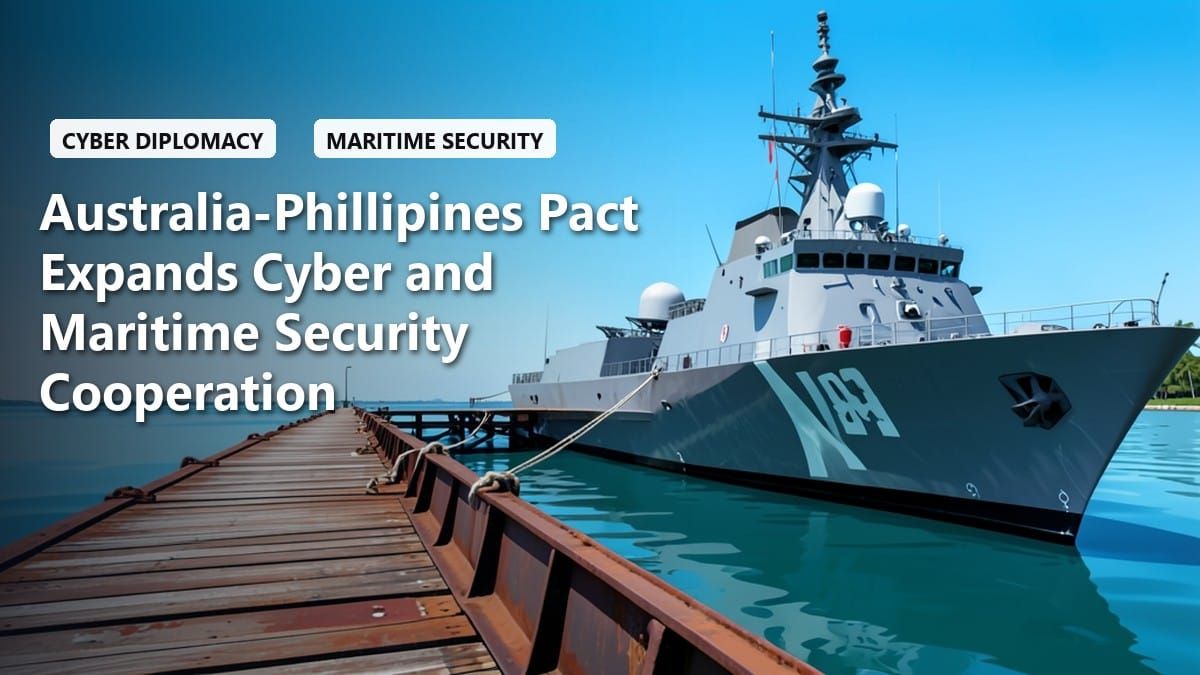
Australia and the Philippines signed a new Defence Cooperation Arrangement (DCA) on 15 November 2026, establishing an expanded framework for cooperation across maritime security, military coordination, cyber defence and secure communications. The development reflects a broader effort by both countries to strengthen their security relationship amid continuing tensions in the South China Sea.
While the arrangement places considerable emphasis on maritime cooperation, its inclusion of cyber defence and secure communications deserves closer attention. These areas are increasingly relevant to regional security, particularly as maritime operations become more dependent on interconnected digital systems and reliable information exchange.
Beyond conventional maritime security
The South China Sea remains an important part of the strategic context surrounding the agreement. Both governments have expressed concern about coercive and dangerous actions against Filipino nationals and vessels, while reaffirming the importance of freedom of navigation, maritime safety and international law.
The two countries also reaffirmed the 2016 South China Sea Arbitral Tribunal Award, which remains binding on the parties to that arbitration. Their joint statement reiterates the importance of the United Nations Convention on the Law of the Sea (UNCLOS) in governing maritime activities.
However, maritime security is no longer limited to the physical presence of naval vessels or the ability to monitor activity at sea. Maintaining awareness of maritime movements increasingly involves surveillance technologies, information-sharing systems and secure communications between relevant organisations.
This creates an important connection between maritime domain awareness and cybersecurity. The reliability of maritime information depends not only on the availability of monitoring capabilities but also on the integrity and security of the systems transmitting and processing that information.
The cyber defence dimension
The new arrangement explicitly identifies cyber defence and secure communications as priority areas for expanded cooperation. The accompanying leaders' statement goes further, committing both governments to strengthen cyber defences, improve shared awareness of cyber and critical technology threats, and continue joint investigations into cybercrime and cyber-enabled crime.
This is not the beginning of bilateral cyber cooperation. Australia and the Philippines signed a Memorandum of Understanding on Cyber and Critical Technology Cooperation in February 2024, establishing an existing framework for information-sharing, cyber skills development, capacity building and coordination on cyber threats.
That earlier arrangement also recognised the importance of international law and responsible state behaviour in cyberspace, alongside cooperation through regional and multilateral forums.
The November 2026 development is significant because cyber defence and secure communications are now explicitly included within a wider defence cooperation framework. It brings the digital security dimension closer to the countries' broader defence and maritime relationship.
The practical implications will depend on how these commitments are implemented. The public announcements do not yet establish specific joint cyber operations, a shared threat intelligence platform or a common incident response mechanism.
Why maritime infrastructure deserves attention
The connection between cybersecurity and maritime security becomes clearer when considering the infrastructure supporting regional trade.
Ports, shipping operations, navigation services, telecommunications and logistics networks rely on digital systems to coordinate activities and maintain continuity. Disruption to these systems can create consequences extending beyond individual organisations, potentially affecting the movement of goods and the reliability of wider supply chains.
Several areas deserve attention from a maritime cybersecurity perspective.
Vessel-tracking information, including data from the Automatic Identification System (AIS), contributes to maritime situational awareness. Manipulation or interruption of such information can complicate the assessment of vessel movements.
Navigation and positioning services also present security concerns. Interference with satellite-based navigation, including GPS spoofing or jamming, can affect the reliability of positioning information used by maritime operators.
Ports and logistics infrastructure represent another important area. Their dependence on interconnected operational and information technology systems creates exposure to cyber incidents that could disrupt cargo handling, scheduling and supporting services.
These are established categories of maritime cyber risk, not incidents attributed to Australia or the Philippines. Their relevance here lies in the growing importance of protecting the digital infrastructure that supports maritime operations.
As both countries expand maritime awareness activities and information-sharing capabilities, ensuring the security and reliability of the supporting systems becomes an important consideration.
Connecting defence cooperation with economic security
The wider leaders' statement also identifies resilient supply chains, diversified foreign investment and critical infrastructure protection as priorities for economic security.
This is particularly relevant to the Indo-Pacific, where maritime routes support significant volumes of international trade and connect regional economies to global supply chains.
A disruption to a major port, communications network or supporting logistics system can have consequences beyond the immediate location. The security of maritime corridors therefore depends on more than the ability to maintain a physical presence at sea. It also involves protecting the infrastructure and digital services that allow trade to function.
Australia has separately announced increased investment in its Southeast Asia Maritime Partnerships. The initiative supports regional partners through aerial and surface drones, secure communications support and operator training, with an emphasis on improving maritime awareness, cyber resilience and detection capabilities.
It is important to distinguish this regional initiative from the bilateral Defence Cooperation Arrangement itself. The two developments are complementary, but the published announcements do not establish that every capability under the regional programme will be deployed specifically through the Australia–Philippines arrangement.
Information integrity and regional stability
Another aspect of the joint statement concerns foreign information manipulation and interference (FIMI).
Both governments have committed to learning from each other's experiences in promoting resilient and fact-based information environments. This is relevant in a region where maritime disputes and security developments can become subjects of competing narratives and information manipulation.
The issue extends beyond conventional cybersecurity. The integrity of information surrounding maritime incidents, regional security developments and international law can influence public understanding and diplomatic responses.
Addressing these challenges requires attention to both the security of digital systems and the credibility of information circulating through them.
What remains to be established
The agreement establishes a framework for expanded cooperation, but several practical questions remain unanswered.
How will cyber threat intelligence be exchanged between the two countries? Will there be structured mechanisms for coordinating responses to cyber incidents affecting maritime infrastructure? What security standards will apply to shared communications and surveillance capabilities? How will the countries translate existing cyber cooperation into practical defence-related activities?
The public documents do not provide detailed answers to these questions. They also do not identify specific maritime infrastructure that will receive priority cyber protection or establish a timetable for implementing individual cyber defence initiatives.
These are not necessarily shortcomings in the agreement. They are areas where further implementation details and government announcements will be important in assessing its practical impact.
Looking ahead
The Australia–Philippines Defence Cooperation Arrangement reflects an increasingly interconnected approach to regional security. Maritime awareness, secure communications, cyber defence and critical infrastructure resilience are no longer entirely separate considerations.
The significance of this development will depend on whether the commitments made by both governments translate into sustained information-sharing, stronger institutional coordination and practical improvements in their ability to respond to emerging threats.
For the wider Indo-Pacific, the question is not simply how countries maintain security at sea, but how they protect the digital and physical infrastructure that makes maritime connectivity possible.
Sources:
2. Australian Government – Defence Cooperation and Maritime Security Announcement
3. Australia–Philippines Cyber and Critical Technology Cooperation MoU (2024)
4. International Maritime Organization – Maritime Cyber Risk
This brief was prepared with AI assistance from the sources above and reviewed by our editors.
Sources
Keep reading

Samsung securities breach leaks personal data of 8,241 Korean investors
Samsung Securities disclosed a data breach affecting 8,241 customers after unauthorised access to its VOC system. Exposed information reportedly covered 13 personal-data categories, while the intrusion method and exact data exposed remain unknown.

Southeast Asia’s Scam-Centre Crisis Is Becoming a Test of Cyber Diplomacy
Southeast Asia’s scam-centre crisis is testing the region’s ability to turn cyber diplomacy into action. From ASEAN–China commitments to wider regional cooperation, the challenge now lies in enforcement, financial disruption and victim protection.

Quimper Municipal Networks Disrupted by Cyberattack Amid Rising Threats to Government Infrastructure
A cyberattack disrupted Quimper's municipal networks on 23 November, adding to growing concerns over attacks targeting local government infrastructure in France. The incident highlights the challenges of protecting public services as cyber threats continue to evolve.