
Front pageCybersecurity Market & Strategy
Cybersecurity Market & Strategy
From Partnership to Platform: CrowdStrike's $43.9 Billion Bet on Zscaler
CrowdStrike's proposed $43.9 billion acquisition of Zscaler goes beyond an industry mega-deal. It brings endpoint and network security under one roof, raising bigger questions about platform consolidation, AI security and dependence on major cybersecurity providers.
- Filed
- Read
- 5 min read
The next major shift in cybersecurity may not come from a new security product. It may come from who controls the platforms that organisations use to defend themselves.
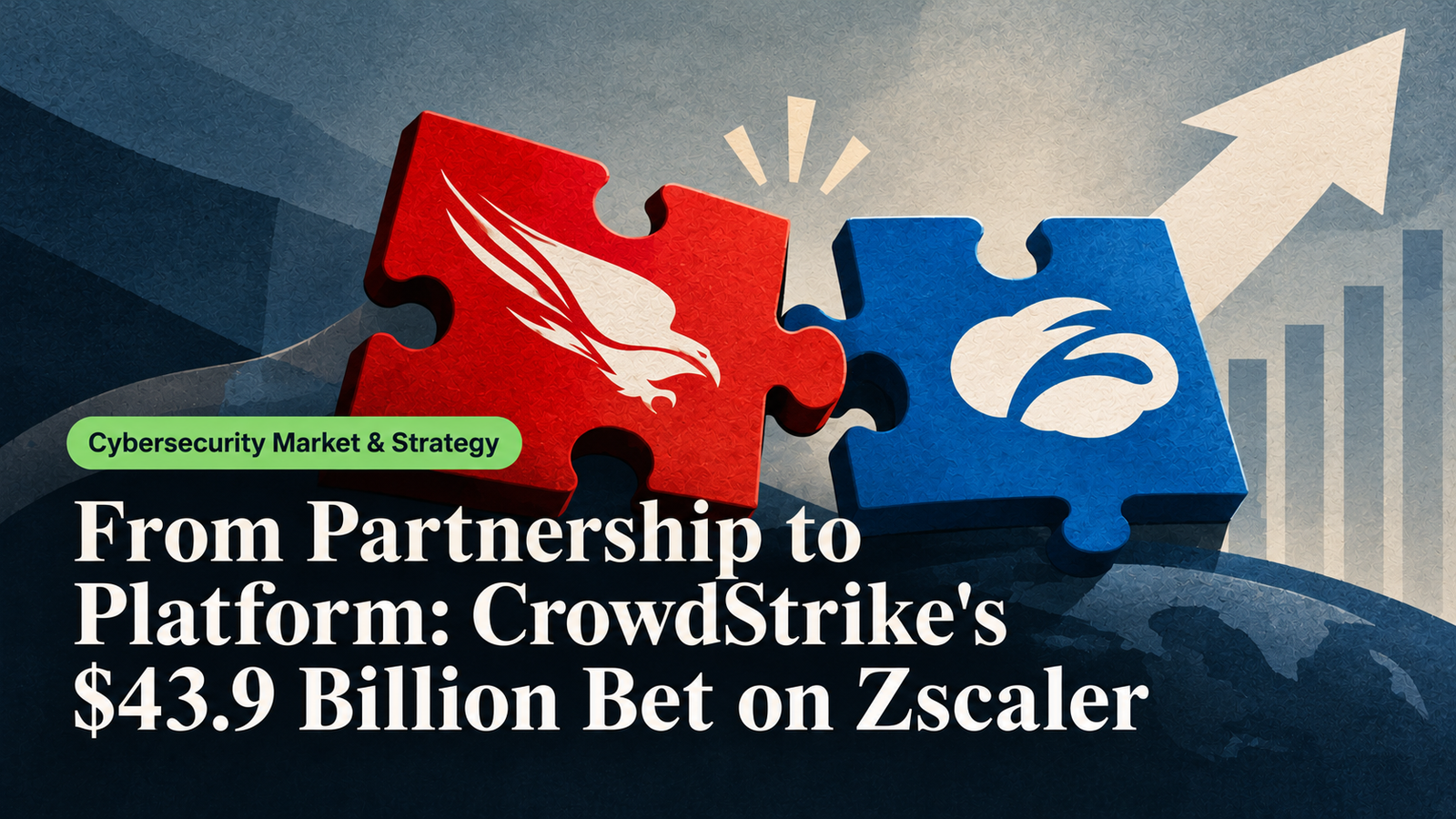
On 23 November 2026, CrowdStrike announced an agreement to acquire Zscaler in an all-stock transaction valued at approximately US$43.9 billion. The proposed acquisition brings together two major parts of enterprise security: protection at the device level and security across the connections linking users, applications and cloud environments.
Under the agreement, Zscaler shareholders will receive 1.135 shares of CrowdStrike common stock for each Zscaler share, representing an implied value of approximately US$260.41 per share and a premium of around 34% over Zscaler's 20 November closing price. Both companies' boards have approved the transaction.
The headline figure makes it one of the largest cybersecurity acquisitions to date. But the more consequential development is what CrowdStrike is attempting to assemble: a security platform with visibility across both the systems organisations operate and the connections through which their data moves.
An existing partnership, now moving under one roof
The acquisition is not the beginning of a relationship between the two companies.
CrowdStrike and Zscaler already share more than 2,000 customers and have established 16 product integrations. The proposed transaction takes that existing relationship further, replacing separate corporate ownership with a single combined platform.
Their technologies address different, but increasingly connected, security requirements.
CrowdStrike's Falcon platform focuses on endpoints, workloads, identities and data. Zscaler's Zero Trust Exchange sits between users, applications and network connections, inspecting traffic and enforcing access policies without relying on traditional perimeter-based security.
The distinction becomes more important as organisations move away from conventional office networks. Employees, cloud workloads and automated systems increasingly access applications directly across distributed environments.
AI agents add another layer. An agent can operate across applications, access organisational information and initiate actions without the same interaction patterns as a human user. Protecting the device on which an agent operates is only part of the problem; controlling what it can access and where its activity travels is another.
This is the strategic argument behind the acquisition. CrowdStrike wants to bring both control points into the Falcon ecosystem.
The value is also in the data
Beyond product consolidation, the announcement contains two figures that deserve attention.
CrowdStrike says its platform generates trillions of events daily from endpoints and cloud workloads. Zscaler, meanwhile, says its Zero Trust Exchange processes more than 750 billion transactions every day.
These are different types of activity and should not be treated as directly comparable measurements. Together, however, they illustrate the scale of security telemetry the companies believe they can bring into a common environment.
The proposed integration would allow endpoint and network signals to be analysed together. A suspicious process running on a device, for example, could be examined alongside the connections it establishes and the applications it attempts to reach.
That could improve the ability to reconstruct an attack across multiple stages rather than investigating isolated alerts.
CrowdStrike also intends to use this combined data environment to strengthen its AI-driven security capabilities. The company is positioning the acquisition as part of its wider ambition to secure autonomous AI systems and the infrastructure they interact with.
But the technical opportunity comes with a corresponding question: how much security visibility should an organisation concentrate in one provider?
A growing business, not simply an acquisition story
The financial results released alongside the announcement provide useful context.
For the quarter ended 31 October 2026, CrowdStrike reported revenue of US$1.58 billion, up 28% year over year, and annual recurring revenue (ARR) of US$6.26 billion.
Zscaler reported first-quarter fiscal 2027 revenue of US$949.3 million, up 20%, while ARR reached US$3.882 billion, representing 21% year-over-year growth.
CrowdStrike says the combined business is expected to begin with more than US$10 billion in ARR.
The commercial opportunity is substantial. Approximately 8,000 Zscaler customers are not currently CrowdStrike customers, giving the combined company a significant potential cross-selling base. Zscaler also reports that it serves more than half of the Fortune 500.
CrowdStrike estimates that the acquisition will expand its addressable market by more than US$185 billion by calendar year 2029.
It has also outlined ambitious financial targets: approximately US$1 billion in annualised revenue synergies within 30 months of closing and US$500 million in annualised cost synergies within 18 to 24 months.
These are management projections, not realised savings or guaranteed revenue. Achieving them will depend on customer adoption, product integration and the ability to combine two substantial technology operations without disrupting existing services.
When consolidation becomes a security question
For enterprise buyers, the appeal is understandable. Fewer vendors can mean fewer contracts, more integrated security signals and less friction between products.
Yet consolidation also changes the consequences of operational failure.
In July 2024, a faulty CrowdStrike content update caused approximately 8.5 million Windows devices to become affected by system crashes, according to Microsoft's estimate. The incident was not a cyberattack. It was a software deployment failure that nevertheless disrupted organisations across multiple industries.
That episode demonstrated how the failure of a widely deployed security product can extend well beyond the vendor itself.
The proposed acquisition introduces a different scale of dependency. If endpoint protection, network security and security telemetry become increasingly integrated under one corporate platform, organisations may gain better visibility while becoming more dependent on the same provider for multiple defensive functions.
This does not mean the combined company will necessarily become a single point of failure. Separate products, infrastructure and recovery mechanisms can still provide resilience. The question is how those systems will be designed and operated after integration.
For governments and organisations with critical infrastructure, vendor concentration is therefore more than a procurement consideration. It touches operational resilience, supply-chain exposure and the ability to maintain independent security controls.
The transaction is only the beginning
The acquisition is not yet complete.
Zscaler shareholders must approve the transaction, and required regulatory approvals and other customary closing conditions remain outstanding. Jay Chaudhry and his affiliates, representing approximately 34% of Zscaler's outstanding shares, have entered into voting agreements supporting the deal.
Existing CrowdStrike shareholders are expected to own approximately 84.1% of the combined company, with Zscaler shareholders holding the remaining 15.9%. Following completion, Chaudhry is expected to continue leading the Zscaler business and join CrowdStrike's board.
The companies expect the transaction to close in the second half of CrowdStrike's fiscal 2028. Until then, both will continue operating independently.
The acquisition ultimately raises a question larger than its valuation. Cybersecurity has long been built around layers of specialised products, with organisations selecting different vendors for different parts of their infrastructure. CrowdStrike's proposed combination with Zscaler points towards a market increasingly organised around integrated security platforms.
Whether that model delivers stronger protection or creates new dependencies will depend on what happens after the deal closes.
For now, the most significant change is not that one company is buying another. It is that two previously separate security control points may soon sit under the same corporate roof.
Sources
- CrowdStrike – Official acquisition announcement
- SEC – CrowdStrike merger filing (Form 8-K)
- CrowdStrike – Transaction terms and details
This brief was prepared with AI assistance from the sources above and reviewed by our editors.
Sources
Keep reading

Peninsula Energy Shuts Down Lance Uranium Operations After Cyber Breach
A cyber incident affecting plant and wellfield control systems has forced Peninsula Energy to suspend operations at its Lance uranium project in Wyoming. Recovery is underway, with production and restart timelines still uncertain.

Brazil's Digital Sovereignty Debate Raises a Bigger Question: Who Controls Its Digital Infrastructure?
Brazil's push for digital sovereignty raises a bigger question: who controls the infrastructure, data and technology a nation depends on? A proposed dedicated ministry could reshape how Brazil approaches cybersecurity, digital governance and strategic autonomy.
The Encryption Ends at the Screen: Signal's New Fight Against AI
Signal has started blocking Siri AI and Gemini from capturing chats, calling operating-system AI agents an existential threat. The fight shows where privacy is now being won and lost: not on the network, but on the screen.