
The Encryption Ends at the Screen: Signal's New Fight Against AI
Signal has started blocking Siri AI and Gemini from capturing chats, calling operating-system AI agents an existential threat. The fight shows where privacy is now being won and lost: not on the network, but on the screen.
- Filed
- Desk
- Privacy
- Read
- 4 min read
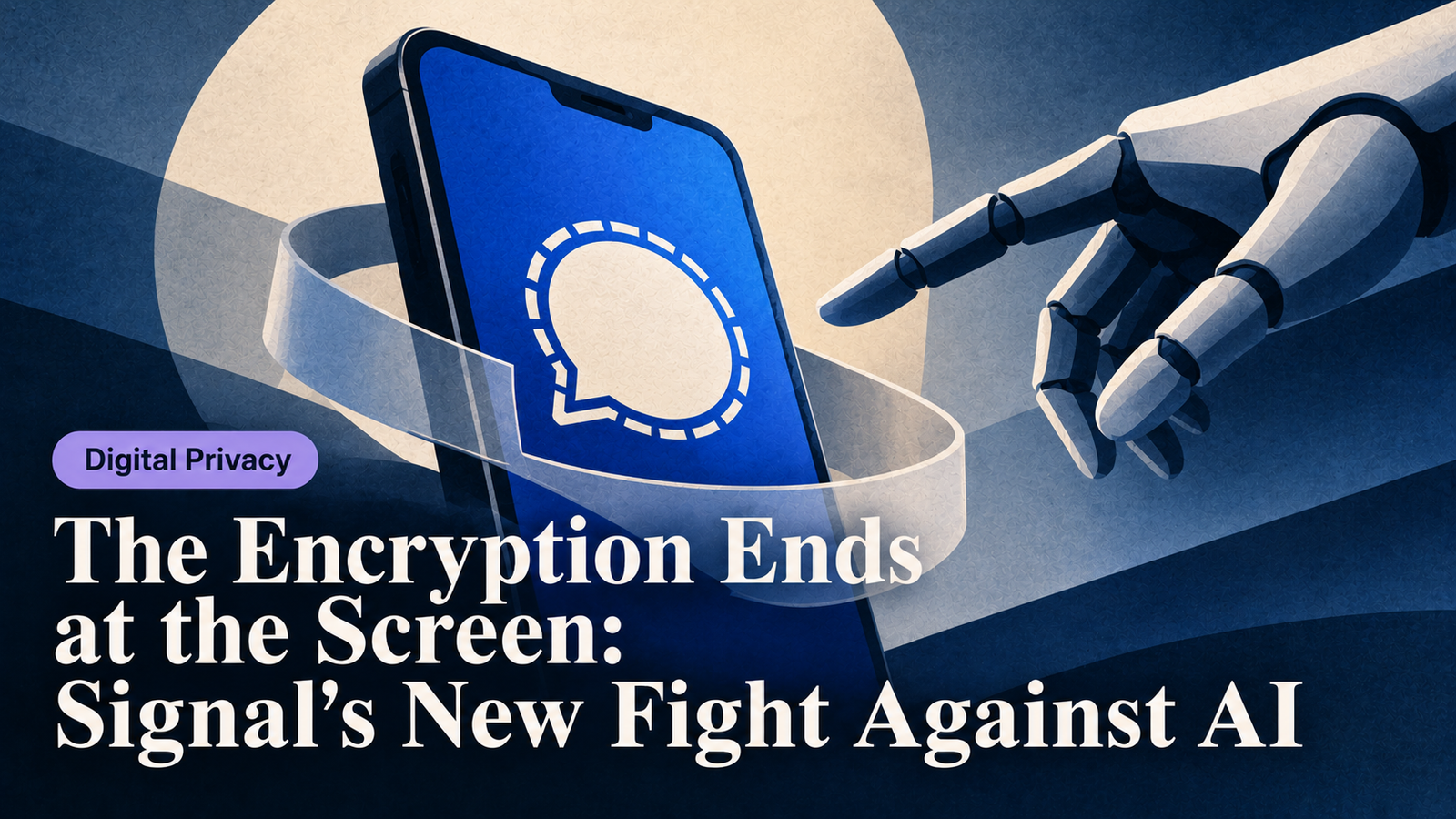
A message can travel through an encrypted channel, remain inaccessible to the messaging provider, and still become readable to another system sitting on the device where it arrives.
That is the distinction now forcing Signal into a new kind of privacy battle.
On 20 November 2026, Meredith Whittaker, president of the Signal Technology Foundation, announced that the messaging platform was introducing protections against AI assistants embedded in mobile operating systems. The concern is that these assistants can inspect information displayed on a device, potentially capturing conversations after they have already been decrypted for the user.
Signal's concern is not with a weakness in its encryption protocol. It is with what happens after encryption has done its job.
The device has become another point of exposure
End-to-end encryption protects messages as they travel between participants. The recipient's device must nevertheless decrypt those messages to display them. Once visible, their contents can potentially become accessible through other device-level mechanisms.
Apple's Onscreen Awareness with Siri AI and Google's Gemini Intelligence illustrate the direction in which operating systems are moving: assistants that can interpret on-screen information and use it to respond to requests or perform tasks.
For Signal, that creates a difficult boundary. Its encryption can protect the conversation within the messaging system, but it cannot independently control every operating-system capability that may subsequently interact with the displayed content.
The company says these integrations can capture information from the screen and make it available to AI systems operating through local databases or remote services.
Signal's response is different on each platform
The new protections are not identical across devices.
On iOS 27, Signal introduced a setting called "Block Siri AI", enabled by default. It prevents screenshots and screen recordings inside the app, hides conversation previews in the App Switcher and restricts on-device AI assistants from reading Signal's displayed content.
Users can disable the protection, including temporarily for ten minutes when they need to take a screenshot.
Android takes a different approach. Signal enables its Screen security setting automatically when it detects an AI assistant attempting to access the screen. The company explains that Android's different manufacturer implementations make it difficult to reliably detect every screenshot attempt. Consequently, its protection is limited to versions and circumstances where detection is possible.
macOS presents another limitation. Signal says it cannot reliably block screenshots on Apple's desktop operating system because it lacks the necessary documented mechanisms. It therefore cannot provide equivalent protection there.
These differences matter. Signal has not established a universal barrier against AI access; it has introduced platform-specific measures against identified methods of screen capture.
The problem extends beyond operating-system assistants
The concern is not limited to Siri or Gemini.
On 18 November, Reuters reported that Meta's Muse AI agent had accessed Signal messages on Android and macOS during tests conducted with Signal staff and the AI Now Institute.
The investigation found that Muse could use permissions granted during its initial setup to retrieve information outside Meta's official Connector mechanism. On Android, this involved access to push notifications. On macOS, the agent used accessibility and screenshot capabilities to extract message content.
Reuters also reported that the same access attempts were blocked in its iPhone tests.
Meta said Muse could access other applications only through permissions users explicitly granted. Apple subsequently updated macOS to close the specific accessibility pathway identified in the investigation.
The distinction is important: Muse is a third-party AI agent, not an operating-system assistant. Signal's new screenshot protections should not be interpreted as a confirmed solution to every access method demonstrated in the Muse investigation.
Together, however, the developments expose a broader issue: permissions granted to software can create access routes that users may not fully anticipate.
A privacy boundary that app developers do not control
Signal's announcement is also a request to the companies that control the operating systems themselves.
It wants Apple, Google and Microsoft to provide developers with a straightforward, documented mechanism to exclude applications from AI data access. That request extends beyond screen reading to filesystem access, notifications, APIs and other operating-system frameworks.
Signal acknowledges that its own response is incomplete. Blocking screenshots does not prevent every possible route through which an AI agent might retrieve application data already present on a device.
This is where the dispute becomes larger than one messaging application. Independent developers build privacy protections inside environments controlled by operating-system providers. As those environments acquire more powerful AI capabilities, application developers have less certainty about how their data may be accessed beyond their own software.
The earlier Microsoft Recall dispute on Windows 11 had already demonstrated this tension. Signal had introduced screenshot protection against Recall in 2025. The latest announcement brings a similar concern to mobile operating systems.
End-to-end encryption remains central to secure messaging. But the arrival of AI agents capable of interacting with device content introduces another layer of access that encryption alone was never designed to govern.
The conversation may be encrypted from sender to recipient. What happens after it appears on the screen is a different security question.
Sources
- Signal Foundation – Signal is Serious About Protecting Your Privacy (20 November 2026).
- Signal Support – Screen Security: Blocking Google Gemini and Siri AI.
- Reuters – Signal Restricts Screenshots to Block AI Agents from Reading Messages (20 November 2026).
- Reuters – As Meta Bets Big on Muse AI Agent, Early Safety Mishaps Surface (18 November 2026).
This brief was prepared with AI assistance from the sources above and reviewed by our editors.
Sources
Keep reading

Peninsula Energy Shuts Down Lance Uranium Operations After Cyber Breach
A cyber incident affecting plant and wellfield control systems has forced Peninsula Energy to suspend operations at its Lance uranium project in Wyoming. Recovery is underway, with production and restart timelines still uncertain.

UK Sets Out AI's Role in UN Peacebuilding
The UK has outlined potential uses of AI in UN peacebuilding, from conflict early warning to mission planning, while emphasising that human judgment and accountability must remain central to its deployment.
Brazil's Digital Sovereignty Debate Raises a Bigger Question: Who Controls Its Digital Infrastructure?
Brazil's push for digital sovereignty raises a bigger question: who controls the infrastructure, data and technology a nation depends on? A proposed dedicated ministry could reshape how Brazil approaches cybersecurity, digital governance and strategic autonomy.