
Cyber-Insurance Meets Banking: Why India's Digital Finance Sector Is the World's Most Interesting Test Case
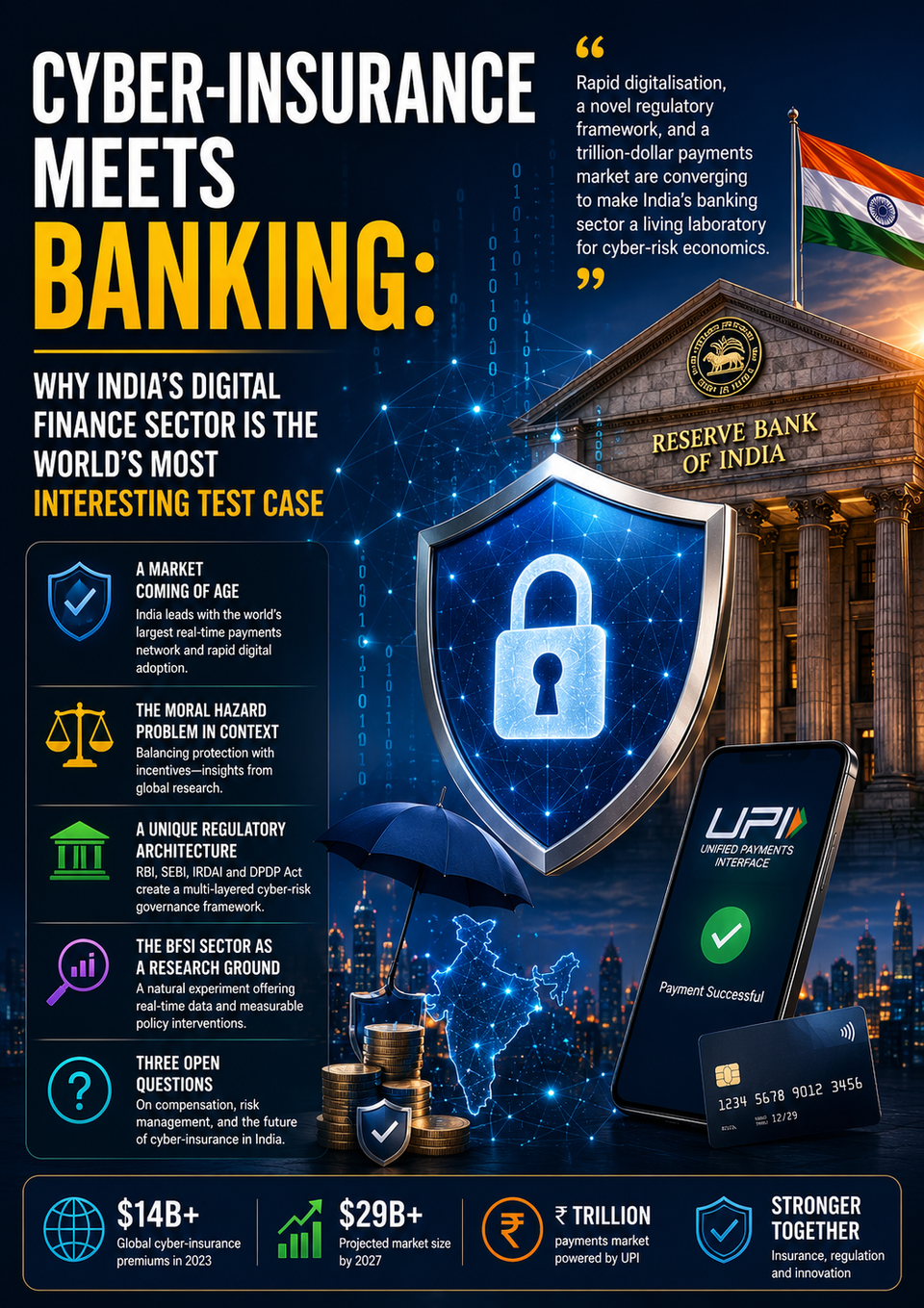
Rapid digitalisation, a novel regulatory framework, and a trillion-dollar payments market are converging to make India's banking sector a living laboratory for cyber-risk economics.
A Market Coming of Age
Global cyber-insurance premiums crossed $14 billion in 2023 and are forecast to exceed $29 billion by 2027. Yet for most of that growth story, the banking sector has occupied an ambiguous position. Banks are simultaneously the most sophisticated buyers of cyber protection and the institutions whose failure would trigger systemic consequences that no private insurer can absorb alone.
India adds a further layer of complexity. The banking sector sits at the intersection of three converging forces: the world's largest real-time payments network (UPI), a regulatory environment that is actively rewriting the rules of digital risk (as evidenced by the RBI's 2026 compensation draft), and a rapidly professionalising insurance market represented by players including ICICI Lombard, HDFC ERGO, and Tata AIG.
"India is not a laggard market adapting Western cyber-insurance models. It is a frontier market creating its own — under conditions of regulatory visibility that Western markets never had."
The Moral Hazard Problem in Context
The central concern in cyber-insurance economics is moral hazard: when institutions know they are protected, do they invest less in prevention? Academic work on this question is genuinely mixed. Some studies find that underwriting scrutiny — the due-diligence process by which insurers assess a potential policyholder's security posture — actually improves security outcomes. The prospect of being refused insurance, or charged a prohibitive premium, creates ex ante incentives to harden defences.
Other research points in the opposite direction, particularly where coverage is broad, premiums are not risk-differentiated, and claims data are too sparse to price risk accurately. The Geneva Association and international insurance bodies have long highlighted this tension, noting that cyber-insurance markets struggle with the correlated nature of cyber events — a single vulnerability can affect thousands of policyholders simultaneously, unlike the independent risks that underpin actuarial models for fire or health insurance.
What India's Regulatory Architecture Adds
India's regulatory environment for cyber-risk in banking is unusually layered. The RBI has, since 2016, issued a succession of circulars covering cybersecurity frameworks, incident reporting, vendor risk management, and customer protection. The Information Technology Act and its amendments create legal obligations around data breach notification. The Digital Personal Data Protection Act, passed in 2023, adds a further dimension — introducing data fiduciaries, consent requirements, and a Data Protection Board that is still being operationalised.
SEBI and IRDAI (the insurance regulator) maintain parallel frameworks that interact with RBI's requirements. For a bank operating in India, cyber governance is not a single compliance exercise — it is a multi-regulator management challenge.
This complexity creates a paradox for cyber-insurance. On one hand, the regulatory density provides insurers with more data points for underwriting — mandatory incident reporting, for instance, generates claims-like data that can inform pricing. On the other hand, the overlapping obligations create ambiguity about which regulatory failure constitutes a covered loss and which triggers exclusions.
The BFSI Sector as Research Ground
For researchers and practitioners, India's banking and financial services sector (BFSI) offers something genuinely rare: a natural experiment in cyber-risk economics, conducted at scale, in real time, with regulatory visibility. The RBI's proposed compensation scheme creates a measurable intervention — if implemented, researchers will be able to observe whether fraud reporting rates change, whether bank investment in fraud prevention adjusts, and whether the scheme's incentive structure produces the consumer-protection outcomes it intends.
This is the kind of clean research opportunity that rarely exists in mature markets, where cyber-insurance has evolved incrementally and without such sharp policy discontinuities. India's researchers — particularly those within institutions like NIBM with direct access to banking sector data — are unusually well-placed to contribute to a global conversation that is still largely shaped by US and European evidence.
Three Open Questions
Several questions remain unresolved and will shape how cyber-insurance develops in India's banking sector over the next decade.
First: will the RBI's compensation scheme crowd out or complement private cyber-insurance? If consumers and banks both know that small-value losses are publicly backstopped, the demand for private insurance in that segment may decline — while demand for coverage of larger, more complex losses may increase.
Second: how will banks' internal risk management practices adapt? The scheme's evidentiary provisions — which require banks to prove customer liability in disputed cases — create an institutional incentive to invest in forensic logging, transaction monitoring, and customer authentication that goes beyond regulatory minimums.
Third: can India's insurance market develop the pricing sophistication required to write profitable cyber policies for large banks? The correlation problem — where a single breach event generates claims from multiple policyholders simultaneously — remains largely unsolved globally. India is not exempt from this structural challenge.
Member discussion