
WHEN IDENTITY BECOMES A WEAPON: INDIA'S AADHAAR FRAUD CRISIS AND THE POLITICS OF BELONGING
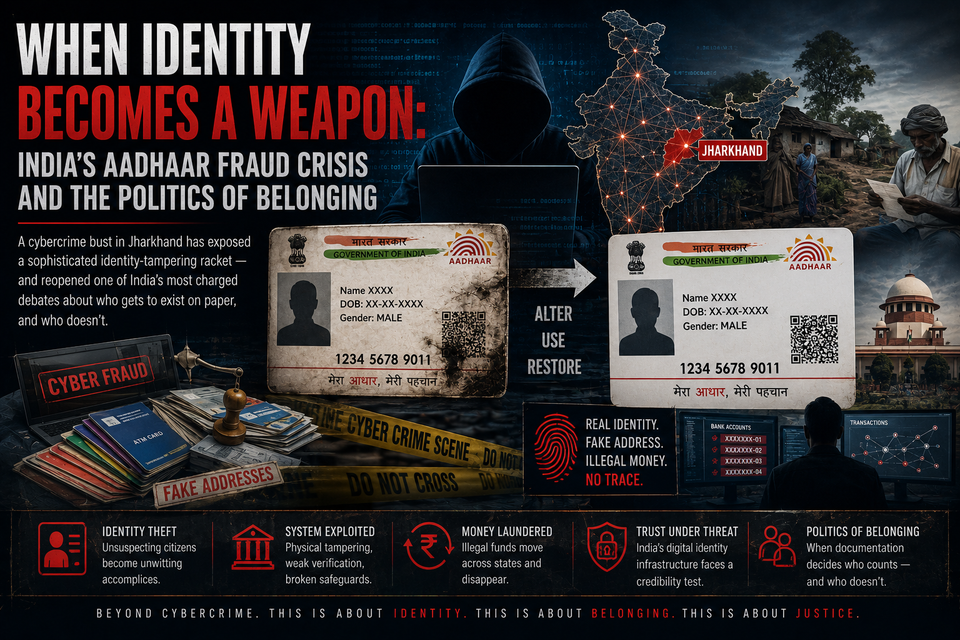
A cybercrime bust in Jharkhand has exposed a sophisticated identity-tampering racket — and reopened one of India's most charged debates about who gets to exist on paper, and who doesn't.
Investigative Analysis · 10 min read · India · Digital Identity · June 2026
On the surface, it looked like a routine cybercrime arrest. Five individuals picked up in Ranchi. Fifty-odd passbooks, a stack of ATM cards, dozens of Aadhaar documents. The kind of haul that Jharkhand Police have grown accustomed to, given the state's proximity to what investigators have long called India's cyber fraud belt.
But the interrogation that followed revealed something more technically sophisticated — and more systemically troubling — than the usual mule account operation. What Ranchi City SP Paras Rana's team had uncovered was a reversible identity fraud: a method of altering Aadhaar cards to open bank accounts under fake addresses, then restoring the documents to their original state, erasing the trail before anyone thought to look.
The implications reach well beyond Jharkhand.
THE MECHANICS OF REVERSIBLE FRAUD
The modus operandi, as described by investigators, has an almost elegant simplicity. Fraudsters obtain genuine Aadhaar cards — belonging, in many cases, to unsuspecting villagers with no knowledge their identity is being weaponised. The address field is physically or digitally altered to reflect a remote location. The modified card is used to open a bank account at that fictitious address. Once the account is activated and operational as a conduit for laundering cybercrime proceeds, the Aadhaar card is restored to its original details.
The result: a bank account traceable to a real person, at an address that never existed, linked to an identity document that now shows no sign of tampering.
"As of now, mule accounts were used by the fraudsters having their own address," said SP Rana, "but during the investigation, it has been found that now they have started using fake addresses of any remote location to receive and transfer illegally obtained money."
The evolution matters. Earlier-generation mule account operations required the active cooperation of account holders — people who knowingly lent their identities for a fee. This newer method removes that requirement entirely. The actual Aadhaar card holder may be a farmer in a village who has never owned a smartphone, entirely unaware that their identity is being used to move money stolen from victims hundreds of kilometres away. Investigators confirmed that 4-5 bank accounts were found linked to a single person in some cases — individuals who are now themselves under scrutiny, even as their victimhood remains the more probable explanation.
THE AADHAAR SYSTEM: STRENGTH AND VULNERABILITY
India's Aadhaar programme is, by any measure, one of the most ambitious digital identity projects in human history. Over 1.4 billion enrollments. Biometric linkage. The backbone of direct benefit transfers, financial inclusion initiatives, SIM card registration and increasingly, voter verification. The Unique Identification Authority of India (UIDAI) has invested heavily in making Aadhaar tamper-resistant — introducing features like masked Aadhaar, QR verification and the mAadhaar app precisely to reduce dependence on the physical document.
The Ranchi case exposes the gap between that digital infrastructure and ground-level reality. In rural areas — where bank correspondents rather than branch managers handle account opening, where verification is often visual rather than electronic, where a laminated card and a matching photograph can still be sufficient — the physical document retains enormous authority. The fraud works not because Aadhaar's digital architecture has been breached, but because the human and institutional systems built around it have not caught up.
This is not a new vulnerability. Cybersecurity researchers and civil society organisations have documented cases of Aadhaar-linked fraud for years, ranging from SIM swaps to ghost beneficiary schemes in welfare programmes. What the Jharkhand case adds is a new layer: the reversibility of the tampering, which defeats the retrospective audit trail that investigators normally rely on. If the document shows no anomaly at the time of investigation, the forensic burden shifts — and may never be met.
THE GEOGRAPHY OF CYBER FRAUD
Jharkhand's appearance at the centre of this story is not incidental. The state sits adjacent to what law enforcement agencies have identified as a concentrated geography of cyber fraud operations — a corridor spanning parts of Jharkhand, Bihar and West Bengal where low economic opportunity, high mobile penetration and weakly supervised financial infrastructure have created conditions that criminal networks have systematically exploited.
The Jamtara district of Jharkhand became internationally known — and the subject of a Netflix series — as a hub of SIM-based phishing fraud. But investigators have consistently noted that the ecosystem has evolved and dispersed. Operations that once concentrated in a handful of districts now span multiple states, adapting to law enforcement pressure by relocating, fragmenting and, as the Ranchi case demonstrates, innovating.
The use of remote addresses — rural locations far from where the account is actually being operated — is partly a jurisdictional strategy. A fraud complaint in Maharashtra triggers an investigation in that state. The bank account was opened using an address in a remote corner of Jharkhand or Bengal. By the time coordination happens between state police forces, the money has moved multiple times. The reversible Aadhaar adds another layer: even if investigators reach the supposed account holder, the document in their hands tells no story of tampering.
THE BENGAL DIMENSION: CONTESTED GROUND
It is here that the cybercrime story intersects with one of India's most politically charged ongoing debates.
West Bengal has, for several years, been at the centre of disputes over identity documentation, illegal immigration and the relationship between document fraud and demographic change. The concerns are not new — they predate the current political configuration of the state — but they have intensified since the National Register of Citizens (NRC) process in Assam, the passage of the Citizenship Amendment Act (CAA) and the continuing political contest between the BJP-led central government and the Trinamool Congress state government in Kolkata.
Those who raise concerns about document fraud in Bengal — including opposition politicians, some civil society voices and sections of law enforcement — point to a pattern: that forged or fraudulently obtained identity documents, including Aadhaar cards, voter IDs and ration cards, have been used by undocumented migrants, primarily from Bangladesh, to establish legal identity in India. They argue that the concentration of fraud infrastructure in border districts, combined with political incentives to expand voter rolls, creates a permissive environment for identity document manipulation.
Those who challenge this framing — including the state government, civil liberties organisations and scholars of migration — make several counter-arguments. First, that the vast majority of document fraud in India is economically motivated rather than politically driven, as the Jharkhand cybercrime case itself illustrates: the fraudsters targeted rural villagers' Aadhaar cards for financial gain, with no evident immigration dimension. Second, that the conflation of economic migration, refugee movements and document fraud often results in harassment of Bengali-speaking Muslim communities who are Indian citizens. Third, that identity document vulnerabilities are a systemic failure of administration, not a problem specific to any border state or any political government.
Both sets of concerns engage with real phenomena. Document fraud is genuinely present. Undocumented migration across the India-Bangladesh border is genuinely documented. The question of who obtains forged documents, for what purpose, and with whose complicity, is where the analysis becomes genuinely contested — and where political narrative has, at times, outrun verified fact.
WHAT THE CYBERCRIME LENS REVEALS
What the Ranchi case usefully demonstrates is that Aadhaar document fraud is first and foremost a financially-driven criminal enterprise — one with sophisticated operational tradecraft, coordination across multiple actors, and a clear economic logic. The fraudsters' innovation was not ideological. It was technical. They identified a gap between the digital security of Aadhaar's backend and the verification practices of ground-level banking, and they exploited it.
This matters for the broader debate because it establishes that the vulnerability is structural, not localised. Any state — not just Bengal, not just border districts — where bank account opening relies on visual document verification rather than live biometric or QR-based authentication is exposed to this method. The same technique that routes cybercrime proceeds through a fake address in Jharkhand could, in principle, be used to establish identity anywhere the physical document carries authority the digital system doesn't support.
The policy response that follows from this analysis is administrative: close the gap between the document and the verification system. Make physical Aadhaar irrelevant to account opening by mandating live biometric or OTP-based authentication universally. Invest in financial institution training so that a correspondent banker in a remote district has the tools — and the instructions — to verify against the UIDAI database rather than the laminated card in front of them.
THE HARDER QUESTION
The harder question — about who is obtaining identity documents fraudulently, at what scale, and whether state governments are complicit or negligent — requires a different kind of investigation than either a cybercrime bust or a political speech can provide. It requires the kind of systematic, state-by-state audit of document issuance that India has consistently struggled to complete, partly for administrative reasons, partly for political ones.
What is clear from Ranchi is that identity document integrity is not an abstract governance concern. It has direct, concrete consequences: for the villager whose Aadhaar is used without their knowledge, who now faces police scrutiny for accounts they never opened; for the fraud victims whose stolen money passes through those accounts; for the investigators trying to reconstruct a paper trail that has been deliberately erased.
India's digital identity infrastructure is, in its architecture, world-class. The gap between that architecture and its daily administration — in rural bank branches, in remote verification practices, in the distance between what UIDAI's systems can do and what ground-level institutions actually do — is where fraud lives.
Closing that gap will not resolve the political debate about immigration and belonging. But it will make it considerably harder to exploit either vulnerable villagers or vulnerable institutions as instruments of financial crime.
That, at least, is a problem with a known solution. The will to implement it is another question.
Sources: New Indian Express, Ranchi City SP Paras Rana (quoted statements), UIDAI public documentation. Political and policy context drawn from publicly reported legislative and administrative record. June 2026.
Member discussion