
MOROCCO'S CYBER DIPLOMACY: BUILDING AFRICA'S DIGITAL SHIELD FROM RABAT
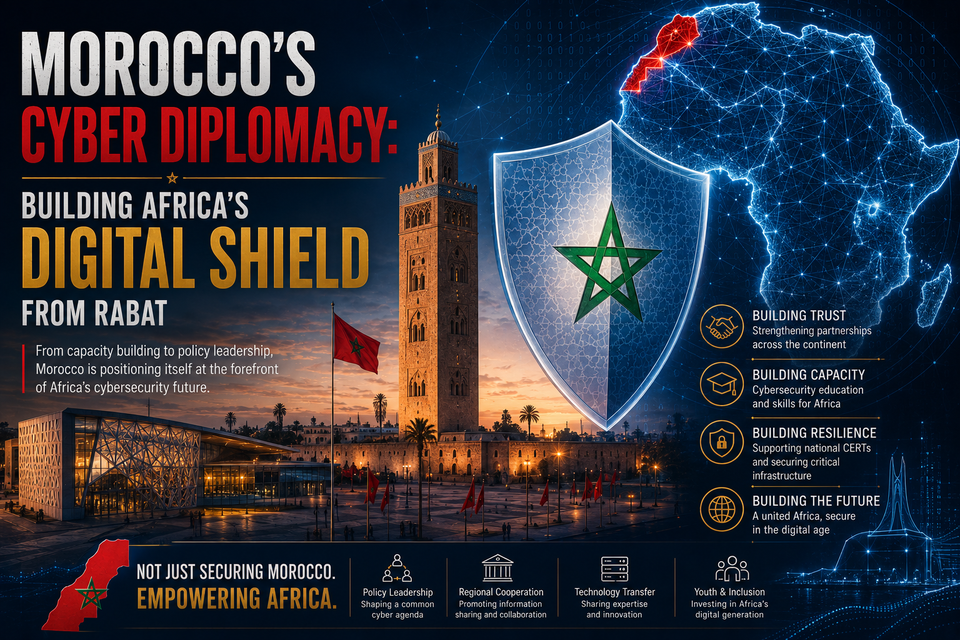
As the continent's cyber threat surface grows, Morocco is positioning itself not just as a participant in Africa's digital future — but as the architect of its defences.
Policy Analysis · 9 min read · Africa Cybersecurity · June 2026
When senior government officials, policymakers and cybersecurity experts gathered in Rabat on June 1 for the inaugural ANCA-CERT Executive Leadership Programme in Cybersecurity, the host city was no coincidence. Morocco has spent the better part of a decade quietly, methodically building the institutional infrastructure to lead Africa's cyber defence conversation — and the Rabat summit was the most visible expression yet of an ambition that now extends well beyond its own borders.
The five-day programme, running until June 5 and organised by ANCA-CERT — the operational arm of the African Network of Cybersecurity Authorities — brought together representatives from across the continent to address what is increasingly recognised as a shared strategic vulnerability: Africa's rapidly expanding digital economy is outpacing its collective ability to defend it.
Morocco's Director General of the Moroccan Agency for International Cooperation (AMCI), Mohamed Methqal, made the Kingdom's position plain at the opening ceremony: "Morocco will remain a committed, supportive and readily available partner in advancing cybersecurity capacities across Africa." The words were diplomatic. The institutional architecture backing them is anything but rhetorical.
WHAT MOROCCO HAS BUILT
At the centre of Morocco's cyber posture is the General Directorate for Information Systems Security — the DGSSI — which has been consistently rated among the most advanced national cybersecurity agencies in Africa and the Arab world. The DGSSI holds the vice-presidency of ANCA, the continental body it has helped shape since 2022, and serves as the host institution for ANCA-CERT, the regional incident-response mechanism designed to share threat intelligence and coordinate responses across member states.
General Abdellah Boutrig, Director General of DGSSI, framed cybersecurity at the Rabat summit not merely as a technical issue but as a question of digital sovereignty. African states, he argued, cannot individually address the scale and complexity of current cyber threats. The attacks are transnational; the response must be too. What he described was a model of continental cyber resilience built on three pillars: information sharing, expertise exchange and joint capability development. Morocco, through the DGSSI and ANCA, is the institutional anchor of all three.
The ANCA-CERT programme itself is structured around five strategic priorities — cybersecurity governance, digital resilience, crisis management, skills development and regional cooperation — that map directly onto the gaps most African governments face. These priorities are also aligned with the International Telecommunication Union's Global Cybersecurity Index, ensuring that capacity built through ANCA is internationally benchmarked, not siloed.
THE AFRICAN UNION DIMENSION
Morocco's cyber diplomacy cannot be read in isolation from its broader role within African continental institutions. The Kingdom rejoined the African Union in 2017 after a 33-year absence, and has since moved with considerable deliberateness to establish itself as an indispensable partner rather than merely a returning member.
In February 2026, Morocco secured a new term on the AU Peace and Security Council — its third — receiving more than the required two-thirds majority of votes. The AU Commission Chair described Morocco as "a key player and cornerstone for all continental matters," a designation earned through sustained engagement rather than simply claimed. The Council, which oversees conflict prevention, crisis management and peacebuilding across the continent, is increasingly where digital threats intersect with traditional security concerns.
The AU Commission Chair also visited the Port of Tangier in April 2026, meeting with Moroccan officials and reinforcing Morocco's positioning as a logistical, diplomatic and now technological node for the continent. The symbolism of that visit — the African Union's highest official at Morocco's flagship infrastructure project — was not incidental. Morocco has built its continental influence precisely at the intersection of physical and digital infrastructure, and Rabat understands that the two are increasingly inseparable.
SOUTH-SOUTH COOPERATION AS STRATEGIC DOCTRINE
What makes Morocco's approach distinctive is not just its institutional investment but its explicit ideological framing. Methqal's remarks at the ANCA summit invoked King Mohammed VI's positioning of South-South cooperation as a core pillar of Moroccan foreign policy — a model built on solidarity, knowledge sharing and sustainable development rather than the transactional dynamic that has sometimes characterised North-South aid relationships.
That framing matters. African governments have grown increasingly wary of cooperation arrangements that extract strategic value while offering limited genuine capability transfer. Morocco's model, at least as articulated, is the inverse: the ANCA Executive Leadership Programme is not a conference circuit for ministers to exchange business cards. It is a structured capacity-building platform designed to produce working cyber professionals who return to their governments with operational skills.
The AMCI coordinates these programmes alongside the Ministry of Foreign Affairs, African Cooperation and Moroccan Expatriates — indicating that cybersecurity cooperation has been fully integrated into Morocco's diplomatic machinery rather than siloed within a technical ministry. When a programme trains a cybersecurity official from a partner country, it is simultaneously a technical intervention, a diplomatic gesture and a long-term relationship investment.
THE THREAT CONTEXT DRIVING URGENCY
The political and institutional framing only makes sense against the backdrop of what Africa is actually facing digitally. The continent's rapid mobile-first digitalisation has created an enormous and, in many countries, poorly defended attack surface. Banking, government services, healthcare and logistics increasingly run on digital infrastructure — but the regulatory frameworks, institutional capacity and technical expertise to protect that infrastructure have not kept pace.
ANCA's roadmap, agreed at a roundtable in Marrakech earlier this year, reflects the scale of the ambition: establishing an ANCA-Partners Coordination Mechanism, launching joint pilot initiatives by Q3 2026, and developing a Continental Cybersecurity Collaboration Roadmap covering 2026 to 2028. The CyberStrike 2026 competition, run by ANCA-CERT, is simultaneously building the next generation of African cyber professionals through ethical hacking, penetration testing and capture-the-flag challenges — a talent pipeline for a continent that will need tens of thousands of skilled practitioners in the coming decade.
Morocco is not just participating in this ecosystem. It is, through the DGSSI's institutional leadership and the AMCI's coordination of technical assistance, largely building it.
THE STRATEGIC LOGIC
Morocco's investment in continental cybersecurity capacity is not purely altruistic. Rabat's strategic interests and its stated values happen to align in this domain, which is why the commitment has been sustained across multiple governments and extended, rather than contracted, during periods of regional tension.
A more cyber-resilient Africa is a more stable neighbourhood for a country whose economic strategy depends on positioning itself as the gateway between the continent and Europe. It is also a larger market for Moroccan technical expertise, a stronger platform for Moroccan diplomatic influence, and a continental network through which Rabat's institutions — the DGSSI, AMCI and others — accumulate the credibility and relationships that translate into geopolitical weight.
The African Union has acknowledged this trajectory explicitly. The award presented to Foreign Minister Nasser Bourita at the April 2026 election observers training in Rabat — recognising outstanding contribution to democratic governance, peace and security — was a signal from the AU's highest bodies that Morocco's continental role is not merely tolerated but valued.
In cybersecurity, as in infrastructure and diplomacy, Morocco is making the same calculation: that the most durable form of influence is not the kind extracted in a transaction, but the kind built through being genuinely useful when it matters most.
Rabat is betting that as Africa's digital threats intensify, what the continent will need is not just better technology, but better-trained people and stronger institutions. And that Morocco, through the DGSSI and ANCA-CERT, will be where many of those people are trained and those institutions are built.
Sources: L'Intelligencer, North Africa Post, Morocco World News, African Press Agency, African Union Commission, Smart Africa, ANCA-CERT, DGSSI. June 2026.
Member discussion