
Deals Above the Lake: Business, Diplomacy, and the Cyber Dimension at the Lake Lucerne Summit
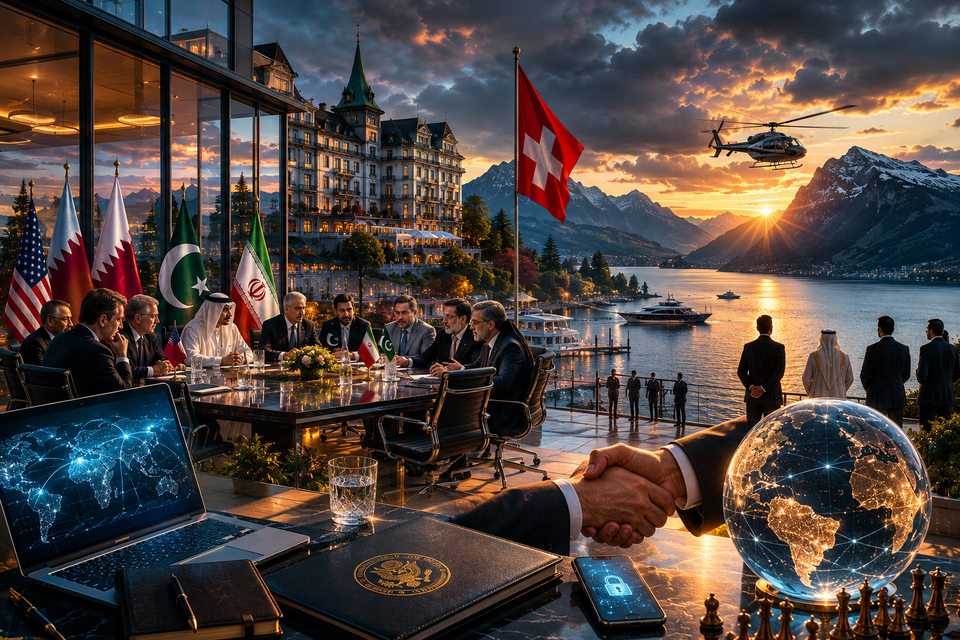
The Bürgenstock talks produced a peace roadmap — and revealed a web of financial entanglements that belong at the centre of any serious analysis of what just happened
Preface: What Happened at Bürgenstock
High above Lake Lucerne, in one of Switzerland's most exclusive resort complexes, a diplomatic experiment unlike any in modern history played out across the weekend of June 21–22, 2026. US Vice President JD Vance, Special Envoy Steve Witkoff, and Jared Kushner sat across from Iranian Parliament Speaker Mohammad Bagher Ghalibaf and Foreign Minister Abbas Araghchi for more than ten hours of direct negotiations — the first face-to-face engagement of this magnitude between senior American and Iranian officials in the modern era.
The outcome, announced in a joint statement by mediators Qatar and Pakistan, included a 60-day roadmap toward a final deal, a Strait of Hormuz communication line, a Lebanon de-confliction cell, and a $300 billion Reconstruction and Development Fund for Iran. OFAC simultaneously issued General License X, authorising Iranian oil and petrochemical transactions through August 21, 2026. Iranian Foreign Minister Araghchi declared that oil and petrochemical exports had been waived, the blockade lifted, frozen assets partially released, and a reconstruction plan launched.
By any diplomatic measure, this was a historic day.
By any governance measure, it was also one of the most conflict-laden diplomatic events in recent American history — because the men who designed the reconstruction fund, negotiated it, and will benefit from the financial architecture it creates are the same men who co-founded the cryptocurrency venture that Pakistan, Qatar, and the UAE have been funding, and that the MoU's economic provisions will now flow through.
This article examines what actually happened at Lake Lucerne — the diplomacy, the business entanglements, the digital financial architecture, and the cybersecurity implications of a peace process that is inseparable from private financial interests at the highest levels of the US government.
Part I: The Delegation That Arrived by Private Interest
Witkoff: The Envoy and the Entrepreneur
Steve Witkoff arrived at Bürgenstock as the US Special Envoy for the Middle East. He also arrived as the co-founder emeritus of World Liberty Financial, the DeFi and stablecoin company co-founded with the Trump family, whose CEO is his son Zach Witkoff.
Forbes estimated in April 2026 that Witkoff had increased his net worth by 15% during his tenure as Special Envoy — primarily driven by his investments in WLF — bringing his fortune to $2.3 billion. This is not passive appreciation. Days before Trump's inauguration, a company controlled by Sheikh Tahnoon bin Zayed Al Nahyan — the UAE's national security adviser — purchased 49% of WLF for $500 million, routing $31 million directly to Witkoff family entities. Weeks later, MGX, another company chaired by Sheikh Tahnoon, deposited $2 billion into WLF's USD1 stablecoin — the largest single investment in a crypto company, ever. The Trump administration subsequently approved export of the world's most advanced AI chips to the UAE, despite national security concerns about diversion to China.
In January 2026, the Pakistani government signed an agreement with WLF to incorporate cryptocurrency into Pakistan's financial system. Zach Witkoff — the envoy's son and WLF CEO — negotiated the deal directly with Pakistan's Finance Minister Muhammad Aurangzeb. A month later, Steve Witkoff negotiated a separate deal with the same Pakistani finance minister to explore redevelopment of the Roosevelt Hotel in Manhattan. Pakistan, of course, was then chosen as one of the two mediators of the Islamabad MoU and led the Bürgenstock talks alongside Qatar.
As Congressman Greg Stanton put it in a confrontation with Secretary of State Rubio in June 2026: "The son of the man negotiating with Iran on behalf of the United States is simultaneously pursuing business deals with — and meeting with the prime minister of the country and its top military official — mediating those negotiations."
Kushner: The Real Estate Developer in the Peace Room
Jared Kushner arrived at Bürgenstock carrying different but equally significant entanglements. Saudi Arabia's Public Investment Fund invested $2 billion in Kushner's private equity firm Affinity Partners in 2021, against the recommendation of its own investment committee, overruled by Crown Prince Mohammed bin Salman who heads PIF's Board. PIF pays Kushner 1.25% of its investment — approximately $25 million per year. The Senate Finance Committee estimates Kushner will have received $137 million in management fees from the Saudis by August 2026.
The UAE invested an additional $200 million in Affinity Partners directly and via Lunate, an Abu Dhabi sovereign wealth vehicle. Qatar's sovereign wealth fund invested a further $1.5 billion in Affinity Partners in December 2024, which Kushner described as a "preemptive" raise to avoid conflicts — an explanation that critics noted achieved the opposite effect.
The $300 billion reconstruction fund at the centre of the Bürgenstock agreement was described by multiple mediators as an idea originated by Witkoff and Kushner themselves. The New York Times reported that "the duo had pitched promoting real estate projects and an investment fund for Tehran in the event that a deal was reached." Two men who are real estate developers, whose personal wealth depends on Gulf sovereign funds that have major interests in Iranian policy, designed and negotiated an Iranian reconstruction fund into a US-Iran peace agreement. As the Taipei Times noted: "When actors are negotiating geopolitical outcomes and pursuing business opportunities in the same arena, diplomacy begins to resemble a marketplace."
Part II: The $300 Billion Fund and Its Digital Architecture
What the Fund Is and What It Isn't
The Reconstruction and Development Fund, as outlined in the MoU, would be financed by "investment from other countries" — not US taxpayer money, per Vance's explicit public statements. Gulf states and regional partners are the implied contributors, securing credit lines, loans, and direct investment for rebuilding Iranian steel mills, petrochemical complexes, refineries, and airports destroyed during the 111-day war.
This framing creates a specific digital financial problem. Reconstruction investment flowing from Gulf states — particularly Qatar and the UAE, both deeply entangled with WLF and both formally implicated in the MoU's mediation structure — into a FATF-blacklisted economy does not pass through normal correspondent banking channels. It requires financial infrastructure capable of processing large-value transactions under enhanced compliance pressure, with significant layering to insulate investing institutions from secondary sanctions exposure.
This is precisely the use case that stablecoins, DeFi platforms, and non-custodial settlement systems are designed to serve. The same architecture that WLF has been building — USD1 on Ethereum, BNB Chain, Solana, Tron and Plume Network; a lending and borrowing platform (World Liberty Markets); a national trust bank charter application with the OCC — is the architecture through which reconstruction finance flowing into an Iran-adjacent environment could plausibly be processed.
No one is alleging that WLF has been explicitly designed to serve Iranian reconstruction. But the convergence of its business development trajectory and the diplomatic deal its founders just negotiated is the kind of structural alignment that governance bodies exist to scrutinise.
Pakistan's Crypto Pivot: The Infrastructure Is Already Being Built
In April 2026, weeks after the Pakistani government signed its crypto agreement with WLF, the State Bank of Pakistan rescinded its 2018 ban on cryptocurrency, authorising licensed Virtual Asset Service Providers to access Pakistani banking. The Pakistan Virtual Assets Regulatory Authority (PVARA) was simultaneously constituted, and the Virtual Assets Act 2026 drafted.
Field Marshal Asim Munir — who led Pakistan's Bürgenstock delegation and, per JD Vance's own remarks, is the American side's single most-contacted interlocutor over the past three months — is the man who personally presided over both Pakistan's mediation role and Pakistan's crypto liberalisation, at exactly the same time.
The sequencing is stark: WLF deal with Pakistan → Pakistan crypto law → Pakistan banking access for VASPs → Pakistan becomes formal mediator in US-Iran agreement → MoU commits to $300 billion reconstruction fund → technical talks continue at Bürgenstock. Each step creates infrastructure for the next. The digital economy of the settlement is being built in parallel with the settlement itself, by the same principals.
Part III: The Cybersecurity Dimension — Who Controls the Digital Rails
The Iran Delegation Brought Its Own Financial Officials
The composition of the Iranian delegation at Bürgenstock was telling. Alongside Foreign Minister Araghchi and Parliament Speaker Ghalibaf — the chief political negotiators — Tehran sent Central Bank Governor Abdolnaser Hemmati and National Iranian Oil Company CEO Hamid Bovard. This was not merely a diplomatic visit. It was a financial negotiation in parallel with a political one, and Iran's most senior economic officials were in the room.
Central Bank Governor Hemmati's presence is particularly significant in the cybersecurity context. Iran's central bank has been the primary vehicle through which the IRGC's cyber-enabled financial evasion operates — managing the hawala networks, cryptocurrency channels, and front-company invoicing systems that FinCEN identified as generating $9 billion in shadow banking activity in 2024 alone. Hemmati's participation in the Bürgenstock technical talks signals that sanctions relief, frozen asset access, and the financial architecture of the settlement are being discussed at the level of the institution that controls that apparatus.
The Digital MoU: A Peace Agreement Signed on Screen
An arresting feature of the Islamabad MoU that preceded Bürgenstock was how it was executed: it was "digitally signed" — transmitted electronically between Trump, Pezeshkian, and Shehbaz Sharif, who signed as mediator. The Swiss government described Bürgenstock as facilitating implementation of a "digitally signed Memorandum of Understanding."
In an era of state-sponsored cyberattacks, quantum cryptographic risk, and active IRGC cyber operations targeting Western digital infrastructure, the execution of a historic peace agreement via digital signature — without any publicly disclosed verification framework, PKI infrastructure, or tamper-evident audit trail — is a governance gap that deserves scrutiny. Who verified the signatures? Under what cryptographic standard? What chain of custody exists for the digital record?
These questions are not academic. The same day the MoU was signed (June 17), President Trump signed Executive Order 14409 mandating post-quantum cryptography migration for all federal systems. The irony that a historic US-Iran agreement was digitally signed on the same day the US government acknowledged that its digital signatures are potentially quantum-vulnerable is not merely symbolic.
The Communication Line: An Untested Channel
One of Bürgenstock's concrete outputs was the establishment of a direct communication line between the US and Iranian parties "to avoid incidents and miscommunication" in the Strait of Hormuz during the 60-day negotiation period. The joint statement described this as a mechanism "for the period mentioned in paragraph 5 of the MoU to ensure safe passage for commercial vessels."
The cybersecurity architecture of this communication line has not been publicly described. A direct US-Iran communication channel, if compromised, represents a significant intelligence asset for third parties — including China and Russia, both of whom have advanced cyber intrusion capabilities targeting US and Iranian communications infrastructure, and both of whom have clear interests in the outcome of these negotiations. The IRGC itself has demonstrated the capability to intercept and manipulate encrypted communications. A poorly secured de-confliction channel could be exploited to manufacture incidents, delay oil shipments, or undermine the settlement architecture.
Part IV: The Conflict Web — Mapping the Entanglements
The financial entanglements visible from open-source reporting alone constitute a web of extraordinary complexity. A summary:
Steve Witkoff — US Special Envoy, co-founder of WLF, recipient of $31 million from UAE investment in WLF, negotiator of Pakistan crypto deal and Roosevelt Hotel redevelopment, designer (with Kushner) of the $300 billion reconstruction fund. Forbes estimated his net worth grew 15% during his diplomatic tenure, driven primarily by WLF.
Jared Kushner — Presidential adviser, negotiator at Bürgenstock, recipient of $2 billion from Saudi PIF (whose Crown Prince actively lobbied Trump to attack Iran), $200 million from UAE, and $1.5 billion from Qatar (the MoU mediator). The Senate Finance Committee estimates his Saudi management fees alone will reach $137 million by August 2026.
Zach Witkoff (Steve's son) — WLF CEO, negotiated Pakistan crypto deal, met with Prime Minister Shehbaz Sharif and the Pakistani Finance Minister while his father was simultaneously leading US-Iran negotiations with Pakistan as mediator.
Sheikh Tahnoon bin Zayed Al Nahyan — UAE national security adviser, purchased 49% of WLF for $500 million (with $187 million to Trump family entities and $31 million to Witkoff family), chairman of MGX which deposited $2 billion in USD1, and head of G42, whose board included two executives placed on WLF's board as part of the UAE investment deal. Two G42-linked executives — Martin Edelman and Peng Xiao — were placed on WLF's board as part of the UAE deal.
Peng Xiao — CEO of G42, the UAE AI company that received US chip export approvals weeks after investing in WLF. G42 has documented ties to Chinese technology and has been scrutinised by US national security officials for potential diversion risk.
Changpeng Zhao — Founder of Binance, through which WLF processes the majority of its transactions. Convicted of money laundering violations, pardoned by Trump in October 2025, one month before the US granted semiconductor export licenses to the UAE.
World Liberty Financial's USD1 stablecoin — runs on Ethereum, BNB Chain, Solana, Tron, and Plume Network. Pakistan's January 2026 agreement with WLF affiliate SC Financial Technologies specifically included introducing USD1 for use in cross-border transactions.
This is not a complete map. It is what is publicly visible.
Part V: The Cybersecurity of the Settlement — What Comes Next
Surveillance, Signals, and the 60-Day Window
The 60-day negotiation period following Bürgenstock is among the highest-value intelligence windows in recent Middle Eastern history. Every party to the talks — the US, Iran, Pakistan, Qatar — and every interested third party — Israel, Saudi Arabia, China, Russia — has an interest in monitoring the negotiations, compromising the communications of opponents, and shaping outcomes.
Iran's IRGC cyber units, described in this series' earlier analysis, routinely embed access inside targeted networks months before operational needs arise. The Bürgenstock delegations — which included Iranian Central Bank officials, IRGC-adjacent ministry representatives, and a US team operating through personal devices and unofficial communication channels (neither Witkoff nor Kushner are professional diplomats subject to standard State Department communications security protocols) — represent a significant collection opportunity for multiple adversaries.
The de-confliction cell for Lebanon, the Hormuz communication line, and the High-Level Committee structure all create persistent digital interfaces between systems that have been adversarial for decades. Each interface is a potential attack surface.
The Reconstruction Fund as a Cyber-Financial Target
The $300 billion reconstruction fund, if it is constituted, will be one of the largest concentrations of cross-border capital flow in the Middle East's history. It will operate in a jurisdiction — Iran — that remains on the FATF blacklist, meaning formal banking cannot service it. It will be financed by Gulf sovereign funds — entities that have already demonstrated a pattern of directing investment through WLF-adjacent structures. And it will flow through digital financial infrastructure that has not been subject to post-quantum cryptographic hardening, at a time when both China and Iran have demonstrated the capability and intent to compromise such systems.
The IRGC's cyber battalions are not merely a threat to reconstruction finance. They are, as previous analysis in this series established, deeply embedded in the digital infrastructure through which Iran's parallel economy has operated for two decades. Reconstruction capital flowing into Iran will flow alongside — and through — that infrastructure. The distinction between legitimate reconstruction investment and illicit financial flows will be difficult to maintain in a system where the same digital channels serve both purposes.
The Missing Cybersecurity Protocol
What is strikingly absent from the Bürgenstock joint statement, the MoU text, and all public reporting on the talks is any mention of cybersecurity provisions — for the communications infrastructure of the negotiations themselves, for the digital architecture of the reconstruction fund, for the Hormuz communication line, or for the monitoring systems through which IAEA compliance will be verified.
The G7 summit in Évian, held just days before Bürgenstock, produced cybersecurity commitments including AI safety standards, critical infrastructure protection frameworks, and post-quantum cryptography coordination. None of that architecture was referenced or incorporated into the Lake Lucerne framework. The two most consequential diplomatic developments of the week happened in parallel, without connection.
Conclusion: The Map of Interests Is the Risk Map
The Lake Lucerne Summit produced genuine diplomatic progress on some of the world's most dangerous flashpoints — an end to active hostilities, a communication mechanism for the Strait of Hormuz, a framework for nuclear compliance monitoring, and an ambition for regional reconstruction. These are not trivial achievements.
But the settlement's integrity is compromised, from its inception, by the private financial interests of the men who designed it. The $300 billion reconstruction fund was conceived by real estate investors whose personal wealth depends on the Gulf sovereign funds that will capitalise it. The Pakistan mediation was facilitated by a country whose cryptocurrency liberalisation was negotiated by the envoy's own son. The UAE's role — as WLF's majority external shareholder, as the chip-export recipient, as the conduit for frozen asset flows — is so thoroughly entangled with the diplomatic structure that it is functionally impossible to distinguish where Emirati national interest ends and Emirati investment interest begins.
In cybersecurity, the term for a system in which a single actor controls both the communication channel and the assets being communicated is "single point of failure." The Lake Lucerne settlement, as currently constituted, has multiple such points. The communication line has no described security architecture. The reconstruction fund has no described compliance framework. The digital signature of the MoU has no described verification standard. The stablecoin infrastructure being built by the envoy's family to service the very economies being normalised has no described AML/CFT framework beyond what Pakistan's new PVARA will eventually produce.
The deal may hold. The 60-day window may produce a permanent agreement. Iran may comply with its nuclear commitments. Reconstruction may genuinely begin. All of this is possible.
But if it holds, it will be despite the governance architecture — not because of it. And the digital financial infrastructure being built in its shadow will outlast the negotiations, serving purposes that have not yet been named.
This article is the fourth in a series examining cybersecurity, financial governance, and geopolitical risk emerging from the G7 Évian Summit and the Lake Lucerne Summit, June 2026. It draws on reporting from Dawn, Fox News, RFE/RL, the New York Times, Reuters, Public Citizen, Congressman Greg Stanton's office, Forbes, the Taipei Times, and Wikipedia's documented record of the 2025-2026 US-Iran negotiations. It makes no allegations of criminal conduct and presents documented relationships and documented financial flows as reported by credentialed journalists and official congressional sources.
Member discussion